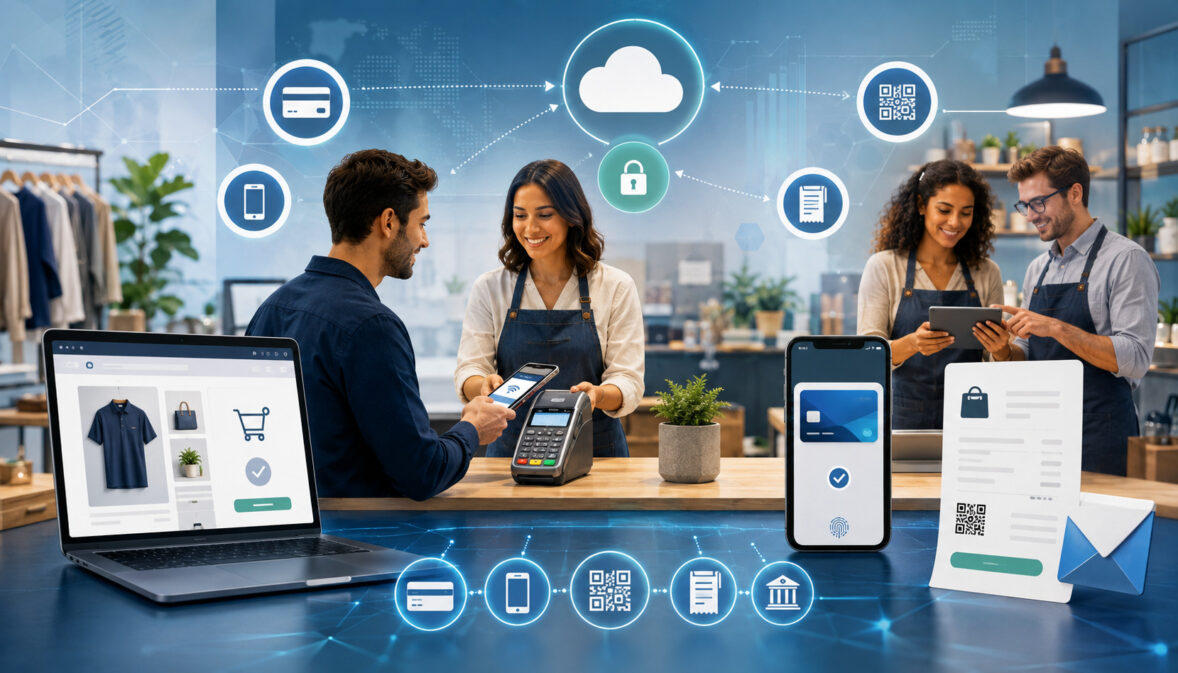
Customers no longer interact with businesses through a single checkout counter. One person may discover a product through social media, review it on a mobile website, complete the purchase on a laptop, request support by telephone, and return the item at a physical location.
Another customer may receive an invoice by email, open a payment link on a phone, and pay through a digital wallet.
Multi-channel payment acceptance gives businesses the ability to collect and manage payments across these different environments. It can include in-store terminals, ecommerce checkout pages, mobile card readers, invoices, virtual terminals, subscriptions, payment links, telephone orders, contactless transactions, and electronic bank transfers.
Adding payment channels can improve convenience, accessibility, and sales flexibility. However, it can also create fragmented reporting, inconsistent refund procedures, duplicate customer records, security gaps, and difficult payment reconciliation if the channels are not coordinated.
A successful multi-channel payment system therefore requires more than several ways to pay. It requires businesses to align technology, security, transaction data, employee procedures, reporting, inventory, customer communication, and financial controls across every payment acceptance channel.
What Is Multi-Channel Payment Acceptance?
Multi-channel payment acceptance is the ability to receive payments through more than one sales or communication channel. A retailer might accept cards at a point-of-sale system, digital wallets through an ecommerce checkout, telephone payments through a virtual terminal, and bank payments through electronic invoices.
Each channel may have its own customer experience, technology, transaction data, security risks, and operating procedures. The business may use one connected payment environment or several separate systems to support these activities.
A single-channel business, by comparison, depends primarily on one payment environment. A physical store that accepts payments only at a checkout terminal is operating through a single payment channel. If that store later launches online ordering, mobile checkout, and invoice payments, it has moved toward multi-channel payment processing.
Customers may also move between channels during the same purchase journey. For example, a shopper might reserve an item online, pay at pickup, receive a digital receipt, and request a refund through customer support. The payment system must preserve enough information to connect the order, authorization, payment, fulfillment, and refund.
Multi-channel payment acceptance does not require every channel to offer every payment method. A store terminal may support cards, contactless payments, and digital wallets, while an invoice may support cards and ACH payments. The objective is to choose suitable methods for each channel while maintaining consistent financial and operational controls.
Multi-Channel and Omnichannel Payments Are Not Identical
Multi-channel payments and omnichannel payment processing are related, but they should not automatically be treated as interchangeable.
A multi-channel payment system supports payments through several channels. Those channels may operate independently. The physical store, ecommerce website, invoice system, and subscription platform could each have separate customer records, reports, refund tools, and settlement schedules.
An omnichannel approach generally attempts to connect those environments. Customer profiles, order details, inventory, loyalty information, stored payment tokens, refunds, and transaction history may be coordinated so that customers can move between channels more easily.
For example, a multi-channel retailer might accept online and in-store payments but require online returns to be mailed to a warehouse. An omnichannel retailer may allow the store to locate the online transaction, verify the order, update inventory, and refund the original payment method.
Omnichannel payment processing can provide a more unified cross-channel payment experience, but it also requires deeper integrations and stronger data governance. Businesses should describe their systems accurately rather than using “multi-channel” and “omnichannel” as marketing synonyms.
Why Businesses Use Multiple Payment Channels
Businesses add payment channels to meet customers where they prefer to shop, communicate, and pay. A service provider may accept a deposit through a payment link, collect a remaining balance through an invoice, and process an additional charge by telephone with proper authorization.
Multiple channels may support:
- Greater customer choice and accessibility
- Remote and after-hours payment collection
- In-store, online, mobile, and delivery sales
- Recurring and subscription revenue
- Faster invoice collection
- Business continuity when one channel is unavailable
- Different payment methods for different transaction values
- More flexible customer service
These benefits come with operational responsibilities. Separate systems may produce different transaction identifiers, settlement reports, fee structures, and refund procedures. Employees may struggle to locate a payment if the customer does not remember where it was made.
Duplicate customer records and inventory mismatches can also develop when channels do not exchange data. Before adding a new payment channel, a business should determine how it will identify transactions, process refunds, secure payment credentials, update orders, record fees, reconcile deposits, and support customers.
Major Payment Acceptance Channels
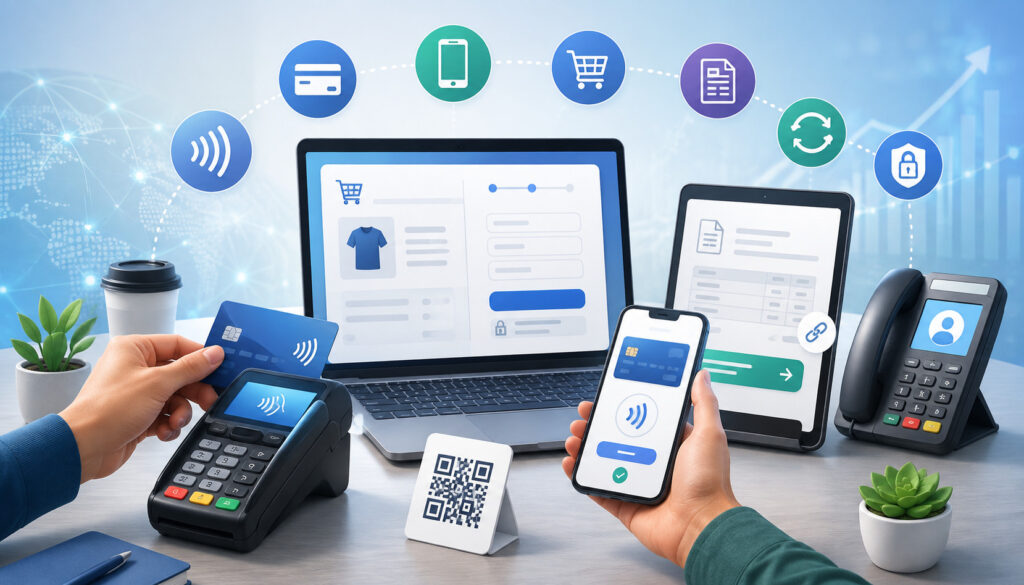
Business payment channels differ in how customers interact with them, how payment information is captured, and which operational risks require attention. The most appropriate combination depends on the business model, customer preferences, transaction value, staffing, fulfillment process, and technical resources.
In-Store, Mobile, and Contactless Payments
A physical point-of-sale system combines payment acceptance with functions such as product lookup, taxes, discounts, receipts, employee permissions, inventory updates, and order reporting. Customers may insert, tap, or swipe a card, although chip and contactless methods are generally preferred when supported.
Mobile point-of-sale devices allow employees to collect payments through a phone, tablet, or portable terminal. They are useful for tableside service, events, deliveries, field services, line reduction, and curbside transactions. Device management becomes important because portable equipment can be lost, stolen, altered, or connected to unsafe networks.
Contactless checkout allows customers to tap a supported card, phone, or wearable device near an enabled reader. Contactless technology can improve checkout speed and reduce manual card handling, but the terminal, software, network connection, and employee procedures must still be maintained securely.
Digital wallets may be used in stores, websites, mobile applications, and payment links. They can reduce typing and may use device authentication and payment tokens, but acceptance depends on compatibility among the wallet, checkout, gateway, processor, and customer device.
Ecommerce, Telephone, Invoice, and Link Payments
An ecommerce checkout collects payment as part of an online order. It commonly relies on a payment gateway to transmit transaction information between the customer-facing checkout and payment-processing systems.
A detailed payment gateway integration checklist can help teams test authorization, capture, webhooks, refunds, mobile usability, fraud controls, and reconciliation before launch.
A virtual terminal is a secure browser-based interface through which an authorized employee enters payment information. It may be used for telephone orders, reservations, deposits, mail orders, or customer-service transactions.
Because the employee is entering information rather than the cardholder, access controls, call procedures, authorization records, and sensitive-data handling require close attention.
Online invoices allow a business to send an amount due, payment terms, and a secure checkout option. Payment links provide a simpler route to a hosted payment page and may be delivered through email, text, messaging, or a customer portal. Businesses should confirm the recipient, amount, purpose, expiration rules, and order reference before sending a link.
QR-code payments can direct a customer to a payment page or initiate a wallet-supported transaction. The business must protect displayed codes from unauthorized replacement and ensure the destination page clearly identifies the transaction.
Social commerce checkout may occur within a social platform or through a link to an external checkout. Businesses should understand which party controls the order, customer data, payment status, refunds, and dispute documentation.
Recurring, Subscription, and Electronic Bank Payments
Recurring billing automatically charges an authorized payment method according to an agreed schedule. Customers may enroll through a website, physical location, telephone conversation, digital invoice, or account portal.
A well-designed recurring payment process records the customer’s authorization, billing amount or calculation method, frequency, trial terms, renewal conditions, cancellation procedure, and communication preferences. Stored credentials should normally be represented by secure tokens rather than raw card details.
ACH payments move funds electronically between bank accounts and may be useful for invoices, memberships, recurring services, rent, tuition, professional services, and higher-value transactions.
Authorization requirements and transaction classifications can differ depending on whether permission is obtained online, by telephone, or in writing. An official ACH workflow guide describes common entry types and authorization methods.
Curbside, delivery, and remote-order payments may combine several channels. An order might begin by telephone, receive a payment link by text, be fulfilled at a store, and generate an electronic receipt. The business needs a shared order identifier so that payment, preparation, delivery, tips, adjustments, and refunds can be traced.
Multi-Channel Payment Acceptance Methods Compared
| Payment channel | Typical use case | Customer interaction | Common payment methods | Main operational concern | Key security consideration |
| In-store point of sale | Retail and service counters | Customer pays at a staffed or self-service terminal | Cards, contactless payments, digital wallets | Terminal management and accurate register closeout | Device inspection, employee permissions, and secure networks |
| Ecommerce checkout | Online product or service purchases | Customer enters or selects payment details online | Cards, wallets, stored methods, ACH | Checkout failures and order-payment synchronization | Secure payment pages, authentication, and fraud screening |
| Mobile point of sale | Events, tableside service, field work, and delivery | Employee accepts payment through a portable device | Cards, tap-to-pay, wallets | Device loss, connectivity, and tip handling | Device controls, updates, and protected access |
| Virtual terminal | Telephone orders, deposits, and reservations | Employee enters payment information | Cards and sometimes bank payments | Authorization evidence and manual-entry errors | Restricted access and secure handling of spoken card data |
| Payment link | Remote deposits and simple checkout requests | Customer opens a hosted payment page | Cards, wallets, and supported bank payments | Sending the wrong amount or link | Verified destination, expiration controls, and transaction references |
| Online invoice | Professional services and business billing | Customer reviews an invoice and pays remotely | Cards and ACH payments | Matching payments to invoice balances | Account verification and protection from invoice-redirection fraud |
| Recurring billing | Memberships, subscriptions, and ongoing services | Customer authorizes scheduled charges | Stored cards and bank payments | Failed renewals, cancellations, and consent records | Tokenization, access controls, and protected credentials |
| ACH payment | Invoices, recurring bills, and larger transactions | Customer authorizes a bank-account debit or sends a credit | Electronic bank transfer | Returns, authorization records, and timing | Account verification, fraud monitoring, and secure data collection |
How Multi-Channel Payment Processing Works
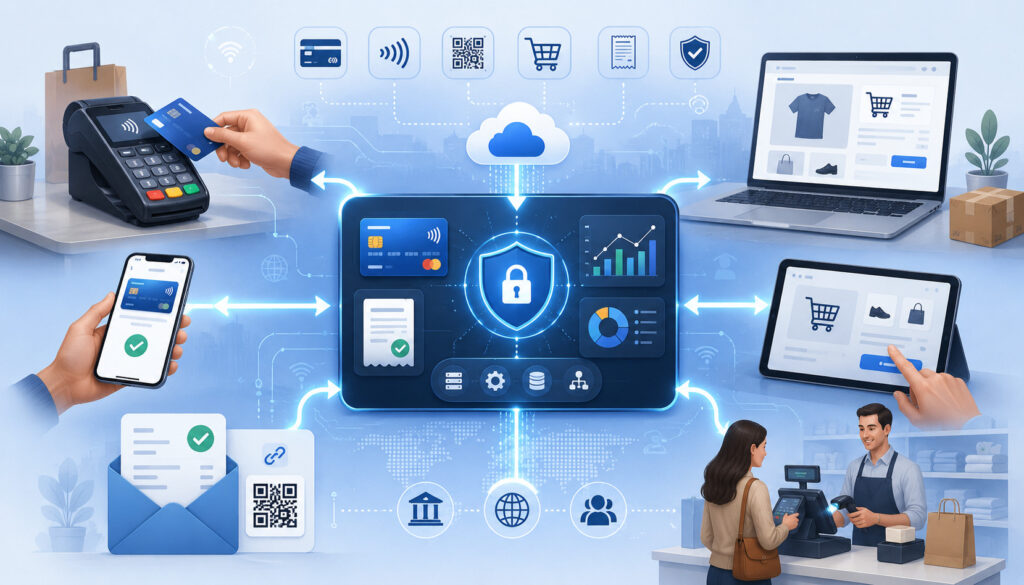
Although payment channels look different to customers, most electronic transactions follow a related sequence. The exact path depends on the payment method, technology, authentication requirements, and whether payment is collected immediately or later.
From Customer Initiation to Reconciliation
The process generally begins when a customer chooses a payment method. Payment data may be captured by a terminal, hosted checkout, ecommerce form, mobile reader, digital wallet, virtual terminal, invoice page, or subscription system.
The transaction then moves through several stages:
- Data capture: The payment interface collects the required payment and order information.
- Authentication: The system may verify the customer, device, cardholder, or account using available methods.
- Authorization: A transaction request is routed to the institution responsible for approving or declining it.
- Approval or decline: The response returns through the processing path to the payment channel.
- Capture: An approved authorization is submitted for clearing and settlement.
- Clearing: Transaction information is exchanged among the relevant payment participants.
- Settlement: Financial obligations are calculated and funds move through the payment system.
- Funding: The business receives a deposit according to its funding schedule.
- Reconciliation: Sales, refunds, fees, disputes, batches, and bank deposits are matched in the accounting records.
Authorization does not always mean that final funding has occurred. A business may authorize a payment at order placement and capture it after confirming inventory or completing a service. The distinction is explained further in this payment authorization workflow.
Funding may be reduced by processing fees, refunds, chargebacks, reserves, or other adjustments. The payment settlement process provides useful background on how approved transactions become deposits.
How the Main Systems Interact
The point-of-sale system or ecommerce platform creates the order and presents the payment interface. A payment gateway securely transmits digital transaction information. The payment processor routes messages and coordinates processing with financial institutions and payment networks.
A merchant account is part of the arrangement that allows eligible card transactions to be accepted and settled. Some payment environments package the gateway, processing relationship, merchant account, reporting, and software together, while others require separate connections.
Order-management software tracks fulfillment. Inventory software adjusts available quantities. Customer relationship systems may retain contact preferences and purchase history. Accounting software records sales, liabilities, deposits, fees, refunds, and chargebacks.
Integrations connect these systems through application programming interfaces, plugins, file exports, webhooks, or scheduled synchronization. A webhook is an automated message sent when an event occurs, such as a successful payment, refund, subscription renewal, failed charge, or dispute.
The most important integration objective is reliable status synchronization. A successful payment should not create an unpaid order, and a declined payment should not release inventory for fulfillment. Systems should also prevent a delayed response or repeated button click from creating duplicate charges.
Card-Present and Card-Not-Present Payments
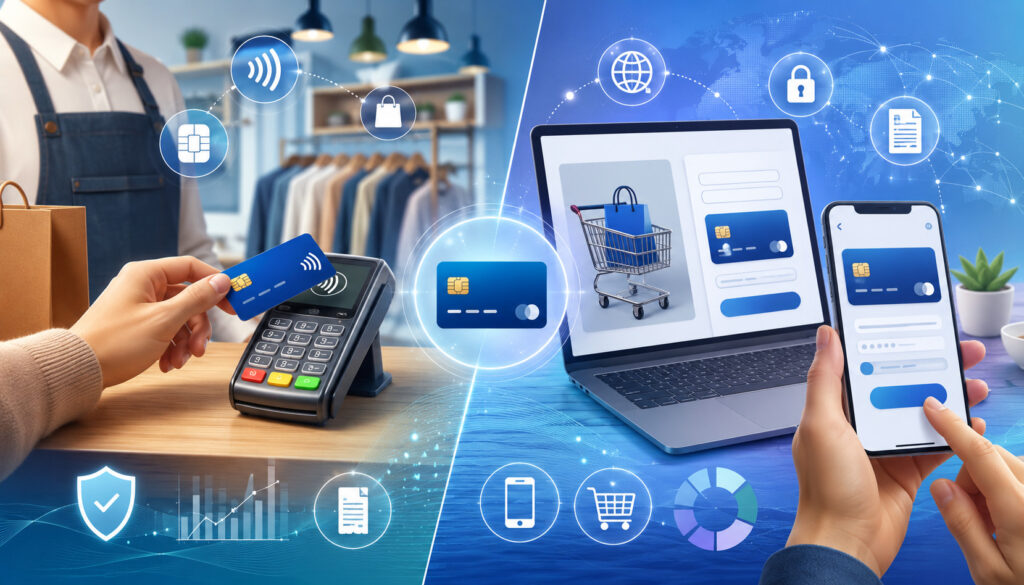
A card-present transaction generally occurs when the payment card or supported wallet interacts directly with a physical payment device. An inserted chip card, contactless card, or mobile wallet used at a terminal is normally treated as card-present.
A card-not-present transaction occurs when the physical card is not electronically read by the merchant’s terminal. Ecommerce orders, telephone payments, manually entered virtual-terminal transactions, invoice payments, payment links, and many subscription charges fall into this category.
The distinction affects payment-data capture, authentication, fraud exposure, dispute evidence, and processing costs. Card-present transactions can use chip or contactless security features and may support cardholder verification at the device.
Card-not-present transactions depend more heavily on entered account details, digital authentication, device signals, billing information, transaction history, and risk screening.
Neither category is automatically safe or unsafe. A stolen physical card can be used at a store, while a legitimate customer can be incorrectly rejected by an overly strict online fraud rule. The correct controls depend on the transaction circumstances.
Official merchant guidance recognizes that both card-present and card-not-present environments must be evaluated and protected according to PCI DSS responsibilities.
Businesses should identify transaction type correctly rather than entering ecommerce or telephone transactions as if the card had been read by a terminal. Incorrect processing can affect costs, reporting, dispute handling, and compliance with contractual rules.
Card-not-present transactions often require stronger documentation. Useful records may include order details, customer communications, delivery confirmation, device information, authentication results, invoice acceptance, subscription consent, and refund history.
Creating a Consistent Cross-Channel Customer Experience
Customers often judge the business as one organization even when its payment channels run on separate systems. Inconsistent prices, receipts, return policies, product details, and payment status messages can create confusion and disputes.
Coordinate Pricing, Receipts, Support, and Refund Policies
A consistent cross-channel payment experience begins with accurate information. Product prices, taxes, service fees, discounts, delivery charges, subscription terms, and refund policies should be displayed before payment whenever applicable.
Receipts should clearly identify the business activity, transaction amount, payment date, order reference, purchased items, and support route. The billing descriptor appearing on a customer’s account statement should also be recognizable. An unfamiliar descriptor can cause a customer to report a legitimate purchase as unauthorized.
Employees should be able to determine whether a transaction was authorized, captured, settled, voided, refunded, partially refunded, or disputed. They should not promise that a pending authorization has been released or that a refund will appear by a guaranteed date unless the timing is known.
Cross-channel policies should answer practical questions:
- Can an online purchase be returned at a physical location?
- Can a store employee locate a payment-link transaction?
- Can a customer update a subscription without calling?
- Can an invoice payment be partially refunded?
- Will a digital receipt be available after an in-person transaction?
- Who handles a dispute involving a delivery order?
Consistency does not require identical procedures everywhere. It requires clear rules and reliable communication about differences.
Select Payment Methods for Each Channel
A business does not need to provide every possible payment method in every channel. More options can improve accessibility, but they can also increase technical complexity, support requirements, security scope, reconciliation work, and contractual obligations.
Payment-method selection should consider:
- Customer demand
- Transaction value
- Frequency of purchase
- Mobile checkout behavior
- Refund and return needs
- Settlement timing
- Fraud and dispute exposure
- Integration compatibility
- Total processing cost
- Employee training requirements
Cards and digital wallets may be well suited to fast retail or ecommerce checkout. ACH payments may suit invoices, recurring charges, or higher-value transactions when authorization and return procedures are properly managed. Stored payment methods can simplify repeat purchases but require secure token management and customer controls.
Electronic fund transfers initiated through terminals, telephones, computers, and related methods may be subject to consumer-protection requirements depending on the account and transaction. Businesses should review applicable electronic transfer guidance and obtain professional advice for their specific obligations.
Technology Required for Multi-Channel Payments
Technology determines whether payment channels operate as isolated tools or as parts of a coordinated business system. The goal is not to purchase the largest possible technology stack. It is to select compatible components that support required workflows reliably.
Core Payment and Business Systems
A multi-channel environment may include:
- Point-of-sale hardware: Terminals, receipt printers, cash drawers, scanners, and customer displays.
- Mobile card readers: Portable hardware or tap-to-pay technology used with managed mobile devices.
- Ecommerce platforms: Systems that manage online products, carts, orders, taxes, and checkout.
- Payment gateways: Secure communication layers for online and software-based transactions.
- Virtual terminals: Browser-based tools for authorized manual payment entry.
- Payment processors: Services that route and manage electronic transaction messages.
- Merchant accounts: Arrangements that support card acceptance and settlement.
- Customer relationship systems: Tools for customer profiles, communication history, and service activity.
- Inventory software: Systems that track quantities by product and location.
- Order-management platforms: Tools that coordinate orders, fulfillment, delivery, pickup, and returns.
- Accounting integrations: Connections that transfer transaction and settlement information into financial records.
- Tokenization services: Technology that replaces sensitive payment values with controlled substitutes.
- Reporting dashboards: Interfaces used to review sales, deposits, refunds, fees, and disputes.
Tokenization replaces valuable card data with a payment token that can be used within an approved payment process. It can support mobile, ecommerce, in-app, and recurring transactions, but tokens still require access controls because some may allow future charges.
Compatibility should be confirmed before implementation. A gateway may not support the chosen processor, subscription platform, wallet, accounting tool, or point-of-sale system. Businesses should test integrations rather than relying only on feature lists.
Centralized and Separate Payment Systems
A centralized environment attempts to manage several payment channels through a connected processor, gateway, reporting structure, or commerce platform. Potential advantages include shared transaction identifiers, consolidated reporting, coordinated refunds, unified customer records, and fewer integration points.
Centralization may also create limitations. The business may depend heavily on one technology environment, experience broader disruption during an outage, or have less flexibility to select specialized tools for individual channels.
Separate systems can provide flexibility. A business might choose one solution for high-volume retail, another for ecommerce subscriptions, and a specialized invoice platform. This approach can support unique workflows and reduce dependence on a single system.
The trade-off is fragmentation. Finance teams may need to combine several settlement reports. Support staff may search multiple dashboards. Security access must be managed in more places, and refund policies may be harder to standardize.
The right architecture depends on transaction volume, technical resources, operational complexity, vendor dependency, reporting needs, and continuity requirements. A connected environment is not automatically better, and separate systems are not automatically inefficient.
Unified Customer Data, Inventory, and Order Management
Connected payment data can help a business understand how customers purchase, which channels generate sales, where refunds occur, and how subscriptions perform. However, payment records should not be combined indiscriminately.
A unified customer profile may connect order history, contact information, loyalty activity, subscriptions, refunds, and stored payment tokens. Access should be based on job responsibilities. A marketing employee may need purchase categories but not refund permissions or payment-account details.
Duplicate profiles can occur when a customer uses different email addresses, telephone numbers, guest checkout sessions, or spelling variations. Automatic merging can also create errors by combining records belonging to different people. Businesses need rules for matching, reviewing, correcting, and separating customer records.
Privacy and consent must be considered when data collected for payment is used for marketing, analytics, personalization, or cross-channel tracking. Businesses should collect only what they need, explain relevant uses, limit retention, and protect exports.
Inventory integration is equally important. Disconnected channels may sell the same final item twice, fail to restore returned stock, or show unavailable products as ready for pickup. Real-time synchronization can help, but scheduled updates may be acceptable when overselling risk is low.
Every order should have a unique identifier, product details, location, payment status, fulfillment status, and refund history. Procedures should also explain how employees correct mismatches without deleting the audit trail.
Multi-Channel Payment Security and Fraud Prevention
Security responsibilities vary by channel because payment information is captured, transmitted, stored, and accessed differently. No individual control eliminates all risk, and outsourcing payment processing does not remove every merchant responsibility.
Apply Security Controls to Each Environment
PCI DSS provides baseline technical and operational requirements for protecting payment account data. The exact responsibilities depend on how the business stores, processes, or transmits card information and how service providers participate in the payment flow.
Important controls include:
- Encryption for sensitive information in transit and, where required, at rest
- Tokenization to reduce exposure to raw payment credentials
- Multi-factor authentication for administrative access
- Unique user accounts instead of shared employee logins
- Role-based permissions for refunds, reports, settings, and exports
- Strong password and credential-management procedures
- Timely software, application, and device updates
- Secure configuration of routers, terminals, computers, and mobile devices
- Monitoring for unauthorized access and unusual transaction activity
- Regular review of connected applications and service providers
- Secure disposal of unnecessary payment records
- Incident-response and escalation procedures
In-store terminals should be inspected for signs of substitution or tampering. Portable devices should use screen locks, managed applications, remote-disable capabilities, and protected networks.
Ecommerce security includes protecting payment pages, administrator accounts, plugins, application programming interfaces, webhooks, and software dependencies. Telephone-payment procedures should prevent employees from writing card details on paper, placing sensitive information in chat, or allowing call recordings to capture payment credentials improperly.
For additional implementation guidance, businesses can review official merchant payment-security resources and this practical guide to ACH payment security practices.
Use Channel-Specific Fraud Controls
Fraud patterns differ across channels. A point-of-sale transaction may involve a stolen card, manipulated terminal, employee misuse, or fraudulent return. Ecommerce fraud may involve account takeover, automated card testing, reshipping, stolen identities, or false non-delivery claims.
Telephone orders may provide fewer device and behavioral signals. Payment links may be intercepted or redirected. Invoice fraud may involve changed bank details or impersonation. Subscription fraud may involve repeated trial abuse, unauthorized enrollment, or continued access after failed payment.
Risk-based controls may include:
- Address and security-code checks
- Customer or cardholder authentication
- Transaction and login velocity limits
- Device, account, email, and network signals
- Order-value and product-risk rules
- Billing and delivery comparison
- Account-access monitoring
- Manual review for unusual orders
- Confirmation before changing payment instructions
- Employee training for impersonation attempts
- Defined escalation and order-hold procedures
Applying identical fraud rules everywhere can create unnecessary declines or allow channel-specific threats to pass unnoticed. A high-value overnight shipment may deserve more review than a low-value in-store purchase from a returning customer.
Businesses should measure both fraud losses and legitimate-customer friction. Declining every unusual transaction may reduce fraud but also reject valid customers. Rules should be tested, reviewed, and adjusted using actual transaction outcomes.
Refunds, Chargebacks, and Recurring Payments
Post-payment activity is often where fragmented systems become most visible. Customers expect the business to locate their transactions even when the purchase and support request occur through different channels.
Managing Cross-Channel Refunds and Returns
Refunds should normally be returned to the original payment method unless an applicable rule or documented exception allows another approach. This can reduce fraud and preserve a traceable relationship between the original sale and refund.
Employees need reliable transaction-search tools. Useful search fields include the order number, date, amount, customer contact details, terminal, location, invoice number, and processor transaction identifier.
A cross-channel refund procedure should address:
- Original-payment verification
- Receipt and order requirements
- Full and partial refunds
- Split-tender transactions
- Shipping and service-fee treatment
- Inventory updates
- Refund approval limits
- Return fraud indicators
- Customer notifications
- Expected processing delays
A store may be able to accept an online return but still require the ecommerce system to issue the refund. Employees should explain this clearly rather than creating a second, unrelated payment.
Refund status should appear in customer-service, payment, order, and accounting records. If one system shows “refunded” while another shows “paid,” the business may accidentally issue a duplicate refund or provide incorrect information.
Preventing and Responding to Payment Disputes
A chargeback is not the same as a merchant-issued refund. It generally begins when a cardholder disputes a transaction through the card issuer. The merchant may receive a reason code, response deadline, and opportunity to provide evidence.
Disputes can arise from unauthorized transactions, unrecognized billing descriptors, non-delivery, damaged products, canceled services, duplicate charges, subscription misunderstandings, or unresolved refund requests.
Helpful documentation may include:
- Transaction and authorization records
- Item or service descriptions
- Customer communications
- Delivery or pickup confirmation
- Signed or digital acceptance
- Refund and cancellation records
- Subscription terms and consent
- Authentication results
- Device or account activity
- Evidence that the customer used the service
Businesses should respond within the required timeframe and provide evidence that directly addresses the dispute reason. A large collection of unrelated documents may be less useful than a clear, organized explanation.
Customer service can prevent some disputes. Recognizable billing descriptors, prompt refund communication, accessible cancellation procedures, and accurate delivery updates make it easier for customers to resolve concerns directly.
Managing Recurring Payments Across Channels
A customer may enroll in recurring billing at a store, on a website, through an invoice, or during a telephone interaction. Regardless of the channel, the business should preserve evidence of informed authorization.
The record should identify the customer, payment method, amount or calculation method, billing frequency, start date, trial conditions, renewal terms, cancellation process, and material changes. Recurring billing guidance emphasizes clear disclosure, express consent, and responsible billing practices.
Card details should generally be replaced by tokens for future charges. Access to those tokens must be restricted because they may still enable billing.
Recurring-payment operations should include:
- Advance or required billing notifications
- Retry rules for failed payments
- Procedures for expired or replaced cards
- Account-updater controls where used
- Limits on repeated authorization attempts
- Customer self-service where practical
- Clear cancellation and pause procedures
- Records of consent and cancellation
- Final billing and refund rules
- Subscription-access updates after payment changes
Payment retries should not continue indefinitely without regard to customer expectations, processing rules, or dispute risk. Failed-payment messages should explain what happened and provide a secure method to update the payment method.
Reporting, Reconciliation, and Total Payment Cost
Multi-channel reporting helps management understand sales activity, while reconciliation confirms that money actually moved as expected. A sales dashboard alone does not establish that every transaction was funded correctly.
Daily, Weekly, and Monthly Reconciliation
A practical daily process compares each channel’s sales with payment-system activity. The finance or operations team should review approved payments, captures, voids, refunds, tips, taxes, discounts, failed transactions, and unusual adjustments.
Daily tasks may include:
- Close point-of-sale batches and registers.
- Compare ecommerce orders with captured payments.
- Match invoices to payment records.
- Review virtual-terminal and telephone transactions.
- Check subscription renewals and failures.
- Investigate duplicate or incomplete transactions.
- Confirm that expected settlement files were received.
- Record differences for follow-up.
Weekly reconciliation can compare processor settlement reports with bank deposits. Teams should account for gross sales, fees, refunds, chargebacks, reserves, funding delays, and batch cutoffs.
Monthly review should compare payment reports with accounting balances and financial statements. It should also examine recurring discrepancies, unreconciled deposits, fee changes, refund trends, chargeback activity, and inactive employee accounts.
Centralized reporting may reduce manual consolidation, but it does not eliminate the need for review. Incorrect integration mapping can reproduce the same error across every report.
Reconciliation procedures should define ownership, acceptable timing differences, documentation requirements, escalation thresholds, and correction methods. Adjustments should preserve an audit trail rather than overwrite original records.
Evaluate the Total Cost of Every Channel
Processing cost includes more than an advertised transaction rate. Costs may vary according to the payment method, transaction channel, card data, pricing model, fraud exposure, equipment, gateway, software, integrations, chargebacks, refunds, and monthly services.
A complete cost review may include:
- Transaction and percentage-based fees
- Gateway or authorization fees
- Monthly platform charges
- Terminal and mobile-device costs
- Integration and development expenses
- Software subscriptions
- Chargeback and retrieval fees
- Refund-related charges
- Security and compliance expenses
- Fraud losses and false declines
- Manual reconciliation labor
- Support and training costs
- Funding delays or reserve requirements
- Contract termination obligations
The lowest rate for one transaction type may not produce the lowest total operating cost. A system with better reporting could reduce finance work, while a poorly integrated low-cost channel could create expensive errors.
Businesses should compare costs using their own transaction mix, average purchase value, refund frequency, channel volume, staffing, and expected growth. Contract terms and fee schedules should be reviewed carefully, and uncertain items should be clarified in writing.
Common Multi-Channel Payment Problems and Solutions
Many multi-channel payment problems begin when a business adds a checkout method without planning the surrounding workflow. The payment may succeed, but reporting, refunds, security, or fulfillment may fail.
| Problem | Possible impact | Warning sign | Practical preventive action |
| Adding channels without a strategy | Unnecessary cost and operational confusion | Employees cannot explain why a channel exists | Define customers, use cases, volume, ownership, and success measures first |
| Incompatible systems | Missing orders and manual data entry | Transactions require spreadsheet transfers | Test gateway, processor, order, inventory, and accounting compatibility |
| Identical fraud rules across channels | Excessive declines or overlooked risk | One channel has unusual fraud or approval patterns | Configure rules using channel, value, customer, and fulfillment risk |
| Unsynchronized transaction data | Incorrect order and payment status | Paid orders appear unpaid | Use shared identifiers, webhooks, and exception reporting |
| Inconsistent refund policies | Customer complaints and duplicate refunds | Different employees provide different answers | Publish cross-channel refund procedures and approval limits |
| Poor mobile checkout | Abandoned transactions | Mobile customers fail at specific fields | Test forms, wallets, buttons, errors, and page speed on real devices |
| Improper storage of payment data | Security and compliance exposure | Card details appear in notes or spreadsheets | Use approved payment interfaces and tokenization |
| Inadequate employee training | Errors, fraud, and weak customer support | Staff share logins or mishandle telephone payments | Train by role and test employees on real workflows |
| Untested integrations | Duplicate charges and missing updates | Problems appear only after launch | Test approvals, declines, timeouts, refunds, webhooks, and reports |
| Ignored settlement differences | Unexplained deposits and cash-flow surprises | Sales never equal deposits | Reconcile gross activity, fees, refunds, disputes, and timing |
| Confusing billing descriptors | Avoidable disputes | Customers do not recognize charges | Use recognizable descriptors and include support details on receipts |
| Too many payment methods | Higher complexity without meaningful use | Some methods have little volume | Review customer demand and retire unsupported options carefully |
| No outage preparation | Lost sales and insecure workarounds | Employees improvise during downtime | Create secure contingency and post-outage reconciliation procedures |
Another frequent mistake is failing to assign ownership. Payment problems may involve technology, finance, customer service, security, operations, and fulfillment. Without defined responsibilities, each team may assume another team is investigating.
Businesses should maintain a payment-operations contact list and escalation path. Employees need to know who handles checkout outages, suspicious orders, refund exceptions, settlement differences, access problems, chargebacks, and possible data-security incidents.
How to Build a Multi-Channel Payment Strategy
A multi-channel payment strategy should begin with customer and operational requirements rather than a list of software features.
1. Map Current and Future Sales Channels
List every place where customers currently pay and where the business expects to add payment acceptance. Include physical locations, websites, applications, invoices, telephone orders, social channels, subscriptions, field services, delivery, and payment links.
Document who owns each channel and how orders move from purchase to fulfillment.
2. Identify Customer Payment Preferences
Review customer requests, checkout behavior, invoice-payment patterns, support conversations, and mobile usage. Separate demonstrated demand from assumptions.
A payment method may be popular generally but unnecessary for a specific business or transaction type.
3. Review Volume and Purchase Value
Estimate transaction count, average purchase value, peak periods, refunds, subscriptions, and seasonal changes for each channel. Volume affects equipment, integration capacity, fraud controls, staffing, and pricing.
4. Evaluate Channel-Specific Risks
Identify likely fraud patterns, security exposure, dispute reasons, fulfillment risks, and employee-access needs. A telephone deposit and an in-store contactless purchase should not be treated as identical transactions.
5. Select Appropriate Payment Methods
Choose cards, digital wallets, ACH payments, stored methods, or other supported options based on customer demand and operational suitability. Avoid adding methods that the team cannot test, support, refund, and reconcile reliably.
6. Review Technology and Integration Requirements
Map the point-of-sale system, ecommerce platform, gateway, processor, merchant account, inventory, order-management software, accounting tools, and customer systems.
Confirm how data will move, which system is authoritative, and what happens when synchronization fails.
7. Compare Total Costs and Contract Terms
Review transaction fees, software charges, hardware costs, gateway fees, support, development, dispute costs, funding terms, reserves, contract length, and termination conditions.
Model costs using realistic transaction activity rather than a single advertised rate.
8. Establish Security Controls
Document where payment data enters, travels, and is stored. Minimize direct handling of raw credentials, use tokenization where appropriate, restrict access, protect devices and accounts, and review applicable PCI DSS responsibilities.
9. Create Refund and Dispute Procedures
Define transaction-lookup methods, refund-to-original-payment rules, partial refunds, approval limits, documentation, customer communication, dispute ownership, and response deadlines.
Procedures should cover purchases and returns occurring in different channels.
10. Train Employees by Role
Cashiers, customer-service representatives, finance staff, developers, managers, and delivery employees have different payment responsibilities. Training should reflect the permissions and risks of each role.
Include practice scenarios involving declines, suspected fraud, duplicate payments, telephone orders, refund requests, and outages.
11. Test Every Transaction Workflow
Test successful payments, declines, timeouts, duplicate clicks, authentication requests, delayed capture, voids, full refunds, partial refunds, subscription renewals, failed renewals, webhooks, receipts, settlement reports, and accounting exports.
Testing should include desktop, mobile, terminal, and employee-assisted workflows where relevant.
12. Monitor Performance After Launch
Review approval rates, checkout completion, refund activity, disputes, settlement timing, customer complaints, costs, outages, and reconciliation differences.
A launch is not the end of implementation. Fraud patterns, customer behavior, software, and business operations change, so payment controls need ongoing review.
Measuring Performance, Preparing for Downtime, and Scaling
A multi-channel environment should be evaluated as an operating system rather than a collection of checkout buttons.
Measure Channel-Specific Performance
Useful measures include:
- Payment approval and decline rates
- Checkout abandonment
- Payment-processing costs
- Refund and return rates
- Chargeback activity
- Settlement timing
- System downtime
- Reconciliation discrepancies
- Sales by channel
- Customer complaints
- Mobile checkout performance
- Subscription renewal success
- Manual-review volume
Universal benchmarks may be misleading. A high-value ecommerce business, local service provider, subscription platform, and physical retailer can have very different approval, refund, and dispute patterns.
Compare each channel with its own historical performance and investigate meaningful changes. A sudden increase in declines may indicate fraud controls, technical errors, issuer behavior, or customer-data problems rather than lower customer demand.
Prepare for Payment-System Downtime
Disruptions may involve internet service, gateways, terminals, mobile devices, integrations, power, processors, or internal software.
A contingency plan should identify:
- Who confirms the scope of the outage
- Which channels remain available
- How employees communicate with customers
- Whether approved offline capability exists
- How orders are recorded securely
- Which transactions must wait
- How duplicate charges will be prevented
- How activity will be reconciled afterward
- Who communicates with technical providers
- How the incident will be documented
Employees should never write down full card details or move sensitive information into unapproved tools as a workaround. When secure payment acceptance is unavailable, delaying the transaction may be safer than improvising.
Scale Without Losing Control
Before adding locations, websites, currencies, employees, subscriptions, or integrations, determine whether the existing environment can support higher transaction volume and more complex permissions.
Scalable payment operations require documented procedures, consistent identifiers, reliable reporting, role-based access, repeatable training, integration monitoring, and tested recovery processes.
Businesses should also consider whether centralized systems create a single point of operational dependence. Backup communication routes, exportable reports, documented configurations, and alternative procedures can improve resilience.
Regular payment-system reviews should examine inactive users, unused channels, outdated devices, unsupported software, fee changes, integration errors, customer complaints, and evolving security responsibilities.
Frequently Asked Questions
What is multi-channel payment acceptance?
Multi-channel payment acceptance means collecting payments through more than one sales or communication environment. A business might accept in-store cards, ecommerce payments, mobile transactions, invoices, payment links, telephone orders, subscriptions, and ACH payments. The channels may operate separately or share transaction, customer, order, and reporting information.
What is the difference between multi-channel and omnichannel payments?
Multi-channel payments support several payment channels, but those channels may remain independent. Omnichannel payment processing generally aims to connect payment, customer, inventory, order, refund, and fulfillment data across channels. A business can therefore be multi-channel without providing a fully unified commerce experience.
Which payment channels can a business use?
Common channels include point-of-sale terminals, ecommerce checkouts, mobile card readers, contactless checkout, digital wallets, virtual terminals, telephone payments, invoices, payment links, QR codes, social commerce, subscriptions, and electronic bank payments.
The right combination depends on customers, transaction value, risk, staffing, cost, and fulfillment requirements.
Can one payment processor support multiple channels?
Many processors can support several channels, but compatibility and functionality vary. A business should verify support for its terminals, ecommerce platform, gateway, mobile devices, virtual terminal, subscriptions, wallets, ACH payments, reporting, accounting tools, and refund procedures before committing to an arrangement.
How are online and in-store payments connected?
Connections may be created through a shared processor, gateway, commerce platform, customer database, inventory system, order-management tool, or reporting environment.
Shared transaction and order identifiers help employees locate purchases, manage returns, update inventory, and reconcile deposits across channels.
Are multi-channel payments more difficult to secure?
They can create a larger and more varied security environment because payment information enters through different devices, applications, employees, and networks.
Security should be reviewed by channel, with appropriate encryption, tokenization, access controls, authentication, updates, monitoring, employee training, and incident procedures.
How can businesses reconcile payments from several channels?
Businesses should compare channel-level sales with captured transactions, settlement reports, fees, refunds, chargebacks, adjustments, and bank deposits.
Daily exception review, weekly deposit matching, and monthly accounting reconciliation can identify missing payments, duplicate entries, timing differences, and integration errors.
What payment methods should businesses offer?
Payment methods should reflect customer demand, transaction value, checkout environment, security needs, settlement timing, refund requirements, total cost, and operational capacity. Every channel does not need to support every method. Each option should have a clear business purpose and a tested support process.
How should cross-channel refunds be managed?
Employees should locate and verify the original transaction, follow the documented return policy, refund the original payment method when required, update the order and inventory records, and provide clear customer communication.
Partial refunds, split payments, shipping charges, and transactions processed through another system need specific procedures.
How can businesses reduce fraud across different channels?
Businesses can use channel-specific verification, authentication, velocity rules, transaction monitoring, access protection, employee training, manual review, delivery confirmation, and escalation procedures.
Fraud controls should be adjusted using actual results so that they reduce suspicious activity without rejecting excessive numbers of legitimate customers.
What are the most common multi-channel payment mistakes?
Common mistakes include adding channels without a strategy, using incompatible systems, applying identical fraud rules everywhere, failing to synchronize transaction data, storing sensitive information improperly, providing inconsistent refund procedures, neglecting mobile checkout, overlooking settlement differences, and failing to prepare for outages.
What should be reviewed before adding a new payment channel?
A business should review customer demand, expected volume, payment methods, processing costs, security responsibilities, fraud exposure, integrations, reporting, settlement timing, refunds, disputes, employee permissions, training, technical support, contract terms, business-continuity procedures, and future scalability.
Conclusion
Effective multi-channel payment acceptance requires more than placing additional payment options in front of customers. Every channel affects transaction processing, customer service, security, reporting, fulfillment, refunds, disputes, accounting, and cash flow.
Businesses should begin by mapping how customers buy and pay. They can then select appropriate payment methods, connect systems where integration provides value, establish channel-specific security controls, and create consistent procedures for employees and customers.
Regular reconciliation, performance monitoring, access reviews, integration testing, and outage planning help ensure that payment activity remains accurate and manageable as the business changes.
The most suitable multi-channel payment strategy depends on the business’s customers, transaction risks, sales environments, operational resources, budget, and growth plans. A carefully coordinated system can provide convenience and flexibility without sacrificing financial visibility or operational control.
This guide provides general educational information. Businesses should verify their individual contractual, technical, legal, tax, security, and compliance responsibilities with qualified professionals and the organizations involved in their payment arrangements.