
By Gerardo Graham June 9, 2026
The payment settlement process is the behind-the-scenes workflow that turns an approved customer payment into money moving toward a merchant’s bank account.
A customer may tap a card, enter card details online, use a digital wallet, or pay through a mobile device in seconds, but the merchant does not instantly receive final usable funds in most payment environments. The transaction still needs to be captured, grouped, cleared, settled, funded, reported, and reconciled.
For business owners, this process matters because settlement affects cash flow, bank deposits, accounting accuracy, refund handling, chargeback exposure, and the way daily sales appear on merchant statements.
A retailer may see a $2,000 sales day in the point-of-sale system, but the actual bank deposit could arrive later, net of interchange fees, assessment fees, processor fees, refunds, reserves, or dispute adjustments. Understanding why that happens helps merchants avoid confusion and make better operational decisions.
This guide explains how the merchant settlement process works across card-present transactions, ecommerce payments, mobile payments, contactless payments, recurring billing, digital wallets, and ACH-related payouts.
It also covers common settlement delays, batch settlement, payment processing settlement reports, reconciliation best practices, and practical ways to improve visibility.
This article is for general educational purposes. Payment settlement timing, costs, deductions, rules, risk reviews, funding outcomes, and reporting formats can vary by provider, payment processor, acquiring bank, payment network, issuing bank, transaction type, business model, risk profile, and merchant account setup.
What Is the Payment Settlement Process?
The payment settlement process is the stage in which approved and captured transactions are processed so funds can move through the payment system toward the merchant’s account.
It comes after authorization and capture, and it is closely connected to clearing and merchant funding. In everyday business terms, settlement is the part of the transaction journey where the sale moves from “approved” to “ready for funds movement.”
A key point is that authorization is not the same as settlement. Authorization confirms that the cardholder’s issuing bank approved the transaction at the time of purchase.
Settlement is the later process that helps move the money between financial institutions and eventually supports the merchant payout. A cardholder may see a pending charge shortly after purchase, while the merchant may receive the related deposit after the payment settlement cycle is completed.
In card payment settlement, the transaction moves through several connected parties: the merchant, payment gateway or point-of-sale system, payment processor, acquiring bank, credit card networks or payment networks, issuing bank, and the merchant bank account. Each party plays a different role in verifying, routing, clearing, settling, funding, or reporting the transaction.
Settlement in payment processing also includes record matching. The payment processor and acquiring bank need to know which approved transactions are ready to be submitted for clearing and settlement.
This is why capture and batch settlement are so important. If a transaction is authorized but never captured, it usually cannot proceed to final settlement.
For example, a restaurant may authorize a customer’s card when the check is presented, then adjust the final amount after a tip is added. An ecommerce seller may authorize a card at checkout, then capture the transaction when the order ships.
A professional services business may capture payment immediately after a client pays an invoice online. Each scenario can affect the payment settlement timeline.
Why Payment Settlement Matters for Merchants
Payment settlement matters because it connects sales activity to real cash flow. A merchant may have strong daily revenue, but if settlement batches close late, funding is delayed, refunds are high, disputes increase, or reserves are applied, the amount deposited may differ from what the sales dashboard shows. For many businesses, this difference creates accounting questions and cash planning challenges.
The merchant payment settlement process also affects how a business pays vendors, meets payroll, orders inventory, and manages operating expenses. A retailer that expects card sales to fund the next inventory purchase needs to know whether funding is usually next-day, two-day, or longer.
A service provider that accepts large deposits needs to understand whether high-ticket transactions may trigger risk review or settlement holds. A subscription business needs to monitor recurring billing declines, refund adjustments, and chargeback deductions because these can reduce expected payouts.
Settlement also matters for reconciliation. The gross sales total in a point-of-sale system may not match the net bank deposit because the deposit can reflect deductions.
These deductions may include interchange fees, assessment fees, processor fees, chargebacks, refunds, reserves, rolling reserves, ACH returns, or prior adjustments. Without good settlement reports, a merchant may struggle to explain why the bank deposit is lower than expected.
The credit card settlement process also has operational consequences. If employees forget to close a batch, the batch settlement may occur later than expected.
If an ecommerce system captures transactions only after fulfillment, orders shipped on different days may settle in different batches. If a merchant changes processors, bank accounts, or gateway settings, funding timelines and reporting formats may change.
For decision-makers, understanding settlement helps with better processor conversations. Instead of asking only, “When do I get paid?” a merchant can ask more useful questions: What is the batch cutoff? Are fees deducted daily or monthly? Are card-present and card-not-present transactions funded differently? What causes delayed funding? How are refunds and chargebacks shown on payout reports?
Key Parties Involved in Payment Settlement

The payment settlement system includes multiple parties that work together to move transaction data and funds. Merchants do not need to memorize every technical message, but they should understand the major players because delays or reporting differences often come from how these parties interact.
Merchant, Cardholder, and Merchant Account
The merchant is the business accepting the payment. The cardholder is the customer using a credit card, debit card, digital wallet, or another supported payment method.
The merchant account is the account relationship that allows the business to accept card payments and receive settlement funding. In many setups, funds are first processed through the merchant account environment before being deposited into the merchant’s business bank account.
The merchant is responsible for using compliant payment tools, capturing transactions correctly, maintaining accurate records, issuing refunds when appropriate, and responding to disputes. The merchant also needs to understand its agreement terms, including funding timelines, reserve policies, chargeback handling, and settlement reporting.
For example, a retail store may accept card-present transactions through a point-of-sale system, while an ecommerce seller may accept card-not-present transactions through a payment gateway. Both merchants rely on settlement, but their risk profiles and reporting details may differ.
Payment Gateway and Point-of-Sale System
A payment gateway is the technology that securely transmits online payment information between the checkout experience and the payment processor. In in-person environments, a point-of-sale system or payment terminal captures card data and routes the transaction for authorization.
For ecommerce businesses, the gateway plays a major role in authorization, capture, fraud screening, tokenization, recurring billing, and transaction reporting.
A useful overview of gateway basics can be found in this guide to how payment gateways work. For in-person merchants, the POS system helps manage sales, tips, taxes, refunds, voids, and batch settlement.
The gateway or POS system does not usually provide final settlement by itself. Instead, it passes transaction information to the processor and related financial institutions. However, gateway settings can affect settlement.
Auto-capture, manual capture, batch close time, tip adjustment settings, and recurring billing schedules can all influence when a transaction enters the settlement batch.
Payment Processor, Acquiring Bank, Issuing Bank, and Payment Networks
The payment processor routes transaction data between the merchant’s system, the acquiring bank, payment networks, and issuing bank. The acquiring bank supports the merchant side of the transaction. The issuing bank supports the cardholder side and approves or declines the transaction during authorization.
Payment networks set rules for how card transactions are routed, cleared, settled, disputed, and reported. They also help calculate network-level fees and define operating rules that processors, banks, and merchants must follow.
The Federal Reserve also provides broader educational resources on payment, clearing, and settlement systems, which can help finance readers understand why settlement systems are designed around risk management, timing, and institutional coordination.
When a transaction settles, funds and data move according to network rules and banking arrangements. The issuing bank ultimately transfers funds through the system, the acquiring side receives settlement, and the merchant receives funding according to the provider’s payout schedule.
Authorization, Capture, Clearing, and Settlement Explained
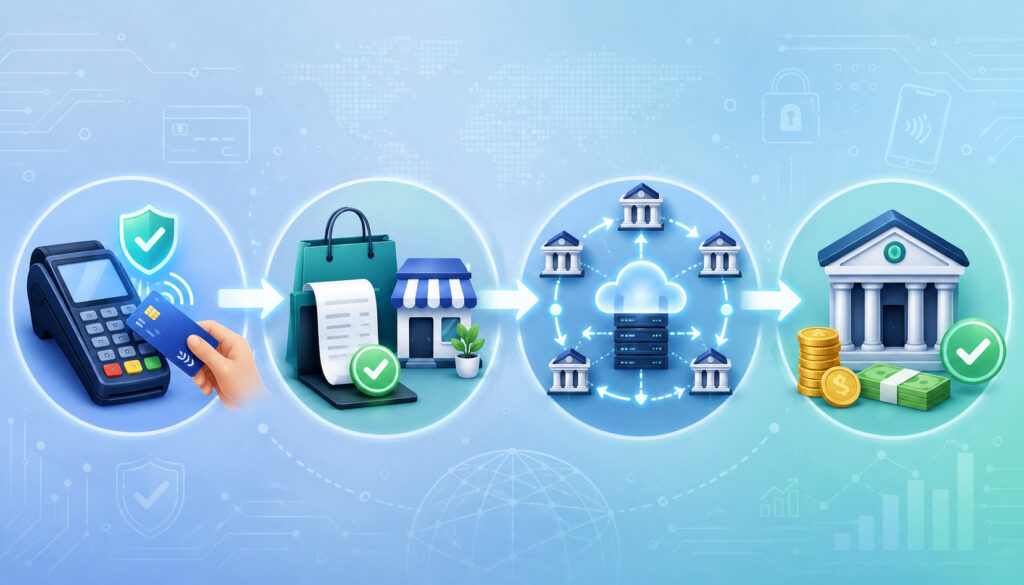
Many merchants use the words authorization, capture, clearing, settlement, and funding interchangeably, but they are not the same. Understanding the difference makes payment processing settlement easier to manage and reduces confusion when reports do not match bank deposits.
Payment Authorization
Authorization happens when the customer presents payment details and the transaction is sent for approval. The issuing bank checks factors such as account status, available credit or funds, fraud signals, card security data, and network rules. If approved, the merchant receives an authorization approval code.
Authorization does not guarantee final funding. It indicates that the issuing bank approved the transaction at that moment. A transaction can still fail to settle if it is not captured, if the batch is not submitted, if a technical issue occurs, or if a later adjustment affects funding.
For example, a hotel may authorize a card for an estimated amount at check-in, then capture the final amount at checkout. An ecommerce seller may authorize payment when the customer orders and capture it after confirming inventory. A quick-service restaurant may authorize and capture in a more immediate flow.
Transaction Capture
Capture is the step where the merchant confirms that an authorized transaction should be submitted for settlement. In many retail environments, authorization and capture happen close together. In ecommerce, capture may happen immediately or later, depending on fulfillment rules, fraud review, or shipping timing.
If a transaction is authorized but not captured, it generally remains pending for a period and then may expire. This is why capture settings are important for online stores, service businesses, and any merchant that uses delayed fulfillment. Manual capture gives merchants control, but it also introduces the risk of forgetting to capture approved transactions.
Capture also affects reporting. A transaction may appear as authorized in the gateway but not appear in settlement reports until captured. For accounting teams, this difference is important because authorized-only transactions should not be treated as completed revenue without additional review.
Payment Clearing and Settlement
Clearing is the exchange and validation of transaction information between payment system participants. It helps determine what each party owes, what fees apply, and how transaction records should be posted. Settlement is the movement of funds between financial institutions based on the cleared transaction data.
A simple way to think about payment clearing and settlement is this: clearing organizes and confirms the transaction details, while settlement supports the financial movement that follows those details. In card settlement process workflows, clearing and settlement are closely linked, but they are still distinct stages.
Merchant funding comes after settlement arrangements are processed. Funding is the deposit that reaches the merchant’s bank account, often net of deductions. This is why a merchant may see a transaction marked as settled in a processor portal before the bank deposit appears.
| Stage | What Happens | Who Is Involved | What Merchants Should Know |
| Authorization | The transaction is approved or declined | Merchant, cardholder, POS or gateway, processor, issuing bank | Approval is not the same as final funding |
| Capture | The approved transaction is submitted for processing | Merchant, POS or gateway, processor | Uncaptured transactions may not settle |
| Batch Settlement | Captured transactions are grouped and submitted | Merchant system, gateway, processor | Batch close time can affect funding timeline |
| Clearing | Transaction details are exchanged and validated | Processor, acquiring bank, payment networks, issuing bank | Fees and transaction details are applied |
| Settlement | Funds move between financial institutions | Issuing bank, network, acquiring bank | Settlement supports merchant funding |
| Merchant Funding | Net funds are deposited to the merchant bank account | Processor, acquiring bank, merchant bank | Deposits may reflect fees, refunds, reserves, or disputes |
Step-by-Step Credit Card Settlement Process
The credit card settlement process may feel complex, but it becomes easier to understand when broken into practical steps. Each step creates a record that eventually affects the merchant’s settlement report, merchant statement, and bank deposit.
First, the customer initiates payment. This may happen at a retail checkout, through an ecommerce shopping cart, via a mobile invoice, through a contactless card tap, or through a digital wallet. The payment details are transmitted through a secure payment environment, usually involving a terminal, gateway, or POS system.
Second, the transaction is authorized. The payment processor routes the request through the proper payment network to the issuing bank. The issuing bank approves or declines the payment. If approved, the merchant receives confirmation and completes the sale from the customer-facing perspective.
Third, the transaction is captured. In many retail settings, this happens automatically. In some ecommerce, restaurant, lodging, rental, or service environments, the final captured amount may be adjusted based on tips, shipping, deposits, or completion of service.
Fourth, captured transactions are placed into a settlement batch. This may happen automatically at a scheduled batch close time or manually when the merchant closes the batch. Batch processing is a major reason why two merchants with similar sales volumes may have different funding timelines.
Fifth, clearing occurs. Transaction records are exchanged among the processor, acquiring bank, payment network, and issuing bank. Fees such as interchange fees, assessment fees, and processor fees may be calculated according to the transaction type, card type, risk category, and pricing arrangement.
Sixth, settlement occurs between financial institutions. The issuing side pays through the system, and the acquiring side receives funds according to the payment network and banking arrangements.
Seventh, merchant funding occurs. The merchant receives a bank deposit according to the agreed funding timeline. The deposit may be gross or net, depending on whether fees are deducted daily, monthly, or by another schedule.
For example, a boutique that closes its batch before the processor cutoff may see funding sooner than a similar boutique that closes after cutoff. An ecommerce store with higher fraud review may see certain orders held before capture. A contractor accepting large invoice payments may face additional review if the transaction amount is outside normal patterns.
Batch Settlement and Merchant Funding Timelines

Batch settlement is the process of grouping captured transactions and submitting them for settlement. A settlement batch may include a day’s sales, a shift’s sales, or transactions captured during a defined processing window. Batch timing is one of the most practical factors affecting the payment settlement timeline.
How Batch Settlement Works
A batch is a group of transactions waiting to move into the settlement process. In a retail store, the POS system may automatically close the batch at the end of the day. In a restaurant, the batch may close after tips are adjusted.
In an ecommerce business, transactions may be captured and batched based on order fulfillment rules. In a mobile payment setup, batches may close according to app or processor settings.
If a batch closes before the processor’s cutoff time, the transactions may enter the next available settlement cycle. If it closes after the cutoff, the batch may be treated as part of the next processing day. This is why a sale made in the afternoon can sometimes fund differently than a sale made late at night.
Manual batch closing can create delays if staff forget to close the batch. Automatic batch settlement reduces that risk but should still be reviewed. Merchants should confirm that auto-close settings match operating hours, tip adjustment procedures, and accounting needs.
Batch reports are especially useful because they help connect sales activity to settlement activity. A batch report should show the transactions included, gross batch total, refund activity, voids, and sometimes processing details. Comparing the batch report to the funding report helps identify missing or delayed deposits.
Merchant Funding Process and Timeline Expectations
The merchant funding process is the payout stage where funds reach the merchant’s business bank account. Funding may be next-day, two-day, or longer, depending on provider policy, bank cutoff times, card type, transaction risk, merchant account setup, and whether the batch was submitted on time.
Next-day funding does not always mean every transaction will deposit the next calendar day. Weekends, banking holidays, late batch close times, risk reviews, settlement holds, and bank processing schedules can affect timing.
Some payment types, especially ACH transfers, follow different settlement schedules. For more context on ACH timing, see this overview of how long ACH payments take to process and the Federal Reserve’s information on FedACH processing schedules.
Merchants should also understand gross versus net funding. Gross funding means the processor deposits the full settled amount and bills fees separately. Net funding means fees, refunds, chargebacks, reserves, or adjustments may be deducted before deposit. Neither format is automatically better, but each affects reconciliation differently.
Payment Settlement for Online, In-Person, Mobile, and Recurring Payments
Payment settlement is not identical across every sales channel. The core steps are similar, but the details vary based on how the transaction is accepted, when it is captured, and how risk is monitored.
Card-present transactions happen when the customer physically presents a card, taps a contactless card, inserts a chip card, swipes when permitted, or uses a compatible digital wallet at a terminal.
These transactions often carry lower fraud risk than card-not-present transactions because the payment credential is present at checkout. For retailers, restaurants, salons, repair shops, and local service businesses, the settlement process usually depends heavily on POS batch timing and tip adjustment rules.
Card-not-present transactions include ecommerce payments, keyed transactions, phone orders, online invoices, and many subscription payments. These transactions may require additional fraud monitoring because the physical card is not presented.
Ecommerce sellers may use fraud filters, address verification, card security codes, device checks, and manual review before capture. This can affect the transaction settlement timeline.
Mobile payments can mean different things. A food truck may use a mobile card reader for card-present transactions. A field service technician may send a mobile invoice that the customer pays remotely.
A retailer may accept digital wallets in person. Each version can settle differently depending on whether the transaction is card-present or card-not-present and how the provider batches transactions.
Recurring billing adds another layer. Subscription businesses, membership organizations, professional services firms, and software providers may bill customers automatically.
Recurring billing depends on stored payment credentials, tokenization, authorization schedules, retries for declined payments, refund handling, and chargeback monitoring. Settlement reports should be reviewed carefully because recurring billing can generate high volumes of small transactions, failed payments, and customer disputes.
ACH-related payouts and e-check payments follow a different rail than card transactions. ACH can be useful for recurring payments, larger invoices, and bank-to-bank transfers, but it has its own authorization, return, and settlement considerations.
For a deeper explanation, see this guide to e-check payments and when to use them. The ACH Network is governed by operating rules, and the network’s administrator explains its role in driving direct deposits and direct payments through ACH education resources.
Common Reasons Payment Settlements Are Delayed
Settlement delays can happen for many reasons, and not all delays indicate a problem. Some are simply the result of batch timing, weekends, holidays, or banking cutoffs. Others may signal a risk review, reporting mismatch, technical issue, or merchant account concern.
One common cause is late batch close. If a batch is submitted after the processor cutoff time, it may not enter the expected settlement cycle. This can push funding later, especially before weekends or holidays. Restaurants, bars, and service businesses that adjust tips after the sale should pay close attention to batch timing.
Another common cause is transaction type. Card-not-present transactions, high-ticket transactions, international cards, unusual order patterns, or transactions that differ from a merchant’s normal processing history may receive additional review. Risk review does not always mean funds will be held, but it can slow the merchant funding process.
Banking schedules also matter. Settlement and funding generally rely on business-day processing. Weekends, holidays, and bank cutoff times can create gaps between the processor’s settlement status and the deposit appearing in the merchant bank account.
Technical issues can also delay settlement. These may include gateway outages, POS sync errors, duplicate batch submissions, incomplete captures, incorrect bank account details, processor file delays, or failed funding instructions. Merchants should monitor batch reports daily so these issues are caught quickly.
Merchant account setup can also affect settlement timing. New merchants, high-risk business models, sudden volume spikes, chargeback increases, excessive refunds, incomplete documentation, or unusual transaction behavior may trigger funding holds or reserve reviews. Businesses with seasonal peaks should notify their provider before large volume changes when possible.
Finally, disputes and chargebacks can reduce or interrupt expected payouts. A chargeback may remove funds from a current or future settlement, even if the original transaction funded earlier.
The consumer dispute process is explained from the cardholder side by the consumer financial protection agency, while merchants should maintain documentation to respond to disputes properly.
Fees, Deductions, Reserves, and Settlement Holds
The amount a merchant receives in the bank is often different from the gross sales amount. This is normal in payment processing settlement because fees, refunds, disputes, reserves, and adjustments may be deducted before or after funding.
Interchange fees are paid through the card payment system and vary by card type, transaction method, industry category, and other factors. Assessment fees are network-level fees.
Processor fees are charged by the payment processor or provider according to the merchant’s pricing arrangement. These may appear as daily deductions, monthly billing, blended rates, itemized fees, or statement adjustments.
Refunds can reduce settlement funding when the refund is processed. If the refund occurs before the original transaction settles, it may offset the settlement batch. If it occurs after funding, it may be deducted from a later payout or billed separately. This is why refund timing matters for reconciliation.
Reserves are another important concept. A reserve is a portion of funds held by the provider or acquiring side to manage risk. A rolling reserve withholds a percentage of sales for a defined period before releasing it later, subject to the agreement.
Reserves are more common for businesses with higher dispute risk, delayed delivery, high-ticket sales, subscription billing, travel-like fulfillment patterns, or sudden volume changes.
Settlement holds may occur when transactions require review. A hold can be triggered by documentation issues, suspected fraud, unusual volume, chargeback spikes, bank account problems, or business model concerns.
A settlement hold is not the same as a routine funding timeline. It usually requires communication with the provider and may involve submitting invoices, delivery proof, customer authorization, business records, or processing explanations.
Merchants should review the terms that explain how fees, reserves, and holds are handled. The official payment security standards council also provides resources related to protecting payment data, which matters because weak payment security can increase fraud exposure and create downstream settlement problems.
Refunds, Voids, Chargebacks, and Their Impact on Settlement
Refunds, voids, and chargebacks all reverse or adjust payments, but they do not work the same way. Understanding the difference helps merchants protect cash flow and keep reconciliation accurate.
A void cancels a transaction before it is fully settled. For example, if a cashier rings up the wrong amount and catches it immediately, the transaction may be voided before batch settlement. A void usually prevents the transaction from moving forward into settlement, though the cardholder may still briefly see a pending authorization.
A refund returns funds to the customer after a transaction has been captured or settled. Refunds may appear in the same batch or a later batch, depending on timing. For merchants, refunds reduce expected deposits or create deductions from future funding. Refund policies should be clear, and refund records should be matched to the original transaction.
A chargeback is a forced reversal initiated through the issuing side after a cardholder dispute, fraud claim, processing issue, or other eligible dispute reason.
Chargebacks can remove funds from the merchant’s current or future settlement, and the merchant may also pay a chargeback fee. Chargebacks may occur after the original sale has already been funded, which can surprise merchants who are not monitoring dispute reports.
Chargebacks affect more than cash flow. A high chargeback ratio may lead to additional monitoring, higher costs, reserves, settlement holds, or even account review.
Merchants should maintain strong transaction records, proof of delivery, refund communication, signed agreements, service documentation, and customer support logs. A practical merchant chargeback guide can help merchants understand how disputes affect operations.
Different business models face different dispute risks. Ecommerce sellers should track delivery confirmation and product descriptions. Subscription businesses should make cancellation terms easy to find.
Restaurants should keep tip adjustment records. Service providers should keep signed work approvals. Professional firms should document client authorization and invoice acceptance.
Payment Settlement Reports and Reconciliation Best Practices
Settlement reports are the bridge between payment activity and accounting records. They help merchants verify which transactions settled, which deposits were funded, which fees were deducted, and which adjustments affected payouts.
A settlement report may include batch ID, transaction ID, authorization code, card brand, transaction date, settlement date, gross amount, refund amount, fee amount, chargeback amount, reserve amount, and net deposit.
A payout report may focus more directly on the bank deposit and the transactions included in that deposit. A merchant statement usually summarizes processing activity, fees, volume, chargebacks, and other account-level details over a statement period.
Reconciliation is the process of matching payment records to accounting records and bank deposits. The goal is to answer a practical question: Do the sales, settled transactions, deductions, and deposits all make sense?
Start with the POS, gateway, or ecommerce platform sales report. Then compare it to the processor’s batch or settlement report. Next, compare the settlement report to the payout or funding report.
Finally, compare the payout report to the bank deposit. This sequence helps identify whether a difference is caused by an uncaptured transaction, late batch, processor adjustment, bank timing issue, or accounting entry.
Merchants should also separate gross sales from net deposits. Gross sales represent the value of transactions before deductions. Net deposits represent what actually reached the bank. Both numbers are useful, but they answer different questions.
A good reconciliation workflow includes:
- Reviewing open authorizations that have not been captured.
- Confirming daily batch totals against POS or gateway records.
- Matching settlement batches to funding deposits.
- Tracking fees, refunds, reserves, and chargebacks separately.
- Investigating missing, duplicate, or delayed deposits.
- Keeping supporting records for disputes and audits.
- Reviewing merchant statements for pricing or fee changes.
- Exporting reports regularly before data becomes harder to retrieve.
How Merchants Can Improve Settlement Visibility and Cash Flow
Merchants cannot control every part of the payment settlement cycle, but they can improve visibility and reduce avoidable delays. The best approach combines operational discipline, reporting review, staff training, and better processor questions.
First, confirm your batch close settings. Know whether batches close automatically or manually. Confirm the cutoff time and make sure it matches your operating schedule. Restaurants should account for tip adjustments.
Ecommerce businesses should confirm when transactions are captured. Service providers should ensure invoice payments are not sitting in authorized-only status.
Second, standardize reconciliation. Assign responsibility for daily, weekly, and monthly review. Daily review should focus on batch completion and deposit matching. Weekly review should focus on refunds, voids, chargebacks, and unusual deductions. Monthly review should focus on merchant statements, fee trends, reserve activity, and reporting accuracy.
Third, monitor risk indicators. Sudden increases in chargebacks, refunds, failed payments, high-ticket transactions, or unusual order patterns can affect settlement.
Fraud monitoring, PCI compliance, secure payment tools, and clear customer communication all help reduce preventable settlement problems. For additional security context, see this educational guide to PCI DSS compliance.
Fourth, plan cash flow around realistic funding timelines, not best-case scenarios. A business that depends on next-day funding should still maintain a buffer for weekends, holidays, delayed funding, chargebacks, and reserves. This is especially important for startups, seasonal merchants, restaurants with narrow margins, and ecommerce sellers with inventory costs.
Fifth, ask better provider questions before problems happen:
- What is my batch cutoff time?
- Are batches closed automatically or manually?
- Are fees deducted daily, monthly, or from each deposit?
- Are refunds deducted from current or future settlement?
- How are chargebacks deducted and reported?
- What can trigger a settlement hold?
- Are reserves possible for my account type?
- How long are transaction reports available?
- Can I export settlement and payout reports by batch ID?
- Do card-present and card-not-present transactions have different funding timelines?
A checklist-style settlement workflow can help:
| Workflow Area | What to Review | Why It Matters |
| Batch close | Confirm daily close time and batch status | Prevents avoidable funding delays |
| Capture settings | Review authorized-only transactions | Ensures approved sales move toward settlement |
| Funding reports | Match deposits to payout reports | Explains net bank activity |
| Fee tracking | Separate interchange, assessment, and processor fees | Improves margin visibility |
| Refunds and voids | Match adjustments to original transactions | Prevents accounting errors |
| Chargebacks | Track dispute deductions and deadlines | Protects cash flow and response rights |
| Reserves | Monitor withheld and released funds | Helps forecast available cash |
| Security controls | Maintain secure payment practices | Reduces fraud and settlement risk |
What is the payment settlement process?
The payment settlement process is the workflow that moves approved and captured transactions through clearing and settlement so funds can move toward the merchant’s account. It happens after authorization and capture.
Settlement is not the same as the customer-facing approval message, and it is not always the same as the final bank deposit. The bank deposit is merchant funding, which usually follows settlement and may be net of fees, refunds, chargebacks, reserves, or other adjustments.
How does credit card settlement work?
Credit card payment settlement starts when a customer’s card transaction is authorized. The merchant then captures the transaction and submits it in a settlement batch.
The processor, acquiring bank, payment networks, and issuing bank exchange transaction details through clearing. Settlement then supports movement of funds between financial institutions. After that, the merchant receives funding according to the provider’s payout schedule and account terms.
What is the difference between authorization and settlement?
Authorization is the approval step. It confirms that the issuing bank approved the transaction at the time of purchase. Settlement is the later process that helps move funds through the payment system after the transaction has been captured and cleared.
An authorized transaction may appear as pending to the cardholder, but the merchant usually does not receive funding until the transaction moves through settlement and payout.
What is batch settlement?
Batch settlement is the process of grouping captured transactions and submitting them for settlement. A batch may close automatically at a scheduled time or manually when the merchant closes it.
Batch timing can affect the payment settlement timeline because transactions submitted after a cutoff may move into a later settlement cycle. Merchants should review batch reports daily to confirm that all expected transactions were submitted.
How long does merchant settlement usually take?
Merchant settlement timing varies. Many card transactions fund within a short business-day window, while some may take longer depending on batch cutoff, weekends, holidays, processor policy, bank processing, risk review, transaction type, and merchant account setup.
ACH-related payments follow different processing and return rules. Merchants should confirm their specific funding timeline with their provider instead of assuming all payment types settle the same way.
Why are payment settlements delayed?
Payment settlements may be delayed because of late batch close, missed capture, weekends, holidays, bank cutoffs, incorrect account details, processor file issues, risk reviews, settlement holds, chargebacks, reserves, unusual transaction patterns, or technical errors.
Card-not-present transactions, high-ticket sales, sudden volume spikes, or incomplete documentation may also receive extra review. The best first step is to compare the batch report, settlement report, funding report, and bank deposit.
How do chargebacks and refunds affect settlement?
Refunds reduce merchant funding because money is returned to the customer. A refund may offset the current batch or be deducted from a later payout. Chargebacks can remove funds from a merchant’s current or future settlement after a cardholder dispute.
Chargebacks may also include fees and can affect risk monitoring. Merchants should track refunds and chargebacks separately because they have different causes, timelines, and documentation requirements.
How can merchants reconcile settlement reports?
Merchants can reconcile settlement reports by matching sales reports to batch reports, batch reports to settlement reports, settlement reports to payout reports, and payout reports to bank deposits.
Differences should be categorized as fees, refunds, chargebacks, reserves, voids, ACH returns, timing differences, or missing captures. Consistent transaction IDs, batch IDs, and daily review routines make reconciliation faster and more accurate.
Conclusion
The payment settlement process is one of the most important parts of payment operations because it connects customer payments to merchant cash flow.
A sale may feel complete when the customer receives an approval, but the transaction still needs to move through capture, batch settlement, clearing, settlement, and merchant funding before the business can fully account for the money.
For merchants, the practical lesson is simple: approved transactions, settled transactions, and funded deposits are related but different. Authorization confirms approval. Capture submits the transaction.
Clearing organizes and validates the details. Settlement supports the movement of funds between financial institutions. Funding is the deposit that reaches the merchant’s bank account. Refunds, voids, chargebacks, fees, reserves, and settlement holds can all change the final amount received.
A strong settlement workflow helps business owners make better decisions. Retailers can close batches on time. Ecommerce sellers can monitor capture and fraud review. Restaurants can manage tip adjustments.
Subscription businesses can track recurring billing issues. Service providers can document high-ticket payments. Finance teams can reconcile bank deposits with confidence.
The best merchants do not wait for a missing deposit to learn how settlement works. They review reports regularly, understand their batch cutoff, monitor deductions, ask informed processor questions, maintain secure payment practices, and forecast cash flow based on net funding. With that discipline, payment settlement becomes less mysterious and far more manageable.