By Gerardo Graham June 9, 2026
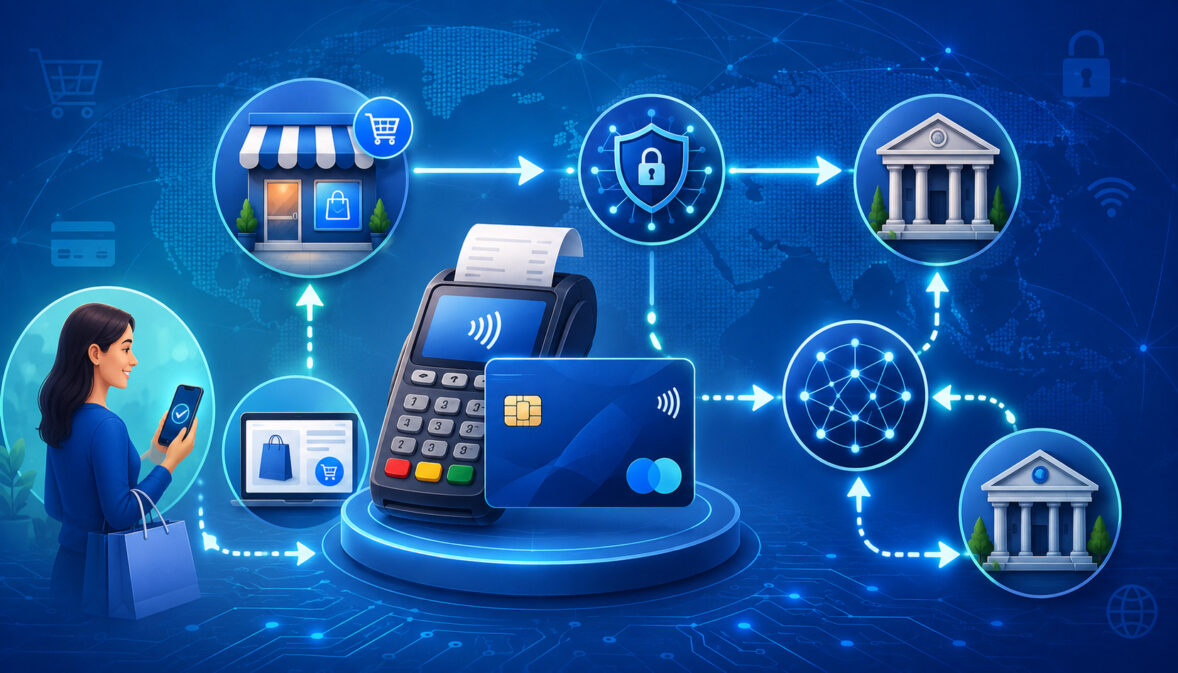
Credit card networks are the communication rails that make card payments possible. When a customer taps a card at a point-of-sale system, enters card details online, uses a digital wallet, or saves a card for recurring billing, a network helps move transaction data between the merchant, payment processor, acquiring bank, issuing bank, and cardholder account.
For business owners, credit card networks can feel invisible because the customer-facing experience is quick. A transaction may appear to be approved in seconds, but behind that approval is a structured system of authorization, clearing, settlement, fraud monitoring, card network rules, and fees.
Understanding that system helps merchants make better decisions about payment acceptance, merchant account setup, ecommerce payments, statement reviews, chargeback prevention, and payment security.
This guide explains how credit card networks work, how they differ from payment processors and banks, why they influence merchant costs, and what businesses should look for when reviewing card payment processing.
It is written for general educational purposes. Payment processing costs, rules, timelines, requirements, and risk decisions can vary by provider, card network, business model, transaction type, and merchant profile.
What Are Credit Card Networks?
Credit card networks are payment networks that connect the different parties involved in credit card transactions. Their job is to help transmit transaction information securely so a card payment can be authorized, cleared, and settled.
They also establish many of the operating rules that govern how cards are accepted, how disputes are handled, how fraud is monitored, and how certain fees are assessed.
In a typical card payment, the card network does not simply “move money” from the customer to the merchant. Instead, it helps route messages between the merchant’s payment environment and the cardholder’s issuing bank. The issuing bank decides whether to approve or decline the transaction based on available credit, account status, fraud risk, card validity, and other factors.
Credit card networks are sometimes called card networks, payment card networks, credit card payment networks, or credit card processing networks. These terms are often used interchangeably, although the exact meaning can vary depending on context.
In merchant services, the key point is that networks provide the rules and technical infrastructure that allow payment cards to work across many merchants, banks, processors, gateways, and transaction environments.
A credit card network may support:
- Card-present transactions at a physical terminal
- Card-not-present transactions through ecommerce checkout
- Contactless payments
- Mobile payments
- Digital wallet transactions
- Recurring billing
- Cross-border transactions
- Refunds and reversals
- Chargebacks and disputes
- Tokenized payment credentials
For merchants, credit card networks matter because they affect acceptance, fees, security expectations, dispute rules, and the way transaction data is routed.
Why Credit Card Networks Matter in Payment Processing
Credit card networks matter because they sit at the center of card payment processing. A merchant may only see a terminal, payment gateway, processor statement, and bank deposit, but the card network is part of the transaction flow that makes those pieces work together.
When a customer presents a card, the merchant needs a reliable way to ask the cardholder’s bank whether the payment should be approved. The credit card network helps carry that authorization request to the issuing bank and returns the response.
Without that payment authorization network, a merchant would not have a standardized way to accept cards issued by thousands of financial institutions.
Credit card networks also influence the rules of payment acceptance. Card network rules can affect how receipts are handled, what information must be captured, how refunds should be processed, when a merchant can surcharge or require minimum purchases where allowed, how disputes move through the system, and what security standards merchants are expected to follow.
They also affect costs. Merchant pricing often includes several layers: interchange fees, assessment fees, network fees, processor markup, gateway fees, monthly fees, chargeback fees, and other transaction fees.
Some of these costs are directly tied to card network fee schedules or network operating rules. Others come from processors, acquiring banks, gateways, software providers, or value-added services.
For a business owner, understanding credit card networks can help answer practical questions:
- Why are rewards cards often more expensive to accept?
- Why do card-not-present transactions usually cost more than card-present transactions?
- Why do some debit card transactions route differently?
- Why do international cards carry added costs?
- Why do certain transactions receive downgrades?
- Why do chargebacks follow structured timelines?
- Why does payment security affect approval rates and liability?
Credit card networks are not the only factor behind these answers, but they are a major part of the ecosystem. Businesses that understand the network layer can ask better questions, read merchant statements more carefully, and build stronger payment operations.
For a broader overview of digital payment methods, this guide to electronic payment systems can help connect card payments with other electronic payment options.
Major Credit Card Networks and How They Differ

The major credit card networks are often grouped together, but they do not all operate in exactly the same way.
Some networks primarily function as open-loop networks, meaning they connect cardholders, merchants, issuing banks, acquiring banks, and processors across a broad acceptance ecosystem. Other networks may operate with more direct involvement in issuing cards or managing cardholder relationships.
The basic purpose is similar: enable card payments between cardholders and merchants. The differences show up in acceptance footprint, fee structures, operating rules, dispute processes, cardholder benefits, fraud tools, debit capabilities, international acceptance, and the way cards are issued.
Some networks are widely used for consumer credit, business credit, debit, prepaid, and commercial card payments. Others may be more prominent in specific merchant categories, customer segments, or transaction environments.
For merchants, the most important question is not simply “Which network is biggest?” It is “Which card types do my customers use, and what does accepting them cost and require?”
Credit Card Networks and Their Role in Payment Processing
| Payment Component | What It Does | Who It Affects | What Merchants Should Know |
| Credit card network | Routes transaction data and sets network operating rules | Merchants, banks, processors, cardholders | Affects acceptance, transaction routing, assessment fees, disputes, and compliance expectations |
| Issuing bank | Provides the cardholder’s card account and approves or declines transactions | Cardholders and merchants | Approval depends on funds or credit, fraud checks, account status, and transaction risk |
| Acquiring bank | Supports the merchant account and receives settlement funds | Merchants | Works with processors to help merchants accept card payments and receive deposits |
| Payment processor | Handles transaction processing between the merchant, acquirer, networks, and issuers | Merchants | Pricing, reporting, integrations, support, and risk controls vary by processor |
| Payment gateway | Securely captures and transmits online payment data | Ecommerce sellers and service providers | Critical for online payments, recurring billing, fraud tools, and tokenization |
| Merchant account | Account structure that allows a business to accept card payments | Merchants | Underwriting, funding timelines, reserves, and pricing depend on business risk and provider terms |
Open-loop credit card payment networks generally connect many issuers and acquirers. This model gives merchants broad access to customers using cards from many banks. Closed-loop or more vertically integrated models may manage more parts of the cardholder and merchant relationship directly.
Debit card networks add another layer. Debit card payments may travel over global card networks or regional debit networks depending on card configuration, transaction method, routing rules, and merchant setup.
Regulation and network routing requirements can affect how certain debit card transactions are routed. The Federal Reserve’s resources on debit card interchange fees and routing are useful for readers who want more technical context.
How Credit Card Networks Work During a Transaction
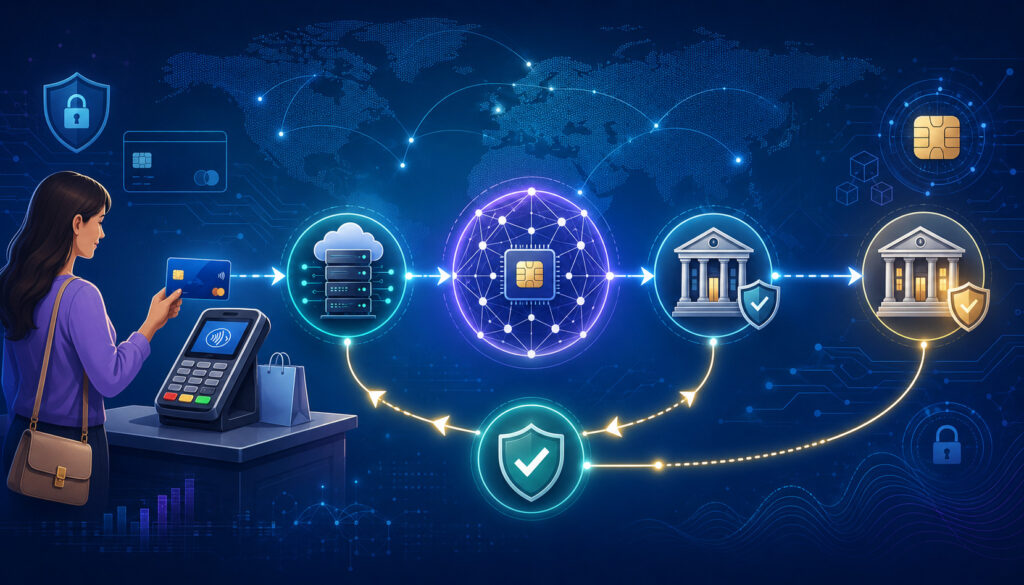
A card transaction looks simple to the customer: insert, tap, swipe, click, or approve through a wallet. Behind the scenes, the payment system checks whether the card is valid, whether the account can support the purchase, whether the transaction looks suspicious, and whether the merchant is allowed to accept that type of payment under the applicable rules.
The process starts at the merchant’s payment acceptance point. In a store, that may be a POS terminal. Online, it may be a payment gateway embedded into an ecommerce checkout. In mobile commerce, it may involve a digital wallet, tokenized card credential, or in-app payment flow.
From there, transaction data moves to the payment processor or gateway, then to the acquiring bank or acquirer-side platform, then through the relevant card network to the issuing bank. The issuer evaluates the request and sends back an approval or decline.
The card network helps return that response through the same ecosystem so the merchant can complete or stop the sale.
A simplified authorization flow looks like this:
- The cardholder initiates a purchase.
- The merchant’s POS system or payment gateway captures transaction data.
- The payment processor formats and sends the authorization request.
- The acquiring side routes the request through the correct card network.
- The issuing bank reviews the request.
- The issuer sends an approval or decline response.
- The response travels back through the network and processor.
- The merchant receives the result and completes or cancels the transaction.
The authorization step does not usually mean the merchant has been paid yet. It means the issuer has approved the transaction and typically placed a hold or confirmed available credit. Actual funding happens later through clearing and settlement.
Key Parties Involved in Credit Card Network Processing

Credit card network processing involves several parties, each with a defined responsibility. Confusion often happens because merchants may have a relationship with only one or two providers, even though several entities are involved behind the scenes.
A business may sign up through a merchant services provider, connect a payment gateway, use a POS system, and receive deposits into a business bank account.
That does not mean all those services are handled by one entity. In many cases, the provider-facing relationship is a bundle of processing, acquiring, gateway, risk, reporting, and support services.
Understanding the key parties helps merchants troubleshoot declined transactions, funding delays, chargebacks, statement questions, and security requirements.
Cardholders
The cardholder is the customer using the payment card. In a credit card transaction, the cardholder is borrowing against a credit line issued by a financial institution. In a debit card transaction, the cardholder is usually paying from a deposit account.
Cardholders influence network processing through the payment method they choose. A rewards credit card, business card, debit card, prepaid card, mobile wallet, or international card can produce different costs and risk signals for the merchant.
The cardholder’s device, location, billing address, card status, and authentication method can also affect fraud screening and authorization approval.
For ecommerce payments, cardholder behavior matters even more. Typing an incorrect billing address, using an expired card, entering the wrong security code, or attempting a purchase from an unusual device may increase decline risk. Clear checkout design and helpful error messaging can reduce avoidable failures.
Merchants
The merchant is the business accepting the card payment. Merchants are responsible for setting up compliant payment acceptance, following card network rules, providing accurate transaction data, issuing refunds properly, responding to disputes, and protecting payment information.
A merchant’s business category, average ticket size, sales channel, refund policy, delivery model, chargeback history, and risk profile can all affect underwriting and pricing. Card-present retail transactions may be treated differently than online payments, subscription billing, travel reservations, or professional services deposits.
Merchants also need to monitor payment reconciliation. This means comparing approved transactions, batch totals, processor reports, deposits, refunds, chargebacks, and fees. Strong reconciliation helps identify missing deposits, unexpected card network fees, duplicate refunds, and reporting errors.
Issuing Banks
The issuing bank provides the payment card to the cardholder. During authorization, the issuer decides whether to approve or decline the transaction. The issuer reviews available credit or funds, account status, fraud signals, merchant category, transaction amount, cardholder behavior, and network data.
Issuers also play a central role in chargebacks. When a cardholder disputes a transaction, the issuer evaluates the claim and may initiate a dispute through the card network. The merchant then responds through the acquiring side with evidence such as receipts, proof of delivery, service agreements, refund policies, or customer communications.
Interchange fees are generally paid to issuing banks as part of the card payment economics. These fees vary by card type, transaction method, industry category, and other factors.
Acquiring Banks
The acquiring bank, sometimes called the acquirer, supports the merchant’s ability to accept card payments. It is connected to the card networks and is responsible for receiving settlement funds on behalf of the merchant. The acquirer may work directly with merchants or through payment processors and merchant services providers.
Acquiring banks also carry risk. If a merchant generates excessive chargebacks, fails to deliver goods, becomes insolvent, or processes fraudulent transactions, the acquiring side may be financially exposed. That is one reason underwriting, reserve requirements, processing limits, and monitoring exist.
Merchants do not always interact directly with the acquiring bank, but the acquirer is still part of the payment chain.
Payment Processors
A payment processor handles the technical processing of card transactions. It connects merchant systems to the acquiring side, card networks, and issuing banks. Processors help format transaction messages, route authorizations, batch transactions, support settlement, generate reports, and apply pricing.
Processors may also provide fraud tools, chargeback portals, virtual terminals, recurring billing features, reporting dashboards, and integrations with POS systems or ecommerce platforms. The processor’s technology and support can strongly affect a merchant’s day-to-day payment experience.
Processor markup is separate from card network fees and interchange fees. Merchants should review statements carefully to understand which fees are passed through and which are processor-level charges.
Payment Gateways
A payment gateway is the technology layer that captures and transmits payment data for online payments. It is especially important for ecommerce sellers, service providers, subscription businesses, invoice payments, and any merchant accepting card-not-present transactions.
A gateway may support hosted checkout pages, embedded payment forms, digital wallets, recurring billing, customer vaults, tokenization, fraud filters, address verification, and transaction reporting. It helps protect sensitive payment data and connects the online checkout experience to the processor.
For more background on gateway functionality, see this guide on what payment gateways are and how they work.
Authorization, Clearing, and Settlement Explained
Card payment processing is commonly described in three stages: authorization, clearing, and settlement. These stages work together, but they are not the same. Knowing the difference helps merchants understand why a sale can be approved instantly but deposited later.
Authorization is the real-time approval request. Clearing is the exchange of finalized transaction details. Settlement is the movement of funds so the merchant can be paid. Each stage relies on accurate transaction data, proper routing, and the rules of the relevant card networks.
Authorization Requests
Authorization begins when the customer presents a payment credential. In a physical store, that credential may come from a chip card, contactless card, or mobile wallet. Online, it may come from card details entered into a checkout form or a stored token used for recurring billing.
The authorization request includes transaction details such as card information, merchant identification, transaction amount, merchant category, currency, terminal or gateway data, and security values. The request moves through the processor and card network to the issuing bank.
The issuer then decides whether to approve or decline. Approval means the transaction can proceed. A decline can happen for many reasons, including insufficient available credit, suspected fraud, expired card, incorrect card data, account restrictions, or issuer risk controls.
Merchants should track decline codes, but they should also understand that not all decline codes provide complete detail. Some are intentionally general to protect cardholder security.
Clearing Process
Clearing happens after authorization, usually when the merchant closes a batch or when the processor submits captured transactions for completion. During clearing, the final transaction data is prepared so the issuer, acquirer, and card network can calculate the amounts owed.
Clearing data may include the final purchase amount, merchant category, authorization reference, transaction date, card type, and other details needed for interchange qualification. If data is incomplete or submitted late, the transaction may downgrade to a more expensive category depending on the applicable rules.
This is where operational discipline matters. Accurate sales data, timely batch submission, proper tax and invoice fields where required, and correct transaction classification can all affect costs and reporting.
Settlement Process
Settlement is the funding stage. The issuing bank sends funds through the network and acquiring side, and the merchant receives the net amount after applicable fees, adjustments, refunds, chargebacks, or reserves.
The settlement timeline can vary. Some merchants receive deposits quickly, while others may experience longer timelines depending on provider terms, batch timing, bank holidays, risk review, transaction type, or funding settings. Cross-border transactions and high-risk business models may involve additional review or delays.
Payment reconciliation should compare the merchant’s expected sales with actual deposits. Because processing fees may be deducted daily, monthly, or per transaction depending on pricing structure, merchants should understand how their provider handles fee billing.
Credit Card Network Fees and Merchant Costs
Credit card networks influence merchant costs through network assessment fees, transaction rules, international fees, routing options, and interchange structures. However, the total cost of credit card processing includes more than network fees alone.
A merchant’s processing cost may include:
- Interchange fees
- Assessment fees
- Card network fees
- Processor markup
- Payment gateway fees
- Monthly account fees
- PCI compliance fees
- Chargeback fees
- Batch fees
- Cross-border fees
- Authorization fees
- Voice authorization fees
- Address verification fees
- Tokenization or account updater fees
- Equipment or software fees
The total cost can vary by card type, transaction method, pricing model, business category, processor terms, risk profile, and whether the transaction is card-present or card-not-present.
Interchange Fees
Credit card interchange is usually the largest component of card acceptance cost. Interchange fees are generally paid to the issuing bank and are based on detailed categories.
A transaction’s interchange category may depend on card type, merchant category, transaction method, data quality, authorization and settlement timing, and whether the card is consumer, business, rewards, debit, prepaid, or international.
A card-present transaction with a chip or contactless credential often has different risk characteristics than a manually entered online payment. Because card-not-present transactions carry higher fraud risk, they often have higher interchange costs.
Merchants cannot usually negotiate interchange directly with the issuing bank. However, they can reduce avoidable downgrades by submitting complete data, using secure acceptance methods, settling promptly, and choosing payment tools that support the right transaction fields.
Assessment Fees and Network Fees
Assessment fees are card network fees that are usually charged based on transaction volume or count. Network assessment fees may appear on a merchant statement as separate line items or may be bundled into a broader rate, depending on pricing structure.
Card network fees can include costs related to authorization, settlement, cross-border activity, digital enablement, account verification, dispute processing, or other network services. The names and amounts can vary by network, transaction type, and provider presentation.
Merchants should not assume every unfamiliar fee is improper. At the same time, they should not ignore fee details. A good statement review separates pass-through costs from processor markup and identifies unusual increases, duplicate charges, or avoidable fees.
Cross-Border Transactions and Foreign Transaction Fees
Cross-border transactions occur when the cardholder, merchant, issuing bank, acquiring bank, or transaction currency involves different jurisdictions. These transactions may carry added network fees, currency conversion costs, foreign transaction fees to the cardholder, or higher fraud scrutiny.
For ecommerce merchants, cross-border activity can happen even when the business does not actively market internationally. A customer may use an internationally issued card, ship to a freight forwarder, or purchase while traveling. These transactions can increase acceptance costs and fraud risk.
Merchants that accept international payments should use strong fraud prevention, clear billing descriptors, transparent shipping policies, and currency settings that match customer expectations.
Debit Card Networks
Debit card networks operate alongside credit card networks but have different economics and routing considerations.
Some debit transactions can be routed over more than one unaffiliated network, depending on card configuration, transaction type, terminal setup, and regulatory requirements. The official text of Regulation II provides technical detail on debit card interchange and routing rules.
Debit card payments can be PIN debit, signature debit, card-present, card-not-present, contactless, or wallet-based. Each form may carry different costs and routing options. Merchants with significant debit volume should ask their processor how debit routing is configured and whether routing choices are visible in reporting.
Credit Card Networks vs Payment Processors
Credit card networks and payment processors are closely connected, but they are not the same. The network provides the card payment rails, routing standards, brand rules, security requirements, and dispute framework. The processor provides the merchant-facing technology and operational connection that allows transactions to move through those rails.
A payment processor may connect the merchant’s POS system, gateway, or virtual terminal to the acquiring bank and card networks. The processor may also provide reporting, pricing, customer support, risk monitoring, chargeback tools, settlement files, and integrations with accounting or ecommerce systems.
The distinction matters because merchants often call their processor when they have a question about a fee, decline, chargeback, deposit, or rule. The processor may be able to explain the issue, but the root cause may come from network rules, issuer decisions, gateway settings, merchant account underwriting, or transaction data quality.
For example, a merchant may ask why an online transaction cost more than an in-person transaction. The processor may explain that card-not-present transactions typically carry higher risk and may qualify under different interchange categories. That cost difference is influenced by network and interchange rules, not simply processor preference.
Similarly, a merchant may ask why a transaction was declined. The processor can show the response code, but the issuing bank generally makes the final approval decision. The card network carried the message, and the processor transmitted it, but the issuer evaluated the cardholder account and risk signals.
Here is a practical way to separate the roles:
- Credit card network: Sets network rules and routes transaction messages.
- Payment processor: Moves merchant transaction data through the processing system.
- Issuing bank: Approves or declines the cardholder’s transaction.
- Acquiring bank: Supports the merchant’s acceptance and settlement.
- Gateway: Captures and secures online payment data.
- Merchant account: Enables the merchant to accept card payments and receive funds.
Credit Card Networks vs Issuing and Acquiring Banks
Credit card networks connect banks and merchants, but they are not the same as issuing or acquiring banks. The issuing bank has the cardholder relationship. The acquiring bank has the merchant acceptance relationship. The card network connects the two sides so transaction data can move through a common set of rules and standards.
The issuing bank approves or declines transactions. It also bills the cardholder, manages credit lines, handles cardholder rewards, monitors account-level fraud, and responds to billing disputes. If a customer says a transaction was unauthorized, not received, or not as described, the issuer may initiate a dispute under applicable rules.
The acquiring bank supports the merchant side of the transaction. It receives settlement funds, manages risk exposure, and works with processors to support payment acceptance.
If a merchant has unusually high chargebacks, suspicious processing patterns, or financial instability, the acquiring side may require reserves, hold funds, request documentation, or terminate processing.
The card network provides the connection and rulebook. It does not usually decide whether a specific cardholder has enough credit for a purchase. That is the issuer’s role. It does not usually underwrite the merchant relationship directly in the same way an acquirer or processor does. But the network’s standards affect both sides.
For merchants, this distinction is useful when troubleshooting:
- Declined transaction? Often issuer decision.
- Deposit delay? Often processor, acquirer, bank, or risk review issue.
- Fee line item? Could be interchange, network fee, processor markup, or gateway fee.
- Chargeback? Involves issuer, acquirer, merchant, processor, and network rules.
- PCI validation? Involves merchant, provider, and security standards.
- Card acceptance rule? Often governed by card network requirements and merchant agreement terms.
A merchant account sits within this broader structure. It is not just a bank account. It is an arrangement that allows the business to accept card payments under underwriting, settlement, compliance, and risk rules.
Security, Fraud Prevention, and Card Network Rules
Credit card networks are deeply involved in payment security. They help define acceptance rules, data requirements, fraud monitoring programs, dispute rights, and compliance expectations.
They also support technologies that help reduce fraud, such as EMV chip acceptance, tokenization, contactless credentials, digital wallet security, address verification, and authentication tools.
Payment security is not only a technology issue. It is also an operational issue. Merchants need secure systems, trained staff, documented procedures, and clean transaction records. A strong security posture can reduce fraud exposure, improve customer trust, and make disputes easier to respond to.
The PCI Security Standards Council develops payment security standards and resources for safe card payments. Its merchant resources can help businesses understand data security basics such as secure remote access, patching, strong passwords, and protecting payment data.
Fraud Monitoring
Fraud monitoring happens at several levels. Issuers monitor cardholder accounts. Processors and gateways monitor merchant transaction patterns.
Merchants monitor orders, refunds, login attempts, shipping behavior, and customer communication. Card networks monitor ecosystem-level risk and may apply programs or rules for excessive fraud or chargeback activity.
Common fraud indicators include unusual order size, mismatched billing and shipping details, repeated declined attempts, high-velocity transactions, suspicious IP locations, freight-forwarding addresses, and inconsistent customer behavior.
Fraud prevention should be balanced. Overly strict controls may block legitimate customers, while loose controls may increase chargebacks. The best approach is risk-based: apply stronger verification to higher-risk transactions while keeping routine transactions smooth.
Tokenization
Tokenization replaces sensitive card data with a substitute value called a token. This helps reduce exposure because the token is not the actual card number. Tokens are commonly used in digital wallets, recurring billing, customer vaults, and ecommerce payment systems.
For merchants, tokenization can support safer stored payments. Instead of keeping raw card data, a merchant may store a token through a compliant gateway or processor. This can reduce risk and simplify repeat purchases, subscriptions, memberships, and invoicing.
Tokenization does not eliminate all responsibility. Merchants still need secure systems, proper access controls, vendor management, and PCI compliance practices. But it can significantly reduce the amount of sensitive payment data the merchant directly handles.
PCI Compliance
PCI compliance refers to meeting payment card data security standards that apply to organizations that store, process, or transmit cardholder data. Requirements can vary depending on payment environment, transaction volume, provider setup, and how card data is handled.
A small business using a hosted payment page may have a different compliance scope than a merchant storing card data in its own environment. A restaurant using modern terminals may have a different risk profile than an ecommerce platform with custom checkout code.
Merchants should work with their processor, gateway, and security professionals to understand their responsibilities. This guide to PCI DSS compliance provides additional background on protecting cardholder data.
Contactless Payments and Digital Wallets
Contactless payments and digital wallets use technologies that can improve speed and security. A cardholder may tap a physical card, use a mobile wallet, or approve a payment with biometric authentication. These transactions often rely on tokenized credentials rather than exposing the original card number during payment.
For merchants, contactless and wallet acceptance can improve checkout convenience. It can also reduce friction for mobile payments, in-app purchases, and online payments. However, merchants should still review wallet transaction costs, device compatibility, chargeback rules, and reporting visibility.
Multi-factor authentication can also play an important role in securing payment accounts, administrative portals, and high-risk payment actions. For more detail, see this article on multi-factor authentication and payment security.
Chargebacks, Disputes, and Network Guidelines
Chargebacks are one of the clearest examples of how card network rules affect merchants. A chargeback is a transaction reversal initiated through the cardholder’s issuing bank. It may involve claims such as unauthorized use, goods not received, duplicate billing, credit not processed, canceled recurring billing, or product not as described.
The chargeback process involves the cardholder, issuer, card network, acquirer, processor, and merchant. The card network provides the dispute framework, reason codes, evidence requirements, deadlines, and process flow. The issuer and acquirer exchange information through that framework.
Merchants should not view chargebacks only as a cost problem. They are also a signal. A chargeback may reveal fraud, unclear billing descriptors, poor delivery documentation, confusing refund policies, weak customer communication, subscription cancellation friction, or product expectation gaps.
Chargeback Rules
Chargeback rules vary by network, transaction type, reason code, and evidence category. A merchant may need to provide proof of authorization, delivery confirmation, signed agreements, refund policies, customer communications, digital usage logs, cancellation records, or proof that the cardholder participated in the transaction.
Time matters. Dispute response windows can be short, and missing a deadline may result in losing representment rights. Merchants should have a clear internal process for reviewing chargeback notices and gathering evidence quickly.
Businesses should also pay attention to pre-dispute alerts or inquiry tools if available through their provider. In some cases, resolving a customer issue before it becomes a chargeback may reduce fees and operational burden.
Refunds and Disputes
Refund handling can affect chargebacks. If a customer requests a refund and the merchant delays or processes it outside the original payment method, confusion can lead to disputes. Refund policies should be clear before purchase, easy to find, and consistently followed.
For online payments, merchants should send confirmation emails, provide tracking numbers, maintain customer support records, and use billing descriptors customers can recognize. A cardholder who does not recognize a charge is more likely to contact the issuer rather than the merchant.
Disputes are also affected by consumer protection rules. The Office of the Comptroller of the Currency’s consumer resource explains that banks must investigate certain credit card billing errors within defined timeframes after receiving a billing error notice.
Merchants should understand that cardholder dispute rights exist alongside card network rules and processor procedures.
How Businesses Can Better Understand Card Network Costs
Card network costs can be difficult to read because merchant statements vary widely. Some statements show detailed interchange, assessment fees, network fees, processor markup, and transaction counts. Others bundle costs into simplified rates. Neither format is automatically good or bad, but merchants need enough visibility to understand what they are paying.
Start by identifying your pricing model. Common models include interchange-plus, flat-rate, tiered, subscription, and blended pricing. Interchange-plus statements often show pass-through interchange and assessment fees separately from processor markup.
Flat-rate pricing may be easier to read but less transparent about the underlying cost components. Tiered pricing groups transactions into categories, which can make it harder to see why specific transactions cost more.
Next, compare transaction types. Card-present, card-not-present, keyed, ecommerce, mobile wallet, international, rewards, commercial, debit, and prepaid transactions can all price differently. A merchant with mostly online payments should expect a different cost profile than a retail store with chip and tap transactions.
Review these areas on your statement:
- Total processing volume
- Number of transactions
- Average ticket size
- Effective rate
- Interchange fees
- Assessment fees
- Network assessment fees
- Authorization and transaction fees
- Processor markup
- Gateway fees
- Chargeback fees
- Monthly or annual account fees
- PCI-related fees
- Cross-border and currency fees
- Downgraded transaction categories
- Refund fees
- Debit routing details
Checklist: Questions to Ask About Card Network Fees and Rules
Use this checklist when reviewing merchant statements or speaking with a payment processor:
- Which fees are interchange, assessment, card network fees, and processor markup?
- Are card network fees passed through at cost or marked up?
- How are debit card networks and transaction routing handled?
- Do card-present and card-not-present transactions price differently?
- Are international cards or cross-border transactions clearly identified?
- Are digital wallet transactions reported separately?
- What causes interchange downgrades for my business?
- How quickly must batches be settled to avoid higher costs?
- Are address verification, tokenization, and account updater fees separate?
- How are chargeback fees, retrieval fees, and dispute tools billed?
- Are refunds charged the same way as sales?
- Does the gateway support tokenization and fraud rules?
- What reporting helps reconcile deposits to transactions?
- Which card network rules most affect my industry?
- What security requirements apply to my payment environment?
- What happens if chargeback ratios or fraud ratios increase?
Practical Example
Consider an ecommerce retailer with a higher-than-expected effective rate. The owner reviews the statement and sees a mix of rewards cards, card-not-present transactions, address verification fees, gateway charges, and cross-border fees from international buyers.
The issue is not one single “credit card network fee.” It is the combined effect of card type, online risk, gateway usage, transaction geography, and processor pricing.
Now consider a local retailer with many low-ticket debit transactions. A small per-transaction authorization fee may matter more than a percentage rate because transaction count is high. Debit routing and terminal configuration may also influence costs.
A service provider that stores cards for recurring billing faces a different issue. Expired cards, declined renewals, chargebacks after cancellation, and unclear authorization records can create avoidable costs. Tokenization, account updater tools, clear recurring billing consent, and better reminder emails may help improve operations.
What are credit card networks?
Credit card networks are payment networks that connect merchants, issuing banks, acquiring banks, payment processors, and cardholders so card transactions can be authorized, cleared, and settled. They also set many card network rules for acceptance, security, disputes, fees, and transaction processing.
How do credit card networks work?
When a customer makes a card payment, the merchant’s payment system sends an authorization request through the processor and the relevant card network to the issuing bank.
The issuing bank approves or declines the transaction, and the response travels back through the network. Later, the transaction goes through clearing and settlement so funds can be transferred to the merchant.
What is the difference between a credit card network and a payment processor?
A credit card network provides the rules and infrastructure that route card transaction messages between banks and payment participants.
A payment processor provides the merchant-facing technology and processing services that help a business accept card payments. The network is the rail system; the processor helps the merchant access and use that system.
What are the major credit card networks?
The major credit card networks are the widely accepted card payment brands that support credit card transactions across merchants, banks, processors, and cardholders.
They differ in acceptance models, fee structures, dispute processes, card products, debit capabilities, and international reach. Merchants should evaluate which networks their customers use and how each affects cost, acceptance, and operations.
Do credit card networks set processing fees?
Credit card networks influence costs through interchange categories, assessment fees, network fees, cross-border fees, and operating rules.
However, a merchant’s total processing cost also includes processor markup, gateway fees, merchant account fees, software fees, chargeback fees, and other provider-level charges. Total costs vary by business type, transaction method, card type, risk profile, and pricing model.
How do credit card networks affect chargebacks?
Credit card networks provide the framework for chargebacks, including reason codes, evidence requirements, dispute timelines, and process rules.
The cardholder usually starts the dispute through the issuing bank, while the merchant responds through the processor or acquiring side. Good documentation, clear policies, and timely responses can improve a merchant’s ability to manage disputes, but outcomes are not guaranteed.
Why do merchants need to understand card network rules?
Merchants need to understand card network rules because those rules can affect transaction approval, refunds, fraud prevention, chargebacks, dispute timelines, security practices, surcharging requirements where applicable, and acceptance standards. A lack of awareness can lead to avoidable fees, operational friction, customer confusion, or compliance problems.
How can businesses review card network fees on merchant statements?
Businesses can review card network fees by separating interchange, assessment fees, card network fees, processor markup, gateway fees, and other charges. They should compare costs by transaction type, card type, sales channel, and ticket size.
If a statement is unclear, the merchant should ask the processor to explain each fee category and identify which costs are pass-through versus processor-controlled.
Conclusion
Credit card networks are a core part of modern card payment processing. They connect merchants, cardholders, issuing banks, acquiring banks, payment processors, and payment gateways so credit card payments and debit card payments can move through authorization, clearing, and settlement.
For merchants, understanding credit card networks is not just a technical exercise. It helps explain why fees vary, why online payments often cost more than in-person transactions, why debit routing matters, why chargebacks follow structured rules, why payment security is essential, and why transaction data quality affects both approvals and costs.
The most important takeaway is that card processing cost is layered. Credit card network fees, interchange fees, assessment fees, processor markup, gateway charges, cross-border costs, fraud tools, and chargeback expenses can all contribute to the final amount a business pays. No single fee tells the whole story.
Businesses can make better decisions by reviewing statements regularly, asking specific questions, improving payment security, using the right gateway and POS tools, reducing avoidable declines, documenting transactions carefully, and staying aware of card network rules that affect their industry.
Credit card networks may operate behind the scenes, but their impact is visible in every approved sale, declined transaction, settlement deposit, refund, chargeback, and monthly statement. A merchant that understands the network layer is better prepared to manage payment acceptance with clarity, confidence, and stronger financial control.