
Businesses need payment methods that match how they sell, invoice, collect, and pay. Cards are useful for quick checkout, checks remain familiar in some industries, and wire transfers can serve urgent transactions.
Yet many organizations also need an efficient way to move money directly between bank accounts for recurring bills, customer invoices, payroll, vendor payments, rent, and higher-value transactions.
Automated Clearing House payments meet that need through electronic bank-to-bank payments. They can support incoming collections through ACH debits and outgoing transfers through ACH credits.
The benefits of ACH payments for businesses may include lower processing costs, more predictable expenses, less check handling, easier recurring billing, and better payment reconciliation.
Those advantages depend on sound implementation. ACH payments are not always immediate, may be returned, and require accurate bank details, appropriate authorization, secure systems, and clear operational procedures.
This guide explains how ACH payment processing works, when it is useful, what limitations to consider, and how to introduce it responsibly.
What ACH Payments Are and How ACH Processing Works
An ACH payment is an electronic funds transfer between bank accounts through the Automated Clearing House network. The network is batch oriented, meaning participating financial institutions exchange groups of payment entries through scheduled processing and settlement windows.
The official explanation of how ACH transfers work describes credits and debits moving between an originating bank and a receiving bank.
The originating bank is the financial institution that sends the entry into the network. The receiving bank is the institution that receives it for the account being credited or debited.
A payment gateway, bank portal, invoicing platform, payroll system, or processor may provide the business-facing interface, but the underlying payment is still an account-to-account transfer.
ACH is sometimes described as direct debit, direct deposit, electronic bank transfer, electronic funds transfer, or e-check. Those terms may describe different customer experiences, but they commonly rely on the same network.
ACH Credit Payments and ACH Debit Payments
An ACH credit is pushed by the sender. A business may use ACH credits for payroll, contractor compensation, supplier payments, employee reimbursements, customer refunds, partner distributions, or transfers between authorized business accounts. The sender approves the destination, amount, and payment date.
An ACH debit is pulled by a payee after the account holder provides permission. ACH debit payments are common for subscriptions, memberships, rent, tuition, insurance-style billing, professional retainers, installment plans, service agreements, and invoice payments.
A one-time authorization should not be treated as open-ended recurring consent, and recurring terms should clearly explain the schedule and cancellation process. This guide to ACH authorization requirements explains the operational records businesses should maintain.
Credits and debits also present different risks. A debit requires strong customer authorization and return management. A credit requires verified recipient details and controls against fraudulent bank-account changes. Businesses should identify the entry type in each workflow so employees apply the right approval, security, and accounting procedures.
The ACH Transaction Life Cycle
A complete ACH transaction normally includes the following stages:
- Authorization: The customer authorizes a debit, or an approved business user authorizes an outgoing credit.
- Data collection: The system records bank details, payment amount, effective date, customer or vendor reference, and authorization information.
- Submission: The business sends the transaction through its bank, processor, gateway, or connected platform.
- Batch processing: Transactions are grouped and transmitted according to applicable processing windows.
- Clearing and settlement: The originating and receiving institutions exchange payment information and settle their positions.
- Posting and funding: The entry is applied to the receiving account, while the business records the incoming or outgoing funds.
- Reconciliation: Bank activity, processor reports, invoices, fees, returns, and accounting records are matched.
- Return or correction: A failed, invalid, unauthorized, or erroneous entry may require follow-up.
Timing varies by submission cutoff, banking schedule, standard or same-day ACH eligibility, weekends, holidays, verification, and risk review. An official ACH processing schedule shows that settlement follows defined windows rather than a universal instant timeline.
A status such as “submitted” does not always mean that funds are final or available. Businesses should distinguish among authorized, submitted, settled, and usable funds. That distinction is especially important before releasing high-value goods, activating irreversible services, or closing an invoice that may later be returned.
Benefits of ACH Payments for Businesses
The advantages of ACH payments are strongest when the method matches the transaction. ACH is particularly useful for payments that are recurring, invoice based, predictable, or high in value. It can also reduce administrative work when connected to accounting, billing, payroll, or property-management systems.
Benefits of ACH Payments for Businesses
| ACH benefit | How it may help a business | Best-suited use case | Important consideration |
| Lower processing costs | May cost less than percentage-based methods | Invoices, rent, tuition, retainers, higher-value sales | Pricing varies by provider, volume, and risk |
| Predictable expense structure | Flat or capped pricing may simplify forecasting | Subscription billing and frequent bank transfers | Include monthly, verification, and return fees |
| Recurring billing | Supports scheduled collections without repeated data entry | Memberships, services, installment plans | Clear authorization and cancellation are essential |
| Reduced check handling | Cuts printing, mailing, deposits, and manual entry | Accounts receivable and vendor payments | Accurate bank details are still required |
| Cash-flow visibility | Scheduled submissions improve payment tracking | Rent, invoice batches, and regular billing | ACH is not always immediate |
| Higher-value payment support | May avoid costs that increase with transaction value | Business invoices and wholesale orders | Limits and risk controls may apply |
| Automation | Connects billing, accounting, payroll, and portals | High-volume or recurring operations | Configuration errors can repeat quickly |
| Simpler reconciliation | References can match payments to invoices and bills | Accounts receivable and accounts payable | Integrations and exception handling need testing |
No benefit applies equally to every company. A retailer focused on immediate in-person checkout may rely mainly on cards and wallets. A professional firm collecting large monthly invoices may gain more value from online ACH payments. Many businesses achieve the best result by offering ACH alongside other payment methods.
Lower Costs, Predictable Expenses, and Better Cash Flow

One of the best-known ACH payment benefits is the potential for lower payment processing costs. ACH pricing is often based on a flat fee, tiered fee, or capped amount rather than a percentage of the transaction. That structure can be attractive for rent, tuition, recurring services, professional invoices, wholesale orders, and other higher-value payments.
No fee should be treated as universal. A business may pay transaction fees, monthly platform charges, account-verification fees, same-day fees, gateway fees, return fees, setup costs, or minimum commitments.
Actual pricing depends on the provider, bank arrangement, transaction type, volume, return risk, and integration. This overview of ACH processing costs can help finance teams identify charges that belong in a complete comparison.
Why Predictable Processing Expenses Matter
Predictable payment expenses make budgeting easier because a finance team may be able to estimate cost from transaction volume and service fees rather than applying a percentage to every sale.
This can help subscription businesses, schools, property managers, professional firms, and business-to-business sellers forecast collection costs more consistently.
Consider a consulting practice that collects fixed monthly retainers. Percentage-based pricing causes the payment expense to rise with each retainer amount. Flat or capped business ACH payments may create a more stable cost pattern.
The practice must still include verification, returns, software fees, and internal labor, but its routine processing expense may be easier to model.
A proper comparison should include the total cost of acceptance. Review standard and same-day processing, refunds, returns, bank verification, contract terms, monthly minimums, accounting integrations, and employee time.
A low transaction fee does not create a saving when staff spend hours correcting unmatched deposits or repeatedly contacting customers about failed payments.
How ACH May Improve Cash-Flow Management
Electronic bank payments can reduce dependence on mailed checks, office deposits, and loosely scheduled invoice payments. A business can send an invoice with an ACH option, schedule an authorized debit, or collect recurring payments on a consistent billing date. Staff can see which transactions are scheduled, submitted, settled, returned, or overdue.
Scheduled billing does not guarantee immediate cash. Submission cutoffs, banking calendars, risk holds, and returns still affect availability. However, better visibility can improve forecasting because the business has structured payment dates and electronic records rather than waiting for checks to arrive.
Automated reminders and reconciliation also support accounts receivable. When payment records carry the customer ID and invoice number, the accounting system can update balances with less manual entry. Exceptions can be routed to staff for review instead of requiring employees to inspect every payment.
Recurring Billing, Customer Convenience, and Accounts Receivable

ACH works particularly well where a customer and business have an ongoing billing relationship. The customer can authorize payments from a bank account, and the business can schedule collections according to agreed terms. This reduces repeated payment entry and may make revenue more predictable.
Customers also gain convenience. They can pay from a bank account without mailing a check or entering card details for every invoice. Secure payment links, online invoices, account portals, confirmations, and recognizable billing descriptions can make the experience easier to understand.
Convenient Recurring ACH Payments
Recurring ACH payments are commonly used for memberships, subscriptions, rent, tuition, insurance premiums, utility-style billing, professional retainers, loan repayments, service agreements, and installment plans. The business collects authorization once and submits future debits according to the stated schedule.
The authorization should explain whether the payment is fixed or variable, when billing starts, how often it occurs, how the amount is calculated, how notices are delivered, how the customer can update a bank account, and how cancellation works.
For consumer accounts, preauthorized electronic fund transfers generally require a written or similarly authenticated authorization, and a copy must be provided to the consumer under electronic payment authorization rules.
Good recurring billing also includes reminders, confirmation messages, cancellation records, and failed-payment procedures. A business should stop future debits promptly after valid revocation and should not hide recurring terms inside unrelated text.
Easier Invoice Collection and Fewer Card-Expiration Problems
Online ACH payments can improve accounts receivable by linking each payment to an invoice, customer, service period, and amount. A customer can approve a one-time debit through an online invoice or schedule installments for a larger balance. The business receives a payment reference and can track the transaction through settlement or return.
ACH may also reduce failures caused specifically by expired, replaced, or reissued cards because bank accounts do not have card expiration dates. This can lower involuntary interruption for subscriptions and memberships.
The advantage has limits. Bank accounts can be closed, frozen, restricted, or moved. Customers may enter incorrect details, revoke authorization, place a stop payment, or lack sufficient funds. Businesses still need account-update tools, secure verification, return monitoring, and alternative payment options.
Reduced check handling is another operational benefit. ACH can eliminate printing, mailing, opening envelopes, preparing deposits, and manually entering check data. Yet it does not eliminate administrative work entirely; inaccurate bank details and returned transactions still require attention.
Higher-Value Payments, Accounts Payable, and Automation
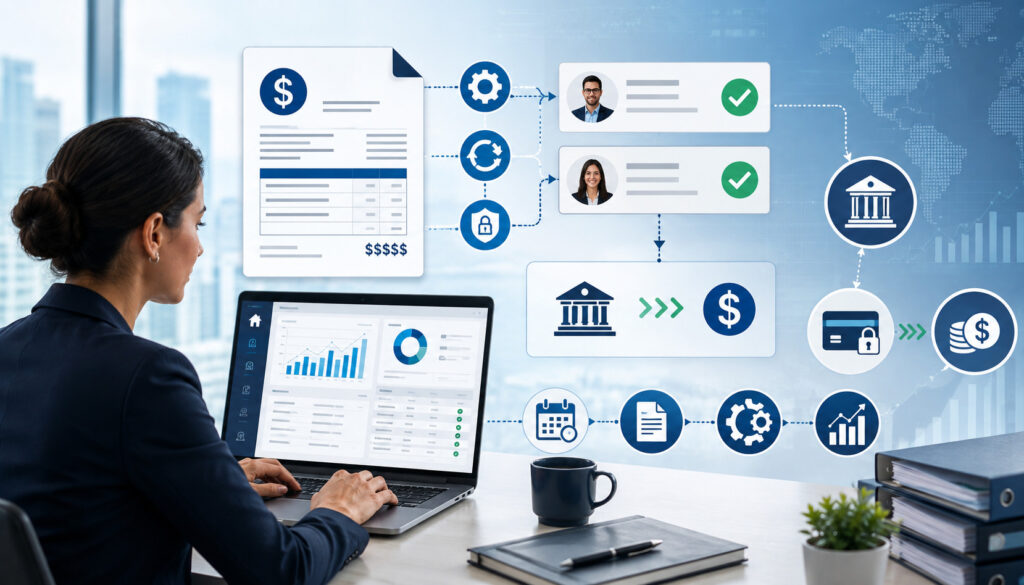
ACH may be useful when percentage-based card fees become significant. Business-to-business invoices, professional services, rent, tuition, wholesale orders, equipment deposits, and recurring retainers often involve amounts for which a flat or capped bank-transfer cost is attractive.
Higher value does not automatically mean lower risk. Providers and financial institutions may apply per-transaction, daily, or monthly limits. New accounts, unusual amounts, or first-time customers may receive stronger verification or delayed availability. The payment method should be matched to the business’s fulfillment and risk tolerance.
Support for Business Invoices, Vendors, and Payroll
A wholesaler may let established customers pay invoices by ACH debit or customer-initiated ACH credit. A professional firm may accept ACH payments from customers for retainers. A property manager may collect rent while preserving tenant and invoice references. Structured data makes it easier to apply funds correctly.
ACH credits can also support payroll, contractor payments, reimbursements, supplier invoices, and other outgoing transactions. A finance team can schedule payment batches, route them through approval, and reconcile each transfer to a bill or payroll record.
Outgoing credits require strong recipient verification. Fraudsters may impersonate a vendor, contractor, or employee and request a bank-account change.
Staff should confirm changes through trusted contact information already on file rather than relying on the contact details supplied in the request. New or high-value recipients may justify dual approval and lower initial limits.
How ACH Payments Support Automation
ACH may integrate with accounting software, invoicing systems, subscription platforms, customer portals, property-management software, payroll systems, accounts payable tools, and accounts receivable platforms.
A connected workflow can generate an invoice, collect authorization, submit the transaction, record settlement, and update the customer balance.
Automation reduces repeated data entry but can repeat mistakes quickly. A misconfigured billing schedule may create duplicate payments. An incorrect field mapping may apply funds to the wrong invoice. Excessive permissions may allow one employee to change bank details and approve a payment without review.
Before launch, test successful payments, invalid accounts, returns, refunds, cancellations, duplicate prevention, holidays, cutoffs, and accounting entries. Define which system is the source of truth when the bank, gateway, and accounting platform show different statuses.
Routine activity can be automated, while unusual amounts, new bank accounts, repeated failures, and refunds to different accounts should trigger human review.
ACH Payment Security and Authorization Responsibilities
ACH payment security depends on technical controls, operational procedures, authorization records, and employee behavior. The network does not make a transaction fraud-proof.
Bank information can be stolen, debit authorization can be disputed, employee credentials can be compromised, and outgoing credits can be redirected through impersonation or business email compromise.
Businesses should protect the entire payment life cycle, including data collection, storage, access, authorization, approval, submission, settlement, refunds, returns, and record retention. The practical guide to ACH payment security best practices provides a broader operational checklist.
Protecting Bank Data and Payment-System Access
Bank details should be collected through secure payment forms, authenticated portals, or controlled onboarding tools. Ordinary email, text messages, shared spreadsheets, and open folders create unnecessary exposure. Full account numbers should be masked when employees do not need to view them.
Encryption can protect data in transit and storage. Tokenization replaces sensitive account information with a reusable reference, allowing recurring billing without displaying the full bank account number in routine workflows.
Businesses should also limit data retention so unnecessary copies do not remain in inboxes, reports, scanned forms, or old spreadsheets.
Multifactor authentication should protect payment dashboards, bank portals, email, accounting tools, payroll systems, and administrator accounts. Official cybersecurity guidance recommends MFA because a stolen password alone may not be enough to enter the account.
Role-based access should define who can view, create, approve, refund, export, or edit payment information. Unique logins and audit logs improve accountability. For sensitive credits or bank-account changes, dual control separates payment entry from final approval.
Obtaining and Managing Customer Authorization
A business should not initiate an ACH debit simply because it possesses bank details. The authorization should match the transaction type and explain the parties, amount or calculation method, one-time or recurring nature, payment date or frequency, and cancellation procedure.
Online consent should be clearly presented as authorization rather than hidden inside unrelated terms. For recurring billing, the customer should understand the start date, frequency, variable-payment treatment, notice method, account-update process, and revocation procedure. The business should provide confirmation and keep a searchable record.
Authorization records may include signed forms, timestamped web consent, portal logs, recurring agreements, confirmation messages, and cancellation history. The exact requirements can depend on the account type, collection channel, transaction classification, network rules, and the agreement with the originating financial institution or processor.
When amounts or schedules change, determine whether new authorization or advance notice is needed. Applicable rules may require notice for variable recurring transfers. This article is educational and is not legal, banking, accounting, or compliance advice; businesses should verify requirements for their specific arrangement.
Fraud Prevention in Daily Operations
Practical fraud controls include bank-account verification, transaction monitoring, payment limits, approval thresholds, secure customer portals, staff training, and callback verification for account changes. Employees should be trained to question urgent messages that ask them to bypass normal approval.
Monitoring should flag unusual amounts, new recipients, frequent account changes, repeated failed verification, abnormal logins, and return patterns. Bank-account verification may reduce errors and some fraud, but it cannot guarantee future payment success.
Data access should be removed promptly when employees change roles or leave. Businesses should also maintain an incident-response process for compromised accounts, misdirected credits, stolen credentials, or exposed bank information.
The procedure should identify who contacts the financial institution, preserves logs, pauses payment activity, informs affected parties, and approves recovery steps.
ACH Returns, Failed Payments, and Reconciliation
An ACH return occurs when an entry cannot be completed or is sent back through the network. Common causes include insufficient funds, a closed or restricted account, incorrect routing or account information, an unauthorized transaction, revoked authorization, a stop-payment request, or a processing error.
Returns are not identical to card chargebacks. They use network return codes and time frames that vary by reason, account type, and applicable rules. A business should identify the return code, update accounting, preserve the authorization record, and decide whether a corrected payment or permitted reinitiation is appropriate.
The guide to ACH returns and rejections provides additional detail on organizing the exception workflow.
How to Respond to Returned ACH Payments
Start by identifying the reason. Insufficient funds may call for customer communication and a permitted retry. An invalid account number requires corrected details and possibly new verification.
A closed account requires another payment method. An unauthorized or revoked entry requires careful review of consent, notices, cancellation history, and billing records.
Next, correct internal records. Reopen an invoice that was marked paid, reverse the payment entry, record the return code, and update the customer balance. If goods or services were already delivered, decide whether collection follow-up or account restrictions are appropriate.
Communicate through a secure channel. Explain that the payment did not complete, provide a safe way to update the account or choose another method, and avoid exposing full bank details. Repeated automatic retries can create fees, disputes, and customer frustration, so staff should confirm that reinitiation is allowed.
Reconciliation, Refunds, and Exception Monitoring
Payment reconciliation compares invoices, submissions, settlement batches, bank deposits, fees, refunds, returns, reversals, customer balances, and accounting entries. Unique invoice numbers and customer identifiers help staff trace a transaction from authorization through final result.
A mismatch may reflect timing, but it can also reveal a duplicate debit, incorrect refund, unexpected return, or fraudulent account change. The business should define who investigates differences and how corrections are approved.
Refunds and reversals require separate procedures. A refund may be sent as an ACH credit, while a reversal is generally intended to correct a qualifying erroneous entry. Staff should not treat the terms as interchangeable. Network risk guidance identifies unauthorized returns and reinitiated entries as important control topics.
Management should review return patterns by reason, channel, customer type, amount, and integration source. The goal is to identify weak verification, confusing billing, data-entry problems, fraud attempts, and other operational issues before they grow.
ACH Payments vs. Other Payment Methods
ACH is one option within a broader payment strategy. It may provide lower costs and strong recurring support, while cards may offer faster checkout and greater customer familiarity. Wire transfers may be preferable for urgent high-value payments, digital wallets can streamline mobile checkout, and paper checks may remain necessary for some counterparties.
ACH Payments vs. Other Payment Methods
| Payment method | Typical use | Processing-cost structure | Settlement characteristics | Main advantage | Potential limitation |
| ACH payments | Invoices, recurring billing, payroll, vendor payments | Often flat, tiered, or capped | Same-day or later banking-day settlement may be available | Cost efficiency and automation | Returns and non-instant processing |
| Credit or debit cards | In-person and online checkout | Commonly percentage plus fixed components | Fast authorization; funding varies | Familiar, convenient checkout | Cost can rise with transaction value |
| Paper checks | Invoices, rent, business payments | Mailing, handling, deposit, and bank costs | Depends on delivery, deposit, and clearing | Familiar and tangible | Slow and labor intensive |
| Wire transfers | Urgent or high-value transfers | Often transaction-based fees | Designed for rapid, final transfer | Speed for urgent payments | Higher cost and difficult recovery after error |
| Digital wallets | Mobile and online checkout | Usually tied to an underlying payment rail | Depends on the underlying method | Fast customer experience | Availability and economics vary |
ACH Payments Compared With Cards
ACH may have an advantage for recurring and higher-value payments because its cost may not rise directly with the sale amount. It also avoids payment failures caused specifically by card expiration. Cards, however, provide immediate checkout feedback, broad familiarity, reward benefits, and a smoother experience for spontaneous purchases.
Fraud and dispute procedures differ. Card transactions use card-network authorization and chargeback processes, while ACH relies on customer authorization records and return codes. Neither method is risk free. Many businesses benefit from offering both and allowing the transaction type and customer preference to guide the choice.
ACH Payments Compared With Checks and Wires
Compared with paper checks, ACH can reduce mailing, deposit preparation, manual entry, and delivery delays. Checks may still work where electronic setup is impractical or the payer prefers them. ACH requires accurate bank details and authorization, while checks face risks such as loss, alteration, and slow handling.
Compared with wire transfers, ACH is designed more for routine, batch-oriented payments than urgent final transfers. Wires may be better where speed and finality are essential, but they can be expensive and difficult to recover when sent to the wrong account. ACH may be less costly and easier to automate, yet it can be returned and may take longer.
The appropriate choice depends on urgency, value, customer expectation, international availability, risk tolerance, and operational needs.
Common Uses and Potential Limitations of ACH
ACH supports incoming and outgoing money movement across many business models. Strong use cases usually involve predictable billing, invoice collection, recurring relationships, structured accounts payable, or high-value transactions.
Common Business Uses for ACH Payments
Practical uses include:
- Customer invoice collection
- Recurring subscriptions and memberships
- Rent and property payments
- Professional service retainers
- Tuition and installment plans
- Payroll and employee reimbursements
- Vendor and supplier payments
- Contractor compensation
- Insurance or financing payments
- Business-to-business transactions
- Online account-to-account checkout
- Transfers between authorized business accounts
Each use case needs a tailored workflow. A subscription company needs recurring authorization and cancellation controls. A property manager needs tenant references and partial-payment procedures. A wholesaler needs invoice matching and customer credit policies. Payroll requires secure employee onboarding and strict release deadlines.
ACH does not have to replace other methods. A business may use cards for immediate checkout, ACH for recurring invoices, wires for urgent transfers, and checks for counterparties that cannot use electronic payments. Choice can also protect cash flow when one method fails.
Potential Limitations Businesses Should Plan For
ACH processing is not always instant, and a payment may be returned after submission. Bank details must be entered accurately, transaction limits may apply, and some customers prefer cards or digital wallets. International use may be limited, while refunds and cancellations can follow different procedures from card transactions.
The customer experience may also create friction. A payer may need to find routing and account information or complete bank verification. Secure account-linking tools can reduce data entry, but the business should review privacy, security, and integration practices.
ACH may be a poor fit when a company must deliver irreversible goods immediately to a new or high-risk customer. A returned debit could arrive after fulfillment. The business may need verification, a hold, a deposit, or another payment method.
Return fees, fraud controls, software, and staff time can reduce expected savings. Businesses should evaluate the complete workflow rather than assuming that every ACH transaction will be cheaper or easier.
How to Start Accepting ACH Payments and Decide Whether It Fits
Implementation should begin with payment needs rather than software features. A business should identify which transactions belong on ACH, how authorization will be collected, who can create and approve payments, how returns will be handled, and how settlement records will reach accounting.
A phased launch allows the team to test customer experience, security, and reconciliation before increasing volume.
Step-by-Step ACH Implementation Guide
- Evaluate business payment needs. Review invoice amounts, recurring volume, check handling, customer preferences, current costs, and settlement expectations.
- Identify suitable ACH use cases. Start with predictable invoices, recurring billing, rent, payroll, or vendor payments.
- Compare total costs and contract terms. Include transaction, monthly, same-day, verification, return, integration, and termination costs.
- Review authorization requirements. Match consent to one-time, recurring, consumer, and business payments.
- Choose secure payment-collection methods. Use encrypted forms, authenticated portals, payment links, or controlled onboarding tools.
- Connect invoicing and accounting. Preserve customer, invoice, settlement, fee, and return references.
- Establish employee permissions. Use unique accounts, role-based access, MFA, approval limits, and dual control.
- Create return, refund, and cancellation procedures. Define notices, retries, account updates, corrections, and accounting actions.
- Test transactions before launch. Test success, failure, returns, duplicates, cancellations, refunds, cutoffs, and reconciliation.
- Train employees. Cover authorization, bank-data handling, payment status, fraud warnings, and escalation.
- Explain ACH clearly to customers. Provide due dates, payment descriptions, confirmations, recurring terms, and cancellation instructions.
- Monitor results. Review settlement, usable funds, returns, fees, adoption, support contacts, and reconciliation time.
Start with a pilot group or limited transaction type. Fix unclear authorization, mapping, or support issues before expanding. Assign responsibility for payment operations, technical integration, security, and policy approval, even when a small team combines several roles.
ACH Suitability Checklist
ACH may be a strong fit when transaction amounts are high enough that percentage-based fees matter, payments recur, invoices are common, or check handling creates delays. It may be less important where purchases are spontaneous, low value, international, or dependent on immediate confirmation.
Ask these questions before deciding:
- What is the average transaction amount and frequency?
- Do customers prefer bank payments or want several choices?
- How quickly must funds become usable?
- What return risk exists for the customer base?
- Can the business collect and retain authorization correctly?
- Do accounting and invoicing systems integrate with ACH?
- Can employees monitor returns and reconcile settlement?
- Are verification, access controls, and fraud monitoring available?
- Do transaction limits fit expected values?
- Can the team support refunds, cancellations, and account updates?
Score each use case on cost, speed, convenience, operational effort, fraud exposure, and reconciliation. ACH may be ideal for monthly retainers but unsuitable for immediate delivery to an unknown buyer. A pilot should measure adoption, total cost per successful payment, return frequency, time to usable funds, support contacts, and reconciliation effort.
Frequently Asked Questions
What are the main benefits of ACH payments for businesses?
The main benefits include potentially lower costs, predictable transaction expenses, automated recurring billing, reduced check handling, improved accounts receivable visibility, support for higher-value payments, and efficient vendor or payroll transfers.
ACH can also reduce failures caused specifically by expired cards and simplify reconciliation when transactions carry customer and invoice references. These benefits depend on secure authorization, accurate data, return monitoring, and suitable integrations.
Are ACH payments less expensive than card payments?
They may be, especially when card pricing includes a percentage of the transaction amount. The difference can matter for rent, tuition, retainers, wholesale orders, and larger invoices.
Costs still vary by provider and arrangement. Businesses should include monthly charges, account verification, same-day service, returns, integration, and staff time rather than comparing only the headline transaction fee.
How can a business accept ACH payments from customers?
A business may accept ACH through a bank service, payment gateway, invoicing platform, customer portal, subscription system, virtual terminal, or accounting integration.
The customer can authorize a one-time debit, recurring debit, or initiate a credit through the customer’s bank. The business should use a secure form, retain authorization, provide confirmation, and test settlement, returns, cancellations, refunds, and reconciliation before launch.
How long do ACH payments take to process?
Timing depends on the submission window, standard or same-day processing, transaction eligibility, banking schedule, processor cutoff, holidays, verification, and risk review.
An eligible transaction may settle on the same banking day, while another may settle over one or more later banking days. Settlement does not always equal final availability, so businesses should verify their specific funding schedule and return exposure.
Are ACH payments secure?
ACH can be secure when the business uses encrypted forms, tokenization, bank-account verification, MFA, role-based access, dual approval, transaction limits, monitoring, and reconciliation.
It is not risk free. Fraud may involve stolen credentials, unauthorized debits, fake vendor changes, phishing, or incorrect account data. Security should cover employee procedures and customer communication as well as technology.
Can ACH payments be used for recurring billing?
Yes. Recurring ACH is well suited to subscriptions, memberships, rent, tuition, utilities, retainers, installments, and service agreements. The authorization should explain the amount or calculation method, frequency, timing, notices, account updates, and cancellation.
The business should provide confirmation, stop future debits after valid revocation, monitor failed payments, and preserve authorization records.
What is the difference between an ACH debit and an ACH credit?
An ACH debit pulls funds after the account holder authorizes the payee to initiate the transaction. An ACH credit pushes funds from the sender’s account to the recipient.
Customer invoice payments and subscriptions are common debits, while payroll, vendor payments, reimbursements, and refunds are common credits. Debits emphasize customer consent; credits emphasize recipient verification and payment approval.
Can an ACH payment be returned?
Yes. Returns can occur because of insufficient funds, closed or restricted accounts, incorrect bank information, stop-payment requests, revoked authorization, unauthorized transactions, or processing errors.
The business should read the return code, correct the invoice or accounting record, contact the customer securely, and determine whether a retry or corrected payment is permitted. Repeated automatic resubmission should be avoided.
What information is needed to make an ACH payment?
The transaction commonly requires the account holder’s name, routing information, account number, account type, amount, date, and a payment reference.
A debit also requires appropriate authorization, while a credit requires approval by an authorized sender and verified recipient details. Depending on risk and provider requirements, account ownership or status verification may also be used.
Are ACH payments suitable for small businesses?
ACH can be useful for small businesses that send invoices, collect recurring fees, accept larger payments, pay contractors, or want to reduce check handling.
A small team still needs secure payment links, clear authorization, unique user accounts, MFA, return procedures, and regular reconciliation. Shared credentials and unverified bank-account changes should be avoided regardless of business size.
How do ACH payments compare with wire transfers?
ACH is generally suited to routine, batch-oriented payments such as invoices, payroll, subscriptions, and vendor bills. Wires are often chosen for urgent, high-value transactions where speed and stronger finality matter.
ACH may be less costly and easier to automate, but it can be returned. Wires may be difficult to recover if sent to the wrong account.
What types of businesses benefit most from ACH payments?
Businesses with recurring billing, invoice collection, high-value transactions, or frequent accounts payable often benefit most.
Examples include professional firms, subscription companies, property managers, membership organizations, schools, wholesalers, service providers, and businesses that pay many vendors or contractors. ACH can be offered for suitable transactions while cards, wallets, checks, and wires remain available for other needs.
Conclusion
The benefits of ACH payments for businesses may include lower processing expenses, more predictable costs, automated recurring collections, improved invoice management, less paper-check handling, efficient outgoing payments, and better support for higher-value transactions.
ACH can also simplify reconciliation when billing, payment, and accounting records are connected correctly.
Those advantages come with responsibilities. Businesses need accurate bank details, clear authorization, secure portals, access controls, verification, return monitoring, cancellation procedures, and reliable reconciliation. They should also recognize that ACH payments are not always immediate and may be returned.
The right decision depends on customer preferences, transaction value, payment frequency, settlement needs, security responsibilities, return risk, employee capacity, and total cost.
Businesses should compare the full workflow, including customer enrollment, verification, processing, failed-payment recovery, refunds, reporting, and accounting work. A limited pilot can reveal whether expected savings and operational improvements appear in practice.
For many organizations, ACH works best as a practical complement to cards, checks, digital wallets, and wire transfers rather than a complete replacement. Matching the method to the transaction gives customers appropriate choice while helping finance and operations teams control cost, timing, and risk.
A well-managed ACH program is therefore less about replacing every payment channel and more about using electronic bank payments where their strengths create measurable business value.