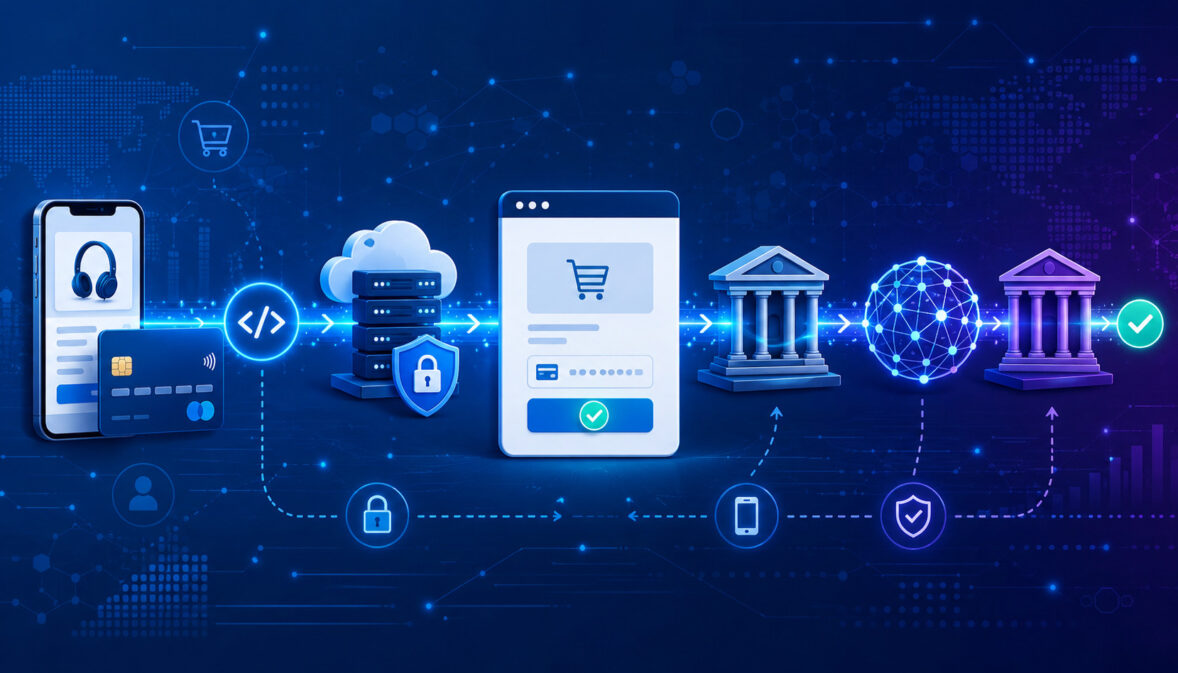
An API-based payment gateway integration connects a business’s website, app, platform, or internal software directly to payment processing functions through structured requests and responses.
Instead of relying only on a plugin, hosted payment page, payment link, virtual terminal, or point-of-sale setup, the business uses a payment gateway API to build payment capabilities into its own checkout flow, billing workflow, customer portal, mobile app, or back-office system.
For business owners and decision-makers, the value is control. A payment API integration can support ecommerce payments, mobile payments, subscription payments, custom booking flows, B2B invoices, stored payment methods, digital wallets, ACH payments, transaction reporting, refunds, voids, settlement tracking, and payment reconciliation.
For developers, the value is flexibility. A well-documented API payment gateway provides API endpoints, SDKs, webhooks, API credentials, test cards, sandbox tools, error codes, and reporting tools that help software teams build reliable payment workflows.
That flexibility also brings responsibility. A custom payment gateway integration can affect checkout experience, PCI compliance scope, data security, fraud prevention, accounting workflows, customer support processes, and operational risk.
Teams need to understand how payment authorization works, when capture happens, how refunds and voids are handled, how webhooks update transaction status, and what happens when an API request fails or times out.
This guide explains API-based payment gateway integration from a practical business and technical perspective. It is intended for general educational purposes.
API integration needs, security requirements, fees, processing rules, and implementation complexity can vary by provider, business model, transaction type, software stack, developer resources, and merchant account setup.
What Is an API-Based Payment Gateway Integration?
An API-based payment gateway integration is a direct software connection between a business system and a payment gateway. The business’s website, app, marketplace, SaaS platform, booking engine, membership portal, or internal software sends payment-related requests to the gateway through a payment API.
The gateway then communicates with the payment processor, card networks, issuing banks, acquiring banks, or other payment rails as needed and returns structured responses.
In practical terms, the API acts like a secure communication layer. Your system might send a request to authorize a card-not-present transaction, tokenize a card, create a customer profile, charge a saved payment method, issue a refund, check transaction status, retrieve settlement data, or reconcile a batch of payments.
The payment gateway API responds with information your system can use, such as an approval, decline, transaction ID, error message, token, settlement status, or webhook event.
The primary focus of API-based payment gateway integration is not simply “taking payments online.” It is about connecting payments to the way a business actually operates. An ecommerce team may want a checkout flow that supports digital wallets, tax calculation, shipping logic, fraud screening, and post-purchase notifications.
A SaaS company may need recurring billing, subscription upgrades, proration, failed-payment retries, and payment method updates. A marketplace may need split payments, seller onboarding, payouts, refunds, and reporting across multiple parties.
This is where API-based integrations differ from simpler payment tools. A hosted payment page can redirect customers to a payment form controlled by the gateway. A payment link can let a customer pay a specific invoice or amount. A plugin can connect a shopping cart to a gateway with limited configuration.
A virtual terminal can let staff key in payments manually. A point-of-sale integration focuses on in-person transactions. An API-based setup, by contrast, gives development teams more control over payment logic, user experience, data flow, and automation.
That control makes API-based integration useful, but it also requires careful planning. Teams must understand how payment data moves, where sensitive data is handled, which system is responsible for storing tokens, how API keys are protected, and how the business will meet PCI DSS obligations.
The PCI Security Standards Council provides resources for protecting payment card data and understanding PCI DSS requirements, which are important when designing payment workflows that touch cardholder data.
Why Businesses Use Payment Gateway API Integrations
Businesses use payment gateway API integrations when standard checkout tools do not provide enough flexibility, automation, or control. A small online store may be fine with a plugin or hosted payment page at first.
As the business grows, however, payments often become more connected to inventory, customer accounts, subscriptions, reporting, refunds, fraud prevention, and finance workflows. At that point, a payment gateway API integration may become more valuable than a basic payment form.
One major reason is checkout customization. Businesses want to reduce friction, support mobile-friendly checkout, offer digital wallets, display accurate totals, manage shipping and taxes, and keep customers inside a familiar brand experience.
An ecommerce payment API can support these workflows by allowing the website or app to collect order details, create a payment request, receive the payment response, and trigger the next step automatically.
Another reason is automation. A payment processing API can connect payments to order management, customer relationship management, accounting software, billing systems, inventory systems, and internal dashboards.
Instead of manually checking whether an invoice was paid or whether a refund was settled, teams can use API responses, webhooks, and reporting API data to update records automatically.
A custom payment gateway integration is also useful when the business model is not a simple one-time sale. Subscription businesses need recurring billing, payment method storage, retries, cancellations, upgrades, downgrades, and renewal notices.
Marketplaces may need to connect buyers, sellers, commissions, refunds, and payouts. B2B portals may need invoice payments, ACH payments, credit card payment API support, partial payments, account-level permissions, and reconciliation by customer or location.
Developers also benefit from API integrations because they can build payment functionality around the software’s architecture. They can choose when to authorize, when to capture, how to handle duplicate requests, how to log transaction status, and how to show customers meaningful messages when a payment fails.
For business teams, the real question is not “Can we accept payments?” The better question is “Can our payment flow support the way we sell, bill, fulfill, report, and scale?”
How Payment Gateway APIs Work
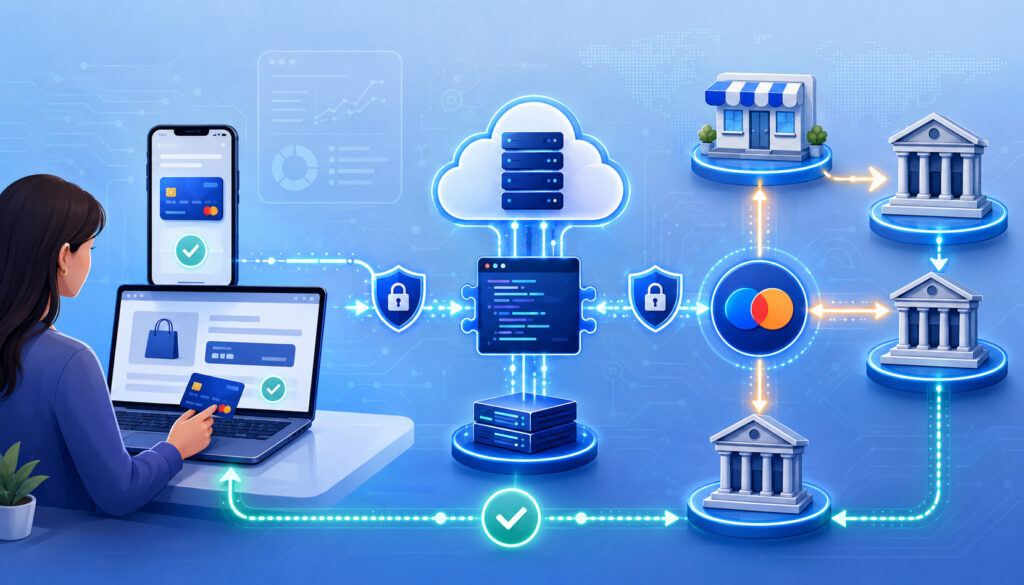
A payment gateway API works through structured communication between software systems. Your application sends a request to an API endpoint, and the gateway returns a response.
The request usually includes authentication details, transaction information, customer or order data, and the action being requested. The response tells your system what happened and what to do next.
For example, an ecommerce checkout may create an order, calculate the total, collect payment details through a secure form, and send a payment authorization request to the gateway. The gateway routes the request through the appropriate processing path.
The response may say the payment was approved, declined, requires additional authentication, failed because of invalid data, or could not be completed because of a temporary network or system issue.
Payment APIs are usually built around common actions. These can include creating a payment intent, authorizing a payment, capturing funds, voiding an authorization, refunding a transaction, tokenizing a card, creating a customer profile, storing a payment method, retrieving transaction status, searching transactions, downloading reports, or subscribing to webhook events.
Most payment gateway developer integration projects include the following flow:
- The business creates a merchant account or gateway account.
- The developer obtains API credentials.
- The team reviews developer documentation.
- The application is connected to a sandbox environment.
- Test transactions are run using approved testing tools.
- Payment responses and errors are handled.
- Webhooks are configured for asynchronous updates.
- The integration is reviewed for security and PCI scope.
- Production API credentials are issued and protected.
- Monitoring, logging, reconciliation, and support workflows are launched.
A payment API integration is not just a single “charge card” function. It is a complete communication pattern between business software and payment infrastructure.
API Endpoints
An API endpoint is a specific URL or route that performs a defined action. In a payment gateway API, one endpoint may create a transaction, another may capture an authorization, another may issue a refund, and another may return settlement details.
Well-designed APIs separate these functions clearly. That helps developers build predictable workflows and makes troubleshooting easier. For example, a checkout system should not guess whether a payment was captured. It should store the transaction ID, check the response, listen for webhook events, and retrieve transaction status when needed.
API endpoints are usually documented with required fields, optional fields, sample requests, sample responses, authentication rules, error codes, and rate limits. Good developer documentation also explains edge cases, such as duplicate requests, timeouts, partial approvals, expired authorizations, failed captures, or webhook retries.
API Keys and Credentials
API keys and credentials identify the system making the request. They may include public keys, secret keys, merchant IDs, client IDs, client secrets, OAuth tokens, HMAC signing secrets, or environment-specific credentials.
These credentials should be treated like sensitive access tools. Secret keys should not be placed in front-end code, mobile app source files, public repositories, browser scripts, or shared spreadsheets. Production credentials should be limited to systems that need them, stored securely, rotated when necessary, and removed when no longer needed.
NIST’s API security guidance emphasizes that APIs need protection across their life cycle, including attention to API endpoints, API keys, authentication, authorization, and runtime controls.
SDKs
An SDK, or software development kit, is a package of code that helps developers integrate more efficiently. Instead of manually building every API request from scratch, developers can use an SDK to handle common tasks such as request formatting, authentication, retries, response parsing, and token creation.
SDKs can save time, but they do not replace architectural planning. Teams still need to understand what the SDK is doing, how errors are returned, how version updates are managed, and whether the SDK supports the business’s required payment methods and workflows.
Key Components of a Payment API Integration
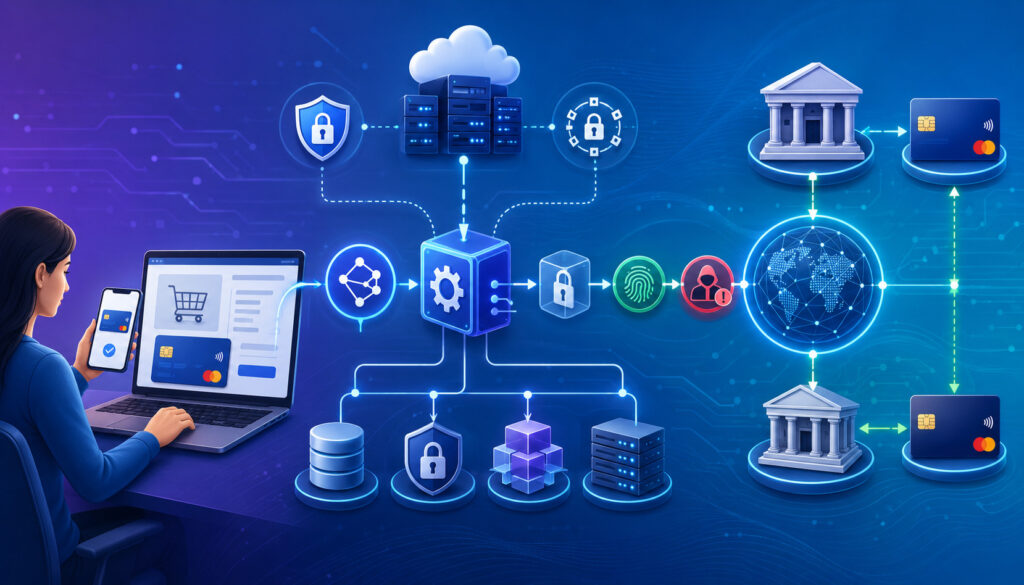
A reliable payment API integration includes more than a checkout button. It usually involves customer-facing components, server-side payment logic, gateway credentials, secure data handling, webhook processing, monitoring, reporting, and operational procedures. When these pieces are planned together, the integration is easier to launch, maintain, and scale.
The customer-facing layer may include checkout forms, billing pages, saved payment method screens, invoice payment pages, customer portals, or mobile payment screens. This layer should be easy to use, responsive, accessible, and clear about totals, taxes, shipping, payment status, and confirmation details.
The server-side layer handles the most sensitive business logic. It communicates with the payment gateway API, validates order amounts, creates transactions, manages tokens, stores transaction IDs, updates order status, and responds to gateway events. In most secure payment API designs, sensitive credentials stay on the server and are not exposed in the browser.
The data layer stores non-sensitive payment records needed for operations. This may include order IDs, transaction IDs, customer IDs, tokens, authorization status, capture status, refund status, settlement references, chargeback notices, and reconciliation fields.
Teams should be careful not to store full card numbers, CVV values, or other restricted data unless they have the required controls and a clear compliance basis.
The operations layer includes monitoring, alerts, support workflows, reporting, and exception handling. A payment gateway integration should help staff answer practical questions: Was the payment approved? Was it captured? Did it settle? Was it refunded? Did the customer receive access? Was the invoice marked paid? Did a webhook fail? Was a duplicate request blocked?
Webhooks
Webhooks are event notifications sent from the payment gateway to your application. They are essential because not every payment event happens instantly inside the original API response. A payment may later settle, fail, be disputed, be refunded, require review, or change status after additional authentication.
For example, your checkout page might receive an initial authorization response, but the settlement update may come later. A subscription renewal may fail after a scheduled billing attempt.
A chargeback notice may arrive days after the original transaction. Webhooks help your system stay updated without relying only on manual reports or repeated polling.
Webhook design should include signature verification, retry handling, duplicate event detection, event logging, and clear mapping between gateway events and internal statuses.
Tokenization
Tokenization replaces sensitive payment data with a token that can be stored and reused under defined rules. Instead of storing a card number, the business stores a token that represents the payment method. The token can be used for future payments, recurring billing, subscription payments, account updates, or customer profiles.
Tokenization can help reduce risk, but it does not remove all security responsibilities. The PCI Security Standards Council notes that tokenization guidance is supplemental and does not replace PCI DSS requirements. It can affect PCI DSS scope depending on how the solution is designed and implemented.
Reporting API
A reporting API allows the business to retrieve transaction, settlement, refund, dispute, and batch data programmatically. This is important for finance teams, operations managers, and SaaS platforms that need accurate payment reporting across systems.
Without strong reporting and reconciliation workflows, teams may rely on manual exports, screenshots, or inconsistent status checks. That can create confusion when a customer says they paid, an order is still pending, or a refund appears in one system but not another.
Hosted Checkout vs Embedded Checkout vs Fully Custom API Integration
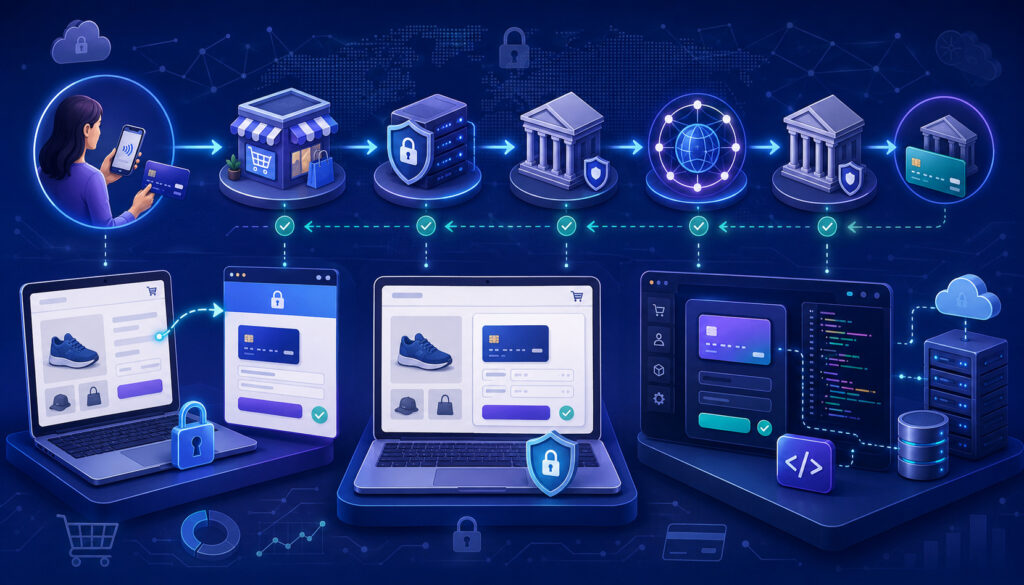
Businesses often compare hosted checkout, embedded checkout, and fully custom API integration when deciding how to accept payments online. Each option can be valid, but they involve different trade-offs in control, complexity, customer experience, security responsibility, and development effort.
A hosted checkout sends the customer to a payment page controlled by the gateway or payment provider. It is often faster to implement and may reduce how much sensitive card data touches the merchant’s systems.
An embedded checkout keeps the payment experience inside the merchant’s page or app, often using secure fields, iframes, hosted components, or client-side tokenization tools. A fully custom API integration gives the business the greatest control but may increase development and compliance responsibilities.
The right choice depends on the business model. A simple ecommerce store may prefer a hosted payment page or plugin to launch quickly. A growing ecommerce brand may choose embedded checkout to improve conversion and user experience while still using hosted secure fields.
A SaaS platform, marketplace, or custom booking system may need deeper API control for subscriptions, account-based billing, split logic, customer portals, and reporting.
Hosted Payment Pages
Hosted payment pages are payment forms hosted by the gateway or payment provider. The merchant’s website redirects the customer to the hosted page or opens it in a controlled payment flow. The customer enters card or payment details there, and the gateway returns the result to the merchant’s site.
This model can be easier to implement because the gateway controls much of the payment form and data collection process. It can also help reduce certain security burdens because sensitive payment fields may not be served directly from the merchant’s environment.
However, hosted checkout may limit design control and checkout flexibility. The redirect can interrupt the customer experience, and some businesses may not be able to support complex order logic, custom billing flows, membership rules, or multi-step checkout requirements as easily.
Embedded Checkout
Embedded checkout keeps customers on the business’s website or app while using secure payment components supplied by the gateway. These may include hosted fields, iframes, JavaScript libraries, or tokenization forms that collect sensitive payment data without exposing raw card details to the merchant’s server.
This approach can balance user experience and security. Customers stay in the checkout flow, while the gateway controls sensitive payment fields. Embedded checkout is often useful for ecommerce teams that want a smooth checkout experience without building every payment collection element from scratch.
Teams should still review PCI DSS scope carefully. PCI SSC payment page guidance highlights the importance of protecting ecommerce payment pages and preventing e-skimming, especially where scripts and payment forms are involved.
Custom Checkout
A fully custom API payment gateway integration gives the business more control over layout, payment logic, transaction timing, billing rules, and system connections. Developers can build custom checkout flows for SaaS trials, deposits, memberships, marketplaces, mobile apps, B2B portals, and booking systems.
The trade-off is responsibility. A custom checkout may require more security review, stronger access controls, vulnerability management, logging, monitoring, and compliance planning. It also requires careful engineering around errors, retries, duplicate submissions, webhook processing, and reconciliation.
Payment Authorization, Capture, Refunds, Voids, and Settlement Through APIs
A payment gateway integration guide should explain the transaction life cycle, not just the initial payment request. Many payment issues happen because teams do not clearly understand the difference between authorization, capture, voids, refunds, and settlement.
These steps determine when funds are approved, when they are submitted for clearing, when they can be canceled, and how money moves back to a customer.
In a typical card-not-present transaction, authorization is the request to confirm that the payment method can be charged. Capture is the step that submits an authorized transaction for settlement.
Settlement is the process by which funds move through the payment system and eventually reach the merchant account, subject to processor rules, batch timing, risk reviews, fees, and other factors.
Some businesses authorize and capture at the same time. This is common for digital goods, simple ecommerce orders, and immediate purchases. Others authorize first and capture later. This can be useful when inventory must be confirmed, an order must be shipped, a booking must be approved, or the final amount may change.
Refunds and voids are also different. A void usually cancels an authorization or unsettled transaction before it is completed. A refund returns funds after a transaction has already been captured or settled. The available options depend on timing, gateway rules, processor rules, transaction status, and payment method.
Authorization
Authorization is the first approval step. The customer submits payment information, and the gateway sends a request through the payment processor and card network to the issuing bank. The issuing bank approves, declines, or requests additional action.
An approved authorization does not always mean the money has fully settled. It means the payment method has been approved for the amount requested, subject to time limits and rules. Businesses should store the authorization ID, response code, transaction ID, and relevant status details.
Authorization can be important for hotels, booking systems, rentals, custom orders, and ecommerce stores that want to confirm availability before capture.
Capture
Capture tells the payment system to move forward with the approved transaction. Some APIs call this “capture,” “settle,” “complete,” or a similar term. Developers need to understand the gateway’s specific terminology.
A business may capture immediately or delay capture until the order is ready. If capture fails, the system should not silently mark the order as paid. It should log the failure, show an appropriate status, alert staff if needed, and avoid duplicate charges.
Refunds
Refunds return money to the customer after a transaction has been captured or settled. A payment gateway API may support full refunds, partial refunds, multiple partial refunds, or refund status checks.
Refund workflows should connect to inventory, customer support, accounting, and reconciliation. For example, if customer support issues a refund, the order system should update, the finance team should see the transaction, and the customer should receive accurate communication.
Voids
A void cancels a transaction before it settles. It is commonly used when an order is canceled shortly after payment, when a duplicate authorization is detected, or when the merchant decides not to capture an authorization.
Voids can be less confusing than refunds when the transaction has not settled, but timing matters. Once a transaction passes the void window, a refund may be required instead.
Settlement
Settlement is where payment records become finance records. A transaction may be approved at checkout but settle later. Settlement timing can depend on batch cutoffs, payment method, processor rules, risk review, weekends, holidays, and business setup.
A strong payment API integration should record settlement status and provide finance teams with reporting data. This helps reconcile gateway activity, processor deposits, refunds, chargebacks, fees, and accounting entries.
Security, PCI Compliance, Tokenization, and Encryption
Security is one of the most important parts of API-based payment gateway integration. Payment systems handle sensitive customer and transaction data, and mistakes can create financial, legal, operational, and reputational risk.
A secure payment API strategy should include API key protection, access controls, secure coding practices, tokenization, encryption, PCI DSS planning, logging rules, monitoring, vulnerability management, and incident response procedures.
Security responsibilities vary by integration type. Hosted payment pages may reduce how much sensitive payment data the merchant environment handles. Embedded checkout may use secure fields or tokenization to limit exposure.
Fully custom API integrations can increase flexibility but may also increase the systems, people, and processes in scope for security review.
PCI DSS applies to environments that store, process, or transmit cardholder data, and the PCI Security Standards Council maintains standards and related guidance for protecting payment card data. Businesses should work with qualified professionals when determining exact PCI scope and validation requirements.
Security is not only about compliance. It also affects uptime, customer trust, fraud prevention, and operational continuity. A payment integration should be designed so that sensitive data is minimized, credentials are protected, logs do not expose secrets, access is limited, and suspicious behavior can be detected.
PCI DSS
PCI DSS is a payment card data security standard that defines requirements for protecting cardholder data. The exact requirements that apply depend on how a business accepts payments, how systems are segmented, which vendors are involved, and whether cardholder data is stored, processed, or transmitted in the merchant environment.
API-based integrations should be reviewed carefully because small design choices can affect PCI scope. For example, collecting card data directly on a merchant-hosted form may create different responsibilities than using a hosted payment page or secure hosted fields.
Storing full card numbers or CVV values is highly restricted and generally unnecessary for most businesses using modern tokenization tools.
Teams should document the payment data flow before building. That includes where card data is entered, which scripts are loaded, where tokens are created, which systems receive payment data, which logs capture transaction details, and which employees can access payment records.
Tokenization
Tokenization is one of the most useful tools for reducing exposure to sensitive card data. A token can represent a payment method without requiring the business to store the actual card number. This is especially useful for recurring billing, subscription payments, customer accounts, mobile apps, and membership systems.
However, tokenization must be implemented correctly. A token should be stored securely, tied to the correct customer or account, and used only within approved workflows. Tokens should not be treated as harmless if they can initiate payments. Access to tokenized payment methods should be limited and monitored.
PCI SSC tokenization guidance explains that tokenization can affect PCI DSS scope, but it does not replace PCI DSS requirements.
Encryption
Encryption protects data by making it unreadable without the appropriate cryptographic keys. Payment integrations commonly use encryption in transit, such as TLS for API communication, and encryption at rest for stored sensitive data.
Encryption is important, but it is not a complete security strategy by itself. Businesses also need key management, access controls, secure development practices, vulnerability scanning, dependency updates, monitoring, and incident response planning.
NIST guidance on API protection emphasizes risk factors and controls across the API life cycle, including design and runtime protections.
API Credential Protection
API credentials should be stored in secure configuration systems, secret managers, or protected server environments. They should not be hardcoded into applications, exposed in front-end JavaScript, committed to repositories, shared through chat tools, or included in logs.
Strong credential practices include:
- Separate sandbox and production credentials.
- Least-privilege access where supported.
- Role-based access control for dashboards and keys.
- Key rotation procedures.
- Immediate revocation when credentials are exposed.
- Monitoring for unusual API activity.
- Separate credentials for different applications or services when practical.
Webhooks, Transaction Status Updates, and Payment Reconciliation
A payment gateway integration is not complete when the checkout page says “success.” Many payment events happen after the initial response. Webhooks, transaction status updates, and reconciliation processes help businesses keep systems accurate after authorization, capture, settlement, refunds, disputes, subscription renewals, failed payments, and payout events.
Webhooks are especially important because they support asynchronous communication. Your system sends a request to the payment API, but the final payment status may change later. A webhook can notify your system that a transaction settled, a refund completed, a subscription payment failed, a chargeback was opened, or a payment method was updated.
Without webhooks, businesses may rely too heavily on the initial API response. That can create mismatches. For example, an order may be marked as paid even though capture failed. A subscription may remain active after a renewal payment failed.
A refund may be issued in the gateway but not reflected in the customer portal. A finance team may see deposits that do not match order reports.
Payment reconciliation connects transaction data to accounting and operations. It helps answer questions such as:
- Which approved transactions were captured?
- Which captured transactions settled?
- Which refunds were issued and completed?
- Which transactions are still pending?
- Which gateway transactions match processor deposits?
- Which deposits include fees, adjustments, or chargebacks?
- Which customer accounts need manual review?
A reporting API can make reconciliation more efficient by pulling transaction and settlement data into internal dashboards, accounting workflows, or data warehouses. This is especially helpful for businesses with multiple locations, high transaction volume, subscriptions, marketplaces, or B2B payment portals.
Webhook processing should be designed carefully. A webhook event should be verified, logged, processed once, and connected to the correct internal record. If the gateway retries a webhook, the system should not duplicate refunds, duplicate access, or create conflicting records. This is where idempotency and event tracking become important.
Testing, Sandbox Environments, Error Handling, and Idempotency
Testing is where a payment API integration becomes reliable. A checkout that works once with a successful test card is not ready for production.
Teams need to test successful payments, declines, timeouts, duplicate submissions, invalid card data, AVS mismatches, CVV mismatches, 3D Secure flows, refunds, voids, settlement updates, subscription renewals, webhook retries, and reporting exports.
A sandbox environment lets developers run test transactions without moving real money. It should be used early and often. Business teams should also participate in testing because they understand real workflows: canceled orders, partial refunds, failed renewals, customer support adjustments, finance reconciliation, and fulfillment timing.
Error handling is a major part of payment reliability. Payment APIs can return validation errors, authentication errors, insufficient funds declines, fraud-related declines, network errors, gateway errors, processor errors, duplicate transaction errors, and rate-limit responses. Each type of error should be handled appropriately.
A customer-facing error message should be helpful without exposing sensitive system details. A developer log should contain enough information to troubleshoot without storing restricted data. An operations dashboard should show payment states clearly. A retry process should avoid duplicate charges.
Sandbox Testing
Sandbox testing should cover the full payment life cycle. Developers should test API requests, SDK behavior, tokenization, webhooks, refunds, voids, reporting, and edge cases. Business teams should test order status changes, customer emails, invoice updates, access control, and reconciliation reports.
A good sandbox plan includes:
- Approved transaction tests.
- Declined transaction tests.
- Invalid payment data tests.
- AVS and CVV response tests.
- 3D Secure or step-up authentication tests where applicable.
- Refund and partial refund tests.
- Void tests.
- Webhook delivery and retry tests.
- Duplicate submission tests.
- Subscription renewal and failed billing tests.
- Reporting and reconciliation tests.
Error Handling
Payment errors should be mapped into categories. A customer-correctable error, such as an expired card, should be handled differently from a gateway timeout. A fraud review status should not be treated the same as a hard decline. A rate limit response should trigger backoff logic rather than repeated immediate retries.
Internal teams should define what happens when payment status is unknown. For example, if the checkout request times out, the system should not automatically retry in a way that risks duplicate charges. It may need to check transaction status, use an idempotency key, or wait for a webhook event.
Idempotency
Idempotency helps prevent duplicate actions when the same request is sent more than once. In payment processing, this is critical because customers may double-click a button, refresh a checkout page, lose connection, or retry after a timeout.
An idempotency key tells the payment API that repeated requests with the same key should be treated as the same operation, not separate charges. Developers should use idempotency where supported for payment creation, capture, refund, and other money-moving actions.
Production Launch
Production launch should be controlled. Teams should verify production API credentials, webhook URLs, logging settings, fraud rules, monitoring, alerts, customer messages, refund permissions, dashboard access, and reconciliation reports. They should also have rollback procedures in case something does not work as expected.
A launch checklist should include both technical and operational readiness. The integration is not ready if only developers know how to interpret payment states.
Common API Integration Challenges and How to Reduce Them
API-based payment gateway integration can be powerful, but several common mistakes create avoidable problems. Many issues come from treating payments like a simple form submission instead of a financial workflow with security, compliance, customer experience, and accounting implications.
One common mistake is exposing API keys. Secret credentials should never be placed in browser code, mobile apps, public repositories, or shared documents. If credentials are exposed, they should be revoked and replaced quickly, and logs should be reviewed for suspicious activity.
Another common mistake is skipping thorough sandbox testing. Teams may test only successful card payments and miss declines, refunds, voids, timeouts, webhook failures, duplicate clicks, and reconciliation edge cases. This creates production surprises that affect customers and support teams.
Ignoring webhooks is another frequent issue. If the system relies only on the initial API response, it may miss settlement updates, failed subscription payments, chargebacks, refund completions, and asynchronous payment method events. Webhooks should be part of the core integration, not an afterthought.
Weak error handling can also cause duplicate charges, abandoned orders, or inaccurate records. For example, if a payment request times out, the system should not blindly send another charge request. It should check status, use idempotency, and avoid creating duplicate payment attempts.
Poor reconciliation is a business risk. A payment gateway may show one status, an order system another, and accounting software a third. This makes it harder to answer customer questions, close books, investigate chargebacks, or match deposits. A reporting API, settlement reports, consistent transaction IDs, and clear internal statuses can reduce this problem.
Unclear PCI responsibilities can create compliance gaps. Teams should know whether their integration uses hosted payment pages, secure hosted fields, direct card entry, tokenization, or other methods. The difference can affect PCI scope, security controls, and validation requirements.
Other challenges include:
- Not planning for rate limits.
- Failing to verify webhook signatures.
- Not monitoring latency or API errors.
- Treating all declines the same.
- Storing too much payment data.
- Not documenting refund workflows.
- Forgetting mobile checkout behavior.
- Not testing browser autofill and validation.
- Not preparing support teams.
- Not reviewing third-party scripts on payment pages.
The best way to reduce these risks is to create a shared integration plan before development begins. Developers, ecommerce teams, finance teams, operations managers, and security stakeholders should agree on payment flows, data handling, statuses, testing requirements, launch criteria, and support procedures.
Questions to Ask Before Choosing a Payment Gateway API
Choosing an API payment gateway is not only a technical decision. It affects checkout experience, payment methods, merchant account compatibility, fraud prevention, reporting, developer workload, support, scalability, and long-term operations. Before selecting a payment gateway API, businesses should ask questions that cover both developer needs and business requirements.
Start with payment method support. Does the gateway support credit card payment API functionality, debit cards, ACH payments, digital wallets, recurring billing, subscription payments, stored payment methods, partial refunds, voids, and transaction reporting? If the business serves both ecommerce and invoice customers, it may need different workflows for each.
Next, review developer documentation. Strong documentation should include authentication details, endpoint descriptions, sample requests, sample responses, SDKs, error codes, webhook events, test cards, sandbox setup, production launch instructions, and versioning policies. Developers should be able to understand not only how to create a transaction but also how to handle edge cases.
Reliability matters as well. Ask about uptime history, latency, status pages, incident communication, maintenance windows, rate limits, webhook retry policies, and support availability. No provider can remove all technical risk, so the business should understand how outages and degraded performance are communicated and handled.
Security features should be reviewed early. Ask how the gateway supports tokenization, encryption, API credential management, access controls, webhook verification, fraud tools, AVS, CVV checks, 3D Secure, device data, and suspicious activity monitoring. Also ask how the integration model affects PCI DSS scope.
Finance and operations teams should evaluate reporting. Can the business retrieve transactions, refunds, disputes, fees, settlement batches, deposit reports, and reconciliation data through an API or export? Can reports be filtered by location, product, customer, subscription, marketplace seller, or internal order ID?
Support and scalability questions are also important. Can the gateway support expected transaction volume? What happens during traffic spikes? Are there rate limits? Is support available for production issues? Are API changes versioned clearly? How are breaking changes communicated?
API-Based Payment Gateway Integration Checklist
A checklist can help teams evaluate readiness before development, testing, and production launch. The goal is not only to confirm that the payment API works. The goal is to confirm that the integration supports security, reliability, customer experience, accounting, support, and future growth.
| Integration Area | Why It Matters | Questions to Ask | Best Practice |
| Business Requirements | Prevents building the wrong payment flow | Do we need one-time payments, subscriptions, deposits, invoices, ACH, digital wallets, or stored cards? | Document required payment workflows before choosing the integration model. |
| Integration Type | Affects control, complexity, and PCI scope | Should we use hosted checkout, embedded checkout, or a custom API integration? | Choose the simplest model that supports the customer and operational needs. |
| Merchant Account Setup | Determines processing capabilities | Is the merchant account approved for the transaction types and business model? | Confirm processing rules, descriptors, funding timelines, and supported payment methods. |
| Developer Documentation | Reduces integration delays | Are API endpoints, SDKs, errors, webhooks, and examples clearly documented? | Review documentation before committing development resources. |
| API Credentials | Protects access to payment functions | Where will API keys, OAuth tokens, HMAC secrets, and credentials be stored? | Use secure server-side storage, least privilege, and credential rotation procedures. |
| Tokenization | Reduces sensitive data exposure | Can payment methods be tokenized for recurring billing or saved cards? | Store tokens securely and avoid storing full card data unless required and properly controlled. |
| PCI DSS Scope | Defines compliance responsibilities | Which systems store, process, or transmit cardholder data? | Map the payment data flow and consult qualified compliance support when needed. |
| Checkout Flow | Affects conversion and customer trust | Is checkout clear, mobile-friendly, and easy to complete? | Test on multiple devices, browsers, and customer scenarios. |
| Authorization and Capture | Controls transaction timing | Do we capture immediately or after fulfillment, shipment, or approval? | Align capture timing with business operations and customer expectations. |
| Refunds and Voids | Affects customer service and accounting | Can staff issue full or partial refunds? When should voids be used? | Document refund permissions, timing rules, and reconciliation steps. |
| Webhooks | Keeps payment status accurate | Which events must update our system? How are events verified and retried? | Verify signatures, store event IDs, and make processing idempotent. |
| Error Handling | Prevents duplicate charges and confusion | What happens after declines, timeouts, validation errors, or rate limits? | Map errors into customer messages, internal statuses, and retry rules. |
| Idempotency | Prevents duplicate money movement | Does the API support idempotency keys for charges and refunds? | Use idempotency for payment creation, capture, and refund requests where supported. |
| Sandbox Testing | Finds issues before launch | Have we tested approvals, declines, refunds, voids, webhooks, and reporting? | Use a test plan that includes successful and failed scenarios. |
| Fraud Prevention | Reduces risk without blocking good customers unnecessarily | Are AVS, CVV, 3D Secure, velocity checks, and review rules available? | Tune fraud tools to the business model and review results over time. |
| Reporting and Reconciliation | Supports finance and operations | Can we match transactions, refunds, settlements, fees, and deposits? | Store transaction IDs and use reporting API data for reconciliation. |
| Monitoring | Detects issues quickly | Are we tracking latency, failures, webhook errors, and unusual activity? | Set alerts for payment failures, webhook retries, and API error spikes. |
| Production Launch | Reduces rollout risk | Are credentials, webhooks, logs, alerts, and staff workflows ready? | Use a launch checklist and verify real transactions carefully. |
| Documentation | Helps future maintenance | Can new developers and support staff understand the payment flow? | Document architecture, statuses, credentials process, and support procedures. |
This checklist should be reviewed by technical and non-technical stakeholders. A payment API integration touches many teams, so readiness should not be measured only by whether the code compiles or the first transaction is approved.
Practical Examples of API Payment Gateway Use Cases
API-based integrations are most useful when payment workflows need to match a specific business model. Different businesses may use the same payment gateway API in very different ways.
An ecommerce store may use an ecommerce payment API to authorize payment during checkout, capture after inventory confirmation, tokenize payment methods for returning customers, support digital wallets, and send order status updates after payment confirmation. It may also use fraud tools such as AVS, CVV, velocity checks, and 3D Secure when appropriate.
A SaaS platform may use a payment API to create customer profiles, store payment tokens, bill monthly or annual subscriptions, process upgrades and downgrades, retry failed payments, handle cancellations, and update account access based on billing status. Webhooks are essential because subscription payment status may change after scheduled billing attempts.
A marketplace may need a more complex setup. It may track buyer payments, seller accounts, platform fees, refunds, disputes, and payout-related reporting. The integration may need to support multiple transaction parties and detailed reconciliation.
A mobile app may use tokenization and app-friendly checkout tools to let customers pay without entering card data repeatedly. Developers must pay close attention to secure credential handling because mobile apps should not contain secret API keys.
A B2B portal may support invoice payments, ACH payments, credit card payments, saved payment methods, customer-specific permissions, and account-level reporting. Finance teams may need invoice numbers, customer IDs, purchase order references, and settlement data to flow into accounting systems.
A membership site may use recurring billing, failed-payment notifications, retry logic, access control, and customer self-service payment method updates. If payment status changes, the member’s access should update based on clear business rules.
A custom booking system may authorize a deposit, capture a balance later, void authorizations when bookings are canceled in time, and issue refunds according to policy. These workflows are difficult to manage with a simple payment link alone.
Performance, Reliability, Scalability, and Customer Experience
A payment gateway API should be evaluated not only for features but also for performance and operational reliability. Checkout is one of the most sensitive parts of the customer journey. Slow payment pages, unclear errors, failed webhook processing, or duplicate charges can quickly create customer frustration and internal support work.
Latency matters because customers expect checkout to respond quickly. If the payment API is slow, the application should show a clear loading state and avoid repeated submissions. If the request times out, the system should check status before retrying. The goal is to avoid both abandoned orders and duplicate charges.
Uptime and incident communication matter because payment systems depend on multiple parties. Even a well-built integration can experience issues if a gateway, processor, bank, network, or internal service has a disruption. Businesses should monitor provider status, track their own payment error rates, and prepare fallback procedures for critical workflows.
Scalability matters when transaction volume grows or becomes uneven. A business may experience spikes during promotions, seasonal sales, product launches, billing cycles, event registrations, or subscription renewals. Teams should understand API rate limits, webhook throughput, retry behavior, and database performance under load.
Customer experience also depends on how payment failures are handled. A decline should not feel like a system crash. A timeout should not leave the customer guessing. A successful payment should trigger confirmation, order updates, and fulfillment steps reliably.
Good payment performance planning includes:
- Monitoring API latency and error rates.
- Tracking checkout abandonment around payment steps.
- Designing retry logic carefully.
- Using idempotency keys.
- Alerting staff when webhook failures increase.
- Testing subscription billing at scale.
- Reviewing reconciliation exceptions.
- Keeping customer messages clear and helpful.
The Federal Reserve provides educational information on payment systems and settlement concepts, which can be useful for teams that want to understand how payments fit into broader financial infrastructure.
Fraud Prevention, AVS, CVV, 3D Secure, and Risk Controls
Fraud prevention is an important part of payment API design, especially for card-not-present transactions. A payment gateway API may support tools such as AVS, CVV checks, device signals, velocity rules, risk scoring, blocklists, allowlists, 3D Secure, manual review queues, and transaction monitoring.
AVS, or address verification, compares billing address details submitted during checkout with information on file with the card issuer. CVV checks verify the card security code provided by the customer.
These tools can help identify risk, but they should not be treated as perfect indicators. Legitimate customers can fail checks because of typos, outdated addresses, or formatting differences.
3D Secure can add an authentication step for certain transactions. It may help shift or reduce some types of fraud risk depending on payment method, rules, and transaction context, but it can also add friction if not implemented thoughtfully. Businesses should understand when step-up authentication is triggered and how it affects checkout completion.
Fraud controls should match the business model. A digital goods seller may need stronger velocity checks and instant fulfillment controls. A B2B invoice portal may focus more on account permissions and ACH authorization.
A subscription business may need failed-payment monitoring and account takeover prevention. A marketplace may need seller risk controls, buyer behavior monitoring, and dispute workflows.
Risk controls should also be reviewed after launch. Fraud patterns change, customer behavior changes, and new products can introduce new risk. Teams should monitor declines, chargebacks, refund patterns, suspicious order clusters, and manual review outcomes.
The FTC offers educational resources on data security and business guidance that can help organizations think about protecting customer information and reducing risk in digital operations.
Documentation, Team Roles, and Long-Term Maintenance
A payment API integration needs documentation because payment workflows outlive the original development project. Developers may change roles, business rules may change, API versions may evolve, and finance teams may need new reporting fields. Without documentation, even a well-built integration can become difficult to maintain.
Good documentation explains the architecture, payment flow, API endpoints used, authentication method, tokenization flow, webhook events, transaction statuses, error handling, refund logic, settlement reconciliation, and production support procedures.
It should also explain what data is stored, where credentials are managed, and who has access to gateway dashboards.
Team roles should be clear. Engineering may own API code, webhook processing, monitoring, and deployments. Security may own credential handling, vulnerability review, access controls, and incident procedures.
Finance may own reconciliation, settlement review, and accounting exports. Operations may own order exceptions, refund workflows, and customer support escalation. Leadership may own provider selection, risk tolerance, and resource planning.
Long-term maintenance includes API version updates, SDK updates, dependency management, credential rotation, access reviews, fraud rule tuning, webhook monitoring, reporting adjustments, and periodic compliance review.
It also includes reviewing whether the integration still fits the business model as transaction volume, products, and customer expectations change.
A common mistake is treating payment integration as a one-time development task. In reality, it is an operational system that needs monitoring, ownership, and improvement.
What is an API-based payment gateway integration?
An API-based payment gateway integration is a direct connection between business software and a payment gateway using a payment API.
It allows a website, app, platform, or internal system to send structured requests for payment authorization, capture, refunds, voids, tokenization, recurring billing, transaction status, reporting, and reconciliation.
It gives businesses more control than many basic payment tools, but it also requires planning around security, PCI compliance, testing, error handling, webhooks, and operational workflows.
How does a payment gateway API work?
A payment gateway API works by receiving requests from your application and returning structured responses.
For example, your system may send a request to authorize a card payment. The gateway routes the transaction through the payment processor and returns a response such as approved, declined, failed, or pending.
The API may also support other functions, including tokenizing payment methods, capturing authorized payments, issuing refunds, voiding transactions, retrieving reports, and sending webhook events when payment status changes.
What is the difference between a payment API and a hosted checkout page?
A payment API lets your software connect directly to payment gateway functions through API endpoints. It can support custom checkout flows, subscription billing, reporting, refunds, and deeper system automation.
A hosted checkout page is a payment page controlled by the gateway or payment provider. It can be easier to implement and may reduce certain security responsibilities, but it usually provides less control over checkout design and payment logic than a custom API integration.
Is API-based payment gateway integration secure?
API-based payment gateway integration can be secure when it is designed and maintained properly. Important controls include protecting API keys, using tokenization, encrypting data in transit and at rest, verifying webhooks, limiting access, avoiding sensitive data in logs, monitoring activity, and understanding PCI DSS responsibilities.
Security depends on implementation choices. A custom payment gateway integration that exposes credentials, stores unnecessary card data, or skips testing can create serious risk.
What should businesses test before launching a payment API integration?
Businesses should test approved payments, declines, invalid card data, AVS and CVV responses, 3D Secure flows, refunds, voids, authorization and capture timing, duplicate submissions, timeouts, webhook retries, subscription renewals, failed payments, reporting exports, and reconciliation.
Testing should include both developers and business teams. Finance, operations, support, and ecommerce teams often identify real-world cases that developers may not see in basic API testing.
How do webhooks help with payment gateway integrations?
Webhooks notify your system when payment events happen after the original API response. They can update your application when a transaction settles, a refund completes, a subscription payment fails, a dispute opens, or a payment method changes.
Without webhooks, systems may show outdated payment status. Webhooks help keep order records, customer accounts, billing systems, and reconciliation reports accurate.
What are common payment API integration mistakes?
Common mistakes include exposing API keys, skipping sandbox testing, ignoring webhooks, weak error handling, not using idempotency, creating duplicate charges, storing sensitive payment data unnecessarily, failing to verify webhook signatures, not planning refunds and voids, and building poor reconciliation workflows.
Another common issue is leaving finance and support teams out of planning. A payment integration must work for customers, developers, operations, accounting, and customer service.
How can businesses reduce PCI scope when using payment APIs?
Businesses may reduce PCI scope by using hosted payment pages, secure hosted fields, embedded payment components, tokenization, and gateway-controlled collection methods that limit how much cardholder data touches their systems. However, PCI scope depends on the full payment data flow, system design, vendor setup, and security controls.
Tokenization and hosted tools can help, but they do not remove all security responsibilities. Businesses should document payment data flows and consult qualified compliance guidance when needed.
Conclusion
API-based payment gateway integration gives businesses a flexible way to connect websites, apps, SaaS platforms, marketplaces, subscription systems, B2B portals, booking tools, and internal software to payment processing functions.
A payment gateway API can support authorization, capture, refunds, voids, tokenization, stored payment methods, recurring billing, digital wallets, ACH payments, transaction reporting, settlement tracking, and payment reconciliation.
The main advantage is control. Businesses can design payment workflows around how they sell, bill, fulfill, support customers, and close financial records. Developers can build custom checkout logic, automate billing events, listen for webhooks, handle errors carefully, and connect payment data to other systems.
The main responsibility is discipline. Payment integrations need secure credential handling, PCI DSS planning, tokenization, encryption, access controls, sandbox testing, error handling, idempotency, webhook verification, monitoring, and documentation.
Teams should avoid shortcuts such as exposing API keys, relying only on successful test transactions, ignoring webhook events, or treating settlement and reconciliation as afterthoughts.
A strong API-based payment gateway integration is not just a technical connection. It is part of the business’s revenue infrastructure. When planned well, it can improve checkout experience, reduce manual work, support complex billing models, help finance teams reconcile payments, and give decision-makers better visibility into payment operations.
When planned poorly, it can create security gaps, customer confusion, duplicate charges, reporting errors, and support challenges.
The best approach is to start with the business workflow, choose the simplest integration model that meets the need, involve technical and operational teams early, test thoroughly, document clearly, and monitor continuously after launch.
That is how an API-based payment gateway integration becomes more than a checkout feature; it becomes a reliable foundation for modern payment operations.