
By Gerardo Graham June 9, 2026
ACH payments are a practical way for businesses to collect invoices, process recurring payments, pay vendors, fund payroll, and move money between bank accounts without relying on card networks.
They are commonly used for subscription billing, membership dues, rent, utility payments, professional services, ecommerce bank payments, direct deposit, and B2B payments.
But ACH payment processing is not always frictionless. Sometimes an ACH debit or ACH credit fails before it enters the ACH network. Other times, it is accepted for processing, appears to be moving forward, and then comes back later with a return code.
For a business, both situations can create confusion, funding delays, reconciliation issues, customer service questions, and unexpected ACH return fees.
That is why understanding ACH returns and ACH rejections matters. These two terms are related, but they are not identical. An ACH rejection usually happens before or during submission because something about the transaction file, account information, authorization data, formatting, or risk review prevents the payment from being accepted.
An ACH return happens after an ACH entry has been submitted into the ACH network and is sent back by the receiving financial institution for a specific reason.
This guide explains how ACH returns and ACH rejections work, why ACH payments fail, what ACH return codes mean, how the ACH return process affects settlement, and what businesses can do to reduce avoidable ACH transaction failures.
It also covers authorization, compliance, retry policies, customer communication, fraud prevention, and reporting practices that help finance and operations teams manage ACH payment failures more effectively.
This article is for general educational purposes. ACH return rules, timing, fees, risk requirements, and processing outcomes can vary by provider, financial institution, transaction type, authorization method, risk profile, and business model.
What Are ACH Returns and ACH Rejections?
ACH returns and ACH rejections are both types of failed ACH transactions, but they happen at different points in the payment lifecycle. Understanding the distinction helps businesses respond correctly instead of treating every failed payment the same way.
An ACH return occurs when an ACH entry has been submitted through the ACH network and is later returned by the Receiving Depository Financial Institution, commonly called the RDFI. The return is sent back to the Originating Depository Financial Institution, or ODFI, with an ACH return code that explains the reason.
Common ACH return reasons include insufficient funds, closed account, invalid account number, stop payment, account restriction, or unauthorized debit.
An ACH rejection usually happens before the transaction is fully processed through the ACH network. A payment processor, payment gateway, ODFI, bank, or risk system may reject the transaction because the file is formatted incorrectly, the routing number is invalid, required fields are missing, the account failed verification, the transaction violates processing limits, or the business does not meet certain risk requirements.
For example, a subscription business may submit a recurring ACH debit for a monthly membership fee. If the customer’s bank account does not have enough available funds, the transaction may be returned with R01, which means insufficient funds.
That is an ACH return. But if the business enters a routing number that does not pass validation before the transaction is sent, the payment may be rejected before it reaches the RDFI. That is closer to an ACH rejection.
The key idea is timing. ACH rejections are often front-end failures. ACH returns are usually back-end failures after the ACH entry has been accepted into the flow.
For readers who need a broader foundation, this overview of how ACH transactions work can be useful before diving deeper into ACH payment returns, return codes, and settlement impact.
Why ACH Returns and Rejections Matter for Businesses
ACH payment failures can affect much more than one unpaid invoice. For businesses that rely on recurring payments, bank transfers, subscription billing, retainers, rent collection, tuition, dues, or B2B collections, failed ACH transactions can disrupt revenue recognition, customer access, service delivery, reconciliation, and cash flow forecasting.
One returned ACH debit may seem minor. But when a business processes hundreds or thousands of ACH transactions, a small percentage of failed payments can create a large operational workload.
Finance teams may need to identify the failed payment, match the return to the original transaction, update the customer’s account, apply ACH return fees if applicable, send a customer notification, retry the payment, and reconcile the settlement report.
ACH returns also affect funding expectations. A business may see a transaction listed as submitted or pending and assume the funds are reliable. If the transaction is later returned, the business may experience a funding delay or a debit from a settlement account.
This is especially important for businesses that deliver goods, provide access, or start services before ACH funds are fully settled and beyond applicable return risk windows.
ACH rejections can create a different type of problem. If an ACH payment rejection happens before processing, the business may not even get to the settlement stage.
The payment may fail because the account number is missing, the routing number is invalid, the customer authorization is incomplete, the transaction exceeds limits, or the payment gateway blocks the entry due to risk settings.
ACH returns and ACH rejections also matter because they provide feedback. Return codes and rejection messages can reveal patterns, such as:
- Customers entering invalid account numbers during checkout
- Recurring billing attempts hitting accounts with insufficient funds
- Old customer bank accounts remaining on file after account closures
- Unauthorized ACH debit claims increasing after unclear authorization language
- Operations teams retrying payments without a consistent policy
- Fraud attempts using stolen or synthetic bank account information
When businesses monitor ACH payment failures carefully, they can improve payment operations. They can adjust onboarding flows, improve authorization language, add account verification, refine retry timing, train customer support teams, and strengthen fraud prevention.
ACH Returns vs ACH Rejections: Key Differences
ACH returns and ACH rejections are easy to confuse because both result in a failed payment. However, they require different responses from the business.
An ACH return generally means the ACH entry was accepted into the ACH network and then returned by the RDFI. The RDFI sends back a standardized ACH return code. These codes help the originator and its processor understand what happened.
For example, R01 indicates insufficient funds, R02 indicates account closed, R03 indicates no account or unable to locate account, and R10 may indicate a consumer claims the debit was unauthorized or improper.
An ACH rejection generally means the transaction did not successfully enter or continue through normal ACH processing. It may be rejected by the payment gateway, processor, ODFI, bank, or internal validation system.
ACH reject codes are not always the same as ACH return codes. Some processors provide their own decline or rejection messages in addition to network-level information.
| Category | ACH Return | ACH Rejection |
| When it usually happens | After the ACH entry is submitted into the ACH network | Before or during submission, validation, risk review, or file acceptance |
| Who usually initiates it | RDFI, though some returns may involve other parties depending on the situation | Payment gateway, processor, ODFI, validation system, bank, or risk controls |
| Common cause | Insufficient funds, closed account, invalid account, stop payment, unauthorized debit | Invalid routing number, missing data, file formatting error, failed account verification, limit issue, duplicate file, risk block |
| Main identifier | Standard ACH return code | Processor message, validation error, reject reason, or internal ACH reject code |
| Business response | Review return code, update records, contact customer, decide whether retry is allowed | Correct data, fix file issue, verify account, review risk settings, resubmit if appropriate |
| Settlement impact | May reverse expected funding or create settlement adjustment | Usually prevents the payment from reaching settlement |
ACH returns should also be distinguished from ACH reversals, ACH corrections, card chargebacks, and settlement delays.
An ACH reversal is not simply a failed payment. A reversal is used to correct certain erroneous ACH entries, such as duplicate transactions or wrong dollar amounts, under specific rules. Nacha provides guidance on ACH reversal rules, including limits on improper use of reversals, through its reversals and enforcement resources.
An ACH correction often involves a Notification of Change, also called an NOC. An NOC tells the originator that certain account information should be corrected for future entries. It does not always mean the original payment failed, but it does mean the business should update its records.
A card chargeback is different from an ACH return. Card disputes follow card network rules and usually involve card issuers, acquirers, reason codes, evidence, and chargeback timelines. ACH debit disputes follow ACH authorization and return rules, and unauthorized ACH return claims can have different timing and documentation requirements.
A settlement delay is also different. A delayed ACH payment may still be valid but not yet funded due to processing schedules, banking days, risk holds, batch timing, or provider review.
How the ACH Return Process Works
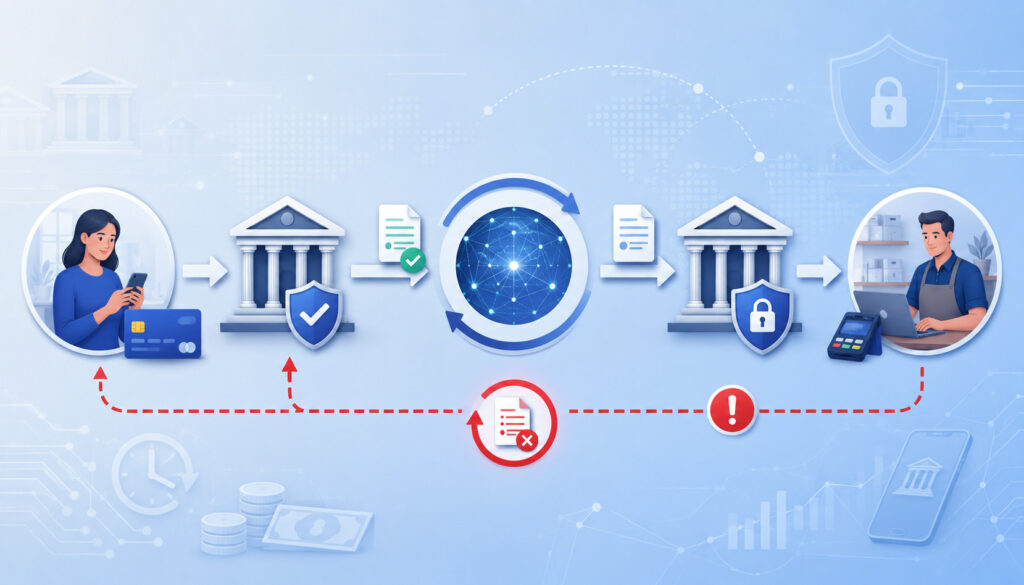
The ACH return process begins after an ACH entry has already been originated. To understand returns, it helps to understand the parties involved in an ACH transaction.
The originator is the business, organization, government entity, or person that initiates the ACH entry. In a business setting, the originator may be a merchant collecting a customer payment, a company paying a vendor, or an employer sending payroll.
The ODFI is the financial institution that receives the ACH entry from the originator or its payment processor and submits it into the ACH network.
The ACH operator routes the entry between financial institutions. The RDFI is the receiving financial institution that holds the receiver’s account. The receiver is the account holder whose account is being debited or credited.
The Federal Reserve explains that FedACH services support the clearing of ACH payments for financial institutions, while Nacha describes ACH as a network used for electronic payments such as direct deposit, bill payments, and account-to-account transfers.
Helpful background is available from the Federal Reserve’s ACH services information and Nacha’s ACH Payments Fact Sheet.
A typical ACH debit return flow looks like this:
- The customer authorizes the business to debit their bank account.
- The business submits the ACH debit through its payment gateway, processor, or bank.
- The ODFI sends the entry into the ACH network.
- The ACH operator routes the entry to the RDFI.
- The RDFI attempts to post the debit to the receiver’s account.
- If the debit cannot be posted or the receiver disputes it, the RDFI sends back a return.
- The return is routed back through the ACH network to the ODFI and originator.
- The business receives an ACH return code and must decide what to do next.
ACH credit returns can also occur. For example, a business may send a vendor payment or payroll credit to an account that is closed or unable to be located. In that case, the credit may be returned because the receiving bank cannot post it.
The ACH return process does not always mean something went wrong with the business’s system. Some returns are customer-side issues, such as insufficient funds or closed accounts. Others are administrative returns caused by incorrect account data. Others involve authorization, fraud prevention, stop payment orders, or account restrictions.
ACH debit returns
ACH debit returns are among the most important categories for merchants and billing teams because they involve pulling funds from a customer’s bank account. ACH debit returns may occur for insufficient funds, unauthorized debit claims, stop payment requests, account closures, account freezes, invalid account numbers, or consumer disputes.
For subscription businesses, ACH debit returns can directly affect monthly recurring revenue. A single failed recurring payment may require automated dunning, customer outreach, retry scheduling, and temporary account suspension. For service providers, a returned ACH debit may delay work, create collection issues, or require alternative payment arrangements.
ACH debit returns require careful handling because retry rules and authorization requirements matter. A business should not blindly retry every returned debit. Some return codes may allow a retry under certain conditions, while others require corrected information or new authorization before another attempt.
ACH credit returns
ACH credit returns happen when funds are being pushed to a bank account and the receiving institution cannot post the credit. This may happen with direct deposit, vendor payments, refunds, insurance payments, marketplace payouts, or B2B disbursements.
Common causes include closed accounts, incorrect account numbers, account restrictions, or a receiver declining the credit. For payroll teams, an ACH credit return may mean an employee’s direct deposit failed and must be corrected quickly. For ecommerce sellers and platforms, a returned payout may delay seller funding and create support tickets.
ACH credit returns should be reconciled promptly because the business may need to issue a replacement payment. Before resending funds, confirm the corrected routing number, account number, account type, and receiver details.
Administrative returns
Administrative returns are usually caused by account or transaction data problems rather than a customer dispute. Examples include no account found, invalid account number, account closed, or account type mismatch.
These returns often point to onboarding or data-entry issues. If customers manually enter routing and account numbers, mistakes are common. If staff members key in account details from forms, errors can also happen.
Administrative returns are often avoidable through account verification, confirmation screens, customer education, and secure updates to stored payment methods.
How the ACH Rejection Process Works
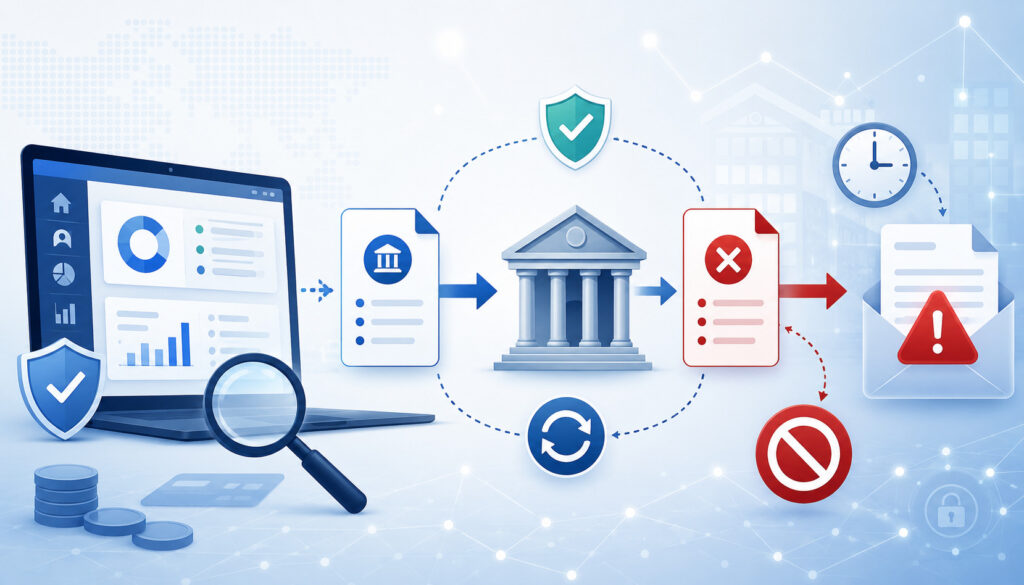
The ACH rejection process is less standardized from the merchant’s point of view because it can happen in several places. A rejected ACH payment may never reach the RDFI, so it may not receive a standard ACH return code.
Instead, the business may receive a payment gateway error, processor reject message, bank file rejection notice, validation failure, or risk review response.
A rejection can happen at the point of data entry. For example, a payment form may reject an invalid routing number because it does not match a recognized routing number format. A payment gateway may reject a transaction because required fields are missing, the account type is unsupported, or the customer profile is incomplete.
A rejection can also happen at the batch or file level. ACH files must follow formatting rules. If a business or software platform sends an improperly formatted file, the bank or processor may reject the file before the ACH entries are processed. This can affect one transaction or an entire batch.
Risk controls can also cause ACH payment rejections. A processor or ODFI may reject transactions that exceed velocity limits, transaction amount limits, exposure limits, or risk thresholds.
A newly onboarded business may have limits on daily ACH volume, maximum transaction size, or return-rate tolerance. If a transaction falls outside those limits, it may be rejected for review or blocked.
ACH rejections can also occur because of compliance or authorization concerns. If a business cannot demonstrate proper ACH authorization requirements, or if the transaction type does not align with the approved business model, a processor may decline to process the entry.
For ecommerce businesses, ACH rejections often happen during checkout or payment method setup. For B2B companies, they may happen during batch uploads or invoice payment runs. For subscription companies, they may happen when stored bank account details become invalid or when account verification fails before the recurring debit is created.
The best response depends on the rejection reason. If the issue is invalid data, ask the customer to re-enter or update their bank information. If the issue is formatting, fix the file or software integration.
If the issue is risk-based, review processing limits, transaction monitoring, and exposure policies. If the issue involves authorization, confirm that the customer’s consent is documented and appropriate for the transaction.
Common ACH Return Codes and What They Mean
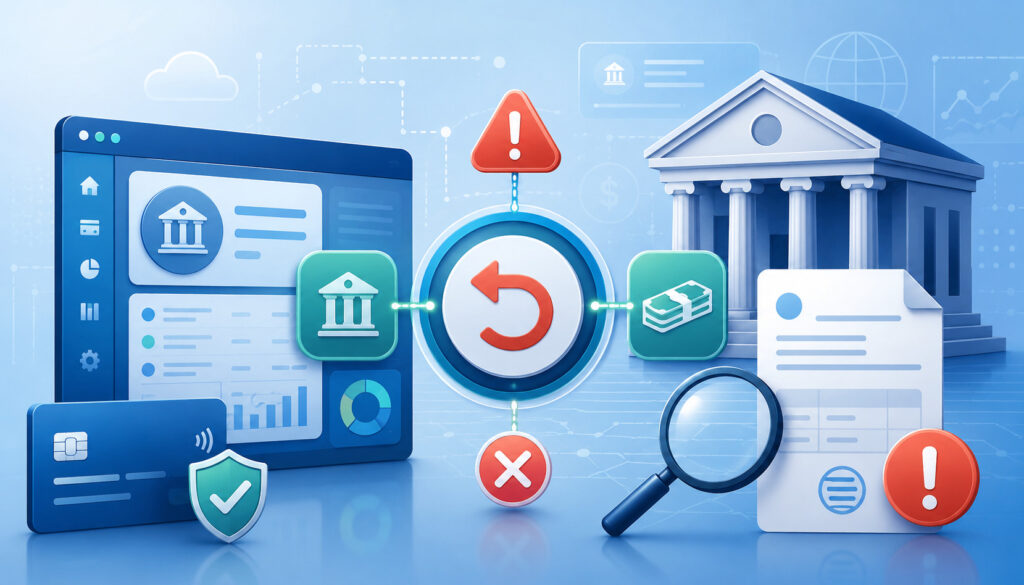
ACH return codes are standardized reason codes that explain why ACH transaction returns occurred. They usually begin with the letter “R” followed by two digits. ACH return codes help businesses decide whether to retry, contact the customer, correct account information, stop future debits, or escalate for compliance review.
Not every code has the same urgency. Some ACH return codes indicate a temporary issue, such as insufficient funds. Others indicate a permanent issue, such as account closed. Some signal an authorization or dispute issue, which should be handled more carefully. Others are administrative and may require correcting account data before future entries are sent.
Businesses should avoid memorizing every possible code and instead build a return-code response playbook. This playbook should group codes into practical categories: insufficient funds, closed or invalid account, unauthorized debit, stop payment, account restriction, credit refused, corporate return, and correction-related items.
Below is a practical ACH return code guide for common situations. Exact handling can vary, so businesses should confirm requirements with their payment processor, financial institution, and applicable rules.
| ACH Code | Common Reason | What It Means | Practical Business Response |
| R01 | Insufficient funds | The available balance is not enough to cover the debit | Notify the customer, follow your retry policy, and avoid excessive retries |
| R02 | Account closed | The account was previously active but is now closed | Stop debiting that account and request updated bank details |
| R03 | No account or unable to locate account | The RDFI cannot find the account based on the information provided | Verify routing number, account number, account type, and customer name |
| R04 | Invalid account number | The account number structure is not valid for the receiving institution | Ask the customer to re-enter account information and verify before resubmitting |
| R05 | Unauthorized debit to consumer account using improper code | A consumer debit issue tied to authorization or entry type | Stop further attempts and review authorization records |
| R07 | Authorization revoked | The receiver says authorization was revoked | Stop future debits and contact the customer before any new authorization |
| R08 | Payment stopped | The receiver placed a stop payment order | Do not retry without resolving the issue with the customer |
| R10 | Customer advises not authorized or improper | The receiver claims the debit was unauthorized, ineligible, incomplete, or improper | Pause collection activity, review authorization, and follow dispute procedures |
| R11 | Customer advises entry not in accordance with authorization terms | The debit may be authorized but contains an error or does not match authorization terms | Review amount, date, frequency, and authorization language |
| R16 | Account frozen or entry returned per instruction | Account is frozen or restricted | Contact customer for another payment method and do not assume retry will succeed |
| R20 | Non-transaction account | The account does not allow ACH transactions | Request a different account or payment method |
| R29 | Corporate customer advises not authorized | A business receiver claims the debit was not authorized | Review B2B authorization and resolve directly with the business customer |
| R31 | Permissible return entry | A business debit return under specific circumstances | Coordinate with the customer, RDFI, processor, or bank as needed |
Return codes
Return codes are more than labels. They are operational instructions. If the code says insufficient funds, a retry may be reasonable if your rules and provider allow it.
If the code says account closed, retrying the same account usually wastes time and may create additional fees. If the code indicates unauthorized activity, the business should stop, review the authorization, and handle the matter carefully.
A payment operations team should record the original transaction ID, return code, return date, customer account, invoice number, communication history, and resolution status. This makes reconciliation easier and helps support teams answer customer questions accurately.
Reject codes
ACH reject codes are often processor-specific rather than standard network return codes. A rejected payment may show a message such as invalid routing number, failed validation, duplicate transaction, amount exceeds limit, missing authorization, invalid file format, blocked account, or risk review failed.
Because rejection messages vary by provider, businesses should ask their payment processor for a rejection code guide or API documentation. Developers should map rejection messages to customer-friendly support actions, while finance teams should map them to reconciliation statuses.
Unauthorized returns
Unauthorized returns require special care. These happen when the receiver states that the ACH debit was not authorized, the authorization was revoked, the amount or timing did not match the authorization, or the debit was otherwise improper.
Nacha has specific rules and return-rate monitoring related to unauthorized entries, and it distinguishes certain unauthorized return reasons. Nacha’s resource on differentiating unauthorized return reasons is useful for understanding how codes such as R10 and R11 can apply in different situations.
For businesses, the practical response is to maintain clear authorization records, stop debiting when authorization is revoked, investigate disputes quickly, and avoid treating unauthorized returns like routine insufficient funds returns.
ACH Return Timeframes, Deadlines, and Settlement Impact
ACH timing can be confusing because submission, settlement, funding, and return windows are not the same thing. A payment may be submitted on one day, settle later, appear in a merchant report, and still be returned afterward depending on the transaction type and return reason.
ACH payments generally move in batches rather than as real-time card authorizations. Same-day ACH exists for eligible transactions, but settlement schedules still depend on banking days, submission windows, operator schedules, financial institution processing, and provider policies.
Nacha notes that ACH payments are settled when the Federal Reserve’s National Settlement Service is open, which means weekends and federal holidays affect settlement availability.
For many administrative returns, such as account closed or invalid account number, the return may come back within a relatively short period. However, unauthorized consumer debit returns can have longer return windows.
Business debit returns often have shorter deadlines than consumer unauthorized claims, which is one reason B2B authorization and account controls are important.
Settlement impact depends on when the business receives funds and when the return arrives. Some providers delay ACH funding to manage return risk. Others may fund earlier and then debit the business later if the transaction is returned.
A business that relies on ACH debits should understand whether its provider uses delayed funding, rolling reserves, risk holds, or settlement adjustments.
For example, a service provider may debit a client for a monthly retainer. The transaction appears successful, and the provider begins work. Several days later, the payment is returned for insufficient funds. If the provider already treated the payment as collected, cash flow and revenue reporting may need adjustment.
Return deadlines
Return deadlines vary by return reason, transaction type, and account type. Some returns are generally handled within a shorter banking-day window, while certain consumer unauthorized debit claims may be returned later. Businesses should not assume that a payment is final simply because it appears in a pending or settled report.
The practical approach is to align business rules with return risk. For low-risk recurring services, a business may allow access while payment is pending. For higher-value goods, large B2B invoices, or fraud-sensitive transactions, the business may wait until appropriate risk windows pass or use additional verification.
ACH settlement impact
ACH returns can create settlement adjustments. If a transaction was already funded to the business and later returned, the provider may debit the business’s settlement account. If the business does not maintain enough funds, it may trigger additional issues with its provider or bank.
Reconciliation teams should match return reports against original payments every business day. The return record should be tied to the invoice, customer account, settlement batch, processor fee, and any retry attempt. This helps prevent overstated revenue and duplicate collection attempts.
Funding delays
Funding delays are not always payment failures. A delay may happen because of batch cutoff times, holidays, risk review, processor policy, or bank processing schedules. However, businesses should be careful not to confuse a delayed ACH payment with a successful payment.
A good payment operations process uses separate statuses such as submitted, pending, settled, returned, rejected, disputed, corrected, retried, and resolved. This gives finance and support teams a clearer view of what is actually happening.
Common Reasons ACH Payments Fail
ACH payment failures usually fall into a handful of practical categories: insufficient funds, bad account data, closed accounts, authorization problems, account restrictions, stop payment orders, technical errors, and risk controls.
Insufficient funds is one of the most common ACH return reasons. It occurs when the customer’s available balance is not enough to cover the ACH debit. This is especially common in recurring payments, rent, memberships, installment billing, and subscription services where the customer may forget the debit date.
Closed account returns happen when a customer changes banks, closes an account, or uses old bank details. Invalid account returns happen when the account number, routing number, account type, or account name does not match what the receiving institution can process.
Authorization issues can occur when the business does not have proper consent, cannot produce authorization records, debits the wrong amount, debits on the wrong date, continues debiting after cancellation, or uses authorization language that does not match the actual payment.
Account restrictions can also cause ACH transaction failures. Some accounts do not allow ACH debits. Some are frozen. Some require special approvals. Some business accounts use ACH debit blocks or filters, which means the receiving business must authorize specific originators before debits are allowed.
Technical issues can also lead to ACH payment rejections. These include malformed files, duplicate batches, missing fields, incorrect SEC codes, API errors, processor downtime, or integration mistakes between billing software and the payment gateway.
Fraud and risk controls may block ACH transactions that look suspicious. A sudden spike in transaction volume, mismatched customer data, unusual payment behavior, repeated failed attempts, or high unauthorized return rates can lead to review.
Insufficient funds returns
Insufficient funds returns require a thoughtful retry policy. Retrying too quickly may fail again and increase fees. Retrying too many times may frustrate customers and create compliance concerns. But a well-timed retry, paired with a clear customer notice, may recover legitimate payments.
For subscription businesses, retry timing often works best when it aligns with customer pay cycles and notification windows. For B2B payments, contacting the customer before retrying may be more effective than automated retries.
Closed account returns
A closed account return usually means the stored payment method is no longer usable. The business should stop debiting that account and request updated bank details.
This issue is common with long-term recurring billing. Customers may change banks and forget to update memberships, tuition plans, insurance payments, or professional service retainers. Automated reminders asking customers to keep payment information current can reduce these failures.
Invalid account returns
Invalid account returns often come from data-entry mistakes. Account numbers may be mistyped, copied incorrectly, truncated, or entered in the wrong field. Customers may confuse routing numbers with account numbers or select checking instead of savings.
Businesses can reduce invalid account returns by using account verification, routing number validation, masked confirmation screens, secure customer portals, and clear instructions during payment setup.
The Authentic Payments guide on reducing ACH payment failures discusses account validation, payment monitoring, and customer communication as practical prevention steps.
How ACH Returns Affect Cash Flow, Fees, and Customer Experience
ACH returns affect businesses in three major ways: money movement, operational cost, and customer trust.
From a cash flow perspective, a returned ACH payment can turn expected revenue into an open receivable. This matters for businesses with tight operating cycles, large invoices, or recurring revenue models. If a company forecasts cash based on submitted ACH debits rather than settled and non-returned payments, projections may be overly optimistic.
ACH return fees can also add up. A business may pay fees for returned items, failed retries, notifications, or administrative handling. Fees vary by provider and financial institution.
Some businesses pass certain fees to customers if allowed by contract and applicable rules, while others absorb them as a cost of doing business. Either way, ACH return fees should be tracked as part of payment operations cost.
Customer experience is also affected. A customer whose ACH debit fails may be embarrassed, confused, or frustrated. If the business sends a harsh message, suspends service too quickly, or retries without explanation, the relationship may suffer.
On the other hand, if the business communicates clearly and offers a quick way to update payment details, many failed payments can be resolved without conflict.
Subscription businesses face a special challenge. Failed recurring payments can lead to involuntary churn. The customer may still want the service, but the bank payment fails because of insufficient funds, expired account details, or account restrictions. A thoughtful dunning process can recover revenue while preserving the customer relationship.
For ecommerce sellers, ACH returns are tied to fulfillment risk. If goods are shipped before ACH return risk is understood, the business may face a loss if the payment is returned and the customer does not provide another payment method.
For landlords, utilities, and membership organizations, ACH returns can affect service continuity, late fees, and account standing. These organizations need clear policies that define when fees apply, when access changes, and how customers can resolve failed payments.
For B2B payments, ACH returns can delay vendor settlement, strain supplier relationships, and complicate month-end close. A returned vendor credit may require reissuing payment, confirming bank details, and documenting the correction.
ACH Authorization, Compliance, and Risk Management
ACH authorization requirements are central to reducing disputes and unauthorized ACH returns. Businesses that debit customer bank accounts must have proper authorization before initiating ACH debits.
The authorization should clearly describe what the customer is agreeing to, including payment amount or calculation method, timing, frequency, account to be debited, cancellation method, and how the customer can contact the business.
Authorization can take different forms depending on the payment channel and transaction type. A customer may authorize an ACH debit through a signed form, online checkout, phone authorization, recurring billing agreement, service contract, invoice payment portal, or other approved method. The key is that the business should be able to prove authorization if a dispute occurs.
For recurring payments, authorization should be especially clear. Customers should understand whether they are authorizing a fixed recurring amount, a variable amount, a subscription plan, installment billing, usage-based charges, or future invoice payments. If the amount can vary, the business should communicate how it is calculated and when customers will be notified.
Recordkeeping matters. Businesses should store authorization records securely and make them accessible to finance, compliance, and support teams when needed. Records may include timestamp, IP address, signed form, customer identity details, account token, payment terms, recurring schedule, cancellation history, and communication logs.
Risk management also includes monitoring return rates. High rates of unauthorized returns, administrative returns, or overall ACH processing returns can raise concerns with processors and financial institutions. Businesses should review return trends and investigate spikes quickly.
Fraud prevention is another important part of ACH risk. Bank account payments can be targeted by fraudsters using stolen account information, synthetic identities, mule accounts, or social engineering.
Businesses can reduce risk through account verification, identity checks, transaction monitoring, velocity controls, customer authentication, and review workflows for unusual behavior.
The FTC’s business guidance on data security and the CFPB’s consumer finance resources provide helpful context for secure handling of consumer information and financial practices. Businesses should also work with legal, compliance, and payment partners to align ACH practices with their specific obligations.
Receiver authorization
Receiver authorization means the account holder has permitted the ACH debit. For consumer payments, the authorization should be easy to understand and retained. For business payments, authorization may be included in a contract, payment agreement, purchase order process, or treasury authorization setup.
If authorization is revoked, the business should stop future debits from that account unless a new authorization is obtained. Continuing to debit after revocation can increase unauthorized returns and damage trust.
Originator responsibilities
The originator is responsible for submitting accurate, authorized ACH entries. That means the business should not treat ACH as a “set it and forget it” payment method. It should maintain proper onboarding, authorization, account verification, return monitoring, customer communication, and reconciliation processes.
A business should also make sure its ACH activity matches its approved use case. For example, payroll credits, customer debits, vendor payments, and marketplace payouts carry different operational and risk considerations.
Fraud prevention
Fraud prevention should be built into the ACH payment process before a transaction is submitted. Once a fraudulent debit or credit is in motion, cleanup can be more difficult.
Practical controls include verifying bank account ownership, limiting first-time transaction amounts, monitoring multiple accounts tied to one customer, reviewing high-risk transactions, flagging repeated returns, and requiring stronger authentication for account changes.
How Businesses Can Reduce ACH Returns and Rejections
Businesses cannot eliminate all ACH returns and ACH rejections. Customers may have insufficient funds. Accounts may close. Banks may restrict transactions. Disputes may happen. But many ACH payment failures are preventable with better data, clearer authorization, stronger verification, and disciplined operations.
Start with account data quality. Routing number and account number errors are a major cause of administrative returns and ACH payment rejections. Businesses should validate routing numbers at entry, use confirmation screens, avoid manual rekeying, and allow customers to update bank details securely.
Account verification is another important control. Depending on the business model and risk level, verification may include micro-deposits, instant account verification, prenote entries, account status checks, name matching, or third-party validation. The right method depends on transaction size, customer type, fraud risk, user experience, and provider capability.
Clear authorization reduces unauthorized returns. Authorization language should match the actual payment experience. If a customer signs up for recurring payments, the business should not surprise them with different timing or unclear amounts. If the amount varies, notices should be consistent with the authorization and billing policy.
Retry policies should be intentional. Retrying every failed debit automatically can lead to additional fees and customer frustration. A good retry policy considers the ACH return code, customer history, transaction amount, account type, and communication strategy.
Customer communication is one of the most effective ways to reduce avoidable failures. Payment reminders, upcoming debit notices, failed payment alerts, account update links, and support options can prevent many returns from becoming disputes or cancellations.
Businesses should also monitor ACH reporting. A weekly or monthly review of return rates, reject reasons, and failed payment trends helps teams identify issues early. If invalid account returns rise after a website update, there may be a form problem. If unauthorized returns rise after a pricing change, customer communication may need improvement.
For more context on ACH risk controls, this overview of ACH risk mitigation can support teams that want to strengthen their broader payment operations.
Notification of change
A Notification of Change, or NOC, tells the originator that certain ACH information should be updated. For example, the account number or routing number may need correction. An NOC is not the same as a return, but ignoring it can lead to future ACH transaction failures.
Businesses should have a process to review NOCs promptly, update records securely, and confirm that future entries use corrected information. If payment software supports automated NOC handling, finance teams should still audit changes regularly.
ACH retry policies
A retry policy should be based on return codes. Insufficient funds may be eligible for a limited retry if allowed by rules and provider policy. Closed accounts, invalid accounts, unauthorized returns, and stop payment returns should not be handled the same way.
A practical retry policy should define:
- Which return codes are eligible for retry
- How many retry attempts are allowed
- How long to wait before retrying
- Whether customer notice is required before retry
- When to request a new payment method
- When to suspend service, pause fulfillment, or escalate to collections
Checklist: reducing ACH returns and rejections
Use this checklist to evaluate your ACH payment process:
| Area | Question to Review | Practical Action |
| Account entry | Are customers entering routing and account numbers correctly? | Add validation, confirmation screens, and secure update forms |
| Authorization | Is customer consent clear, documented, and retrievable? | Store authorization records and align billing with consent terms |
| Recurring billing | Are customers reminded before scheduled debits? | Send upcoming payment notices and account update reminders |
| Account verification | Do you verify new or changed bank accounts? | Use verification methods appropriate for risk and transaction size |
| Retry policy | Do retries depend on ACH return codes? | Create code-based retry rules and avoid automatic retries for every return |
| Reporting | Are return reports reviewed regularly? | Reconcile returns daily or on a set schedule |
| Customer communication | Do failed payment messages explain next steps? | Provide secure links, support channels, and clear deadlines |
| Fraud monitoring | Are unusual ACH patterns reviewed? | Monitor velocity, repeated failures, mismatched data, and account changes |
| NOC handling | Are notifications of change processed quickly? | Update account records and audit changes |
| Settlement controls | Do you understand funding and return risk windows? | Align fulfillment and service access with risk tolerance |
ACH Reporting, Reconciliation, and Customer Communication Best Practices
ACH reporting and reconciliation turn payment data into reliable financial records. Without a structured process, ACH returns and ACH rejections can create mismatched invoices, duplicate payment attempts, incorrect customer balances, and confusion between finance and support teams.
A strong ACH reporting process starts with consistent payment statuses. Avoid using one generic “failed” status for every issue. Instead, use statuses such as rejected, returned, unauthorized, insufficient funds, account closed, invalid account, retry scheduled, customer contacted, resolved, written off, or replaced by another payment method.
Reconciliation should connect the original transaction to the return or rejection. Each failed payment record should include the customer name, invoice number, payment amount, original submission date, settlement date if applicable, return date, ACH return code, processor fee, retry attempts, and final resolution.
For subscription billing, reconciliation should also connect payment status to service access. If a payment fails, the system should know whether to keep access active, pause renewal, enter dunning, notify support, or stop future billing. This prevents customers from being charged incorrectly or losing access unexpectedly.
For professional services and B2B payments, failed ACH transactions should be tied to accounts receivable workflows. A returned payment may reopen an invoice, trigger a follow-up task, or require a replacement payment method.
Customer communication should be prompt and specific. A good failed payment notice should explain that the bank payment did not complete, provide a general reason if appropriate, explain what the customer should do next, and offer a secure way to update payment information. Avoid including full bank account numbers in email. Use masked account details when needed.
The tone of communication matters. A customer with insufficient funds may resolve the issue quickly if the message is clear and respectful. A customer with a closed account may simply need to update their payment method. A customer claiming an unauthorized debit may need a more careful dispute response.
Customer communication
Customer messages should match the failure type. For insufficient funds, ask the customer to confirm when funds are available or provide another payment method.
For invalid account information, ask the customer to update bank details through a secure portal. For authorization disputes, pause automated collection and route the issue to a trained support or finance team member.
Recurring payment notices can prevent failures before they happen. Upcoming debit reminders are useful for memberships, rent, tuition, utilities, installment plans, and retainers. They help customers recognize the transaction and reduce surprise disputes.
Payment reconciliation
Payment reconciliation should happen frequently enough to prevent compounding errors. Businesses with high ACH volume may reconcile daily. Smaller businesses may reconcile several times per week, but they should not wait until month-end to investigate returns.
A good reconciliation process should compare processor reports, bank deposits, accounting records, invoices, and customer balances. It should also identify fees, settlement adjustments, and returned items separately.
Transaction monitoring
Transaction monitoring helps businesses spot patterns before they become major problems. Watch for repeated returns from the same customer, multiple customers using the same bank account, sudden increases in unauthorized returns, repeated account updates before high-value debits, and batches with unusually high rejection rates.
For ecommerce, monitoring can help identify fraud before fulfillment. For B2B payments, it can help detect account changes that need verification. For subscriptions, it can identify customers at risk of involuntary churn.
What is an ACH return?
An ACH return is an ACH debit or ACH credit that was submitted into the ACH network but could not be completed or was later sent back. The RDFI sends the entry back with an ACH return code explaining the reason.
Common ACH return reasons include insufficient funds, account closed, invalid account number, stop payment, account restriction, or unauthorized debit. For businesses, an ACH return means the payment should be reviewed, reconciled, and handled according to the return code.
What is an ACH rejection?
An ACH rejection usually occurs before an ACH transaction is fully accepted for processing or before it reaches normal settlement flow.
A payment gateway, processor, ODFI, validation system, or risk control may reject the transaction because of invalid routing information, missing required data, file formatting errors, account verification failure, duplicate submission, amount limits, or risk concerns. Unlike ACH returns, rejections may not always come with standard ACH return codes.
What is the difference between ACH returns and ACH rejections?
The main difference is timing. ACH returns happen after an ACH entry has been submitted into the ACH network and is returned by the receiving financial institution.
ACH rejections usually happen before or during submission because the payment cannot be accepted, validated, or processed. Returns are typically explained with ACH return codes. Rejections may be explained through processor messages, gateway errors, validation failures, or internal reject codes.
Why do ACH payments get returned?
ACH payments get returned for many reasons. The customer may not have enough funds, the account may be closed, the account number may be invalid, the account may be restricted, the customer may have placed a stop payment, or the customer may claim the debit was unauthorized.
ACH credit returns can happen when a direct deposit, vendor payment, refund, or payout cannot be posted to the receiving account.
What are common ACH return codes?
Common ACH return codes include R01 for insufficient funds, R02 for account closed, R03 for no account or unable to locate account, R04 for invalid account number, R07 for authorization revoked, R08 for stop payment, R10 for a customer claim that the debit was unauthorized or improper, R11 for an entry not in accordance with authorization terms, R16 for account frozen, and R29 for a corporate customer advising that a debit was not authorized.
How long does an ACH return take?
ACH return timing depends on the return reason, account type, transaction type, banking days, and applicable rules. Some returns come back quickly, often within a shorter banking-day window.
Certain unauthorized consumer debit returns can have longer return windows. Businesses should confirm timing with their payment processor or financial institution and avoid assuming that a submitted or recently settled ACH payment is free from return risk.
Can businesses retry a returned ACH payment?
Sometimes, but not always. Whether a business can retry depends on the ACH return code, provider rules, authorization, and the business’s own policy. Insufficient funds returns may be eligible for limited retries under certain conditions.
Closed account, invalid account, stop payment, authorization revoked, or unauthorized returns usually require a different response, such as obtaining updated account information or resolving the authorization issue first.
How can businesses reduce ACH returns and rejections?
Businesses can reduce ACH returns and ACH rejections by verifying account details, validating routing numbers, using clear ACH authorization language, storing authorization records, sending recurring payment reminders, monitoring ACH return codes, creating code-based retry rules, processing NOCs promptly, reconciling reports regularly, and using fraud prevention controls.
Businesses should also train finance and support teams so failed ACH transactions are handled consistently.
Conclusion
ACH returns and ACH rejections are a normal part of ACH payment processing, but they should not be ignored or treated as random failures. They are signals that tell a business what happened, where the payment process broke down, and what action should come next.
An ACH return usually means a transaction entered the ACH network and came back with a specific return code. An ACH rejection usually means the transaction was blocked before or during submission because of validation, formatting, account, authorization, risk, or processor issues.
Understanding this difference helps businesses avoid wasted retries, reduce fees, improve reconciliation, and communicate more effectively with customers.
The most common ACH payment failures often come from insufficient funds, closed accounts, invalid account numbers, authorization problems, stop payment requests, account restrictions, and data-entry errors. ACH return codes and ACH reject codes help businesses identify the reason and choose the right response.
For business owners, merchants, finance teams, ecommerce sellers, subscription companies, service providers, startups, and decision-makers, the goal is not to expect every ACH transaction to succeed.
The goal is to build a reliable ACH operations process that verifies account data, documents authorization, monitors return reports, manages retry policies, reconciles settlement activity, and communicates clearly with customers.
ACH payments remain valuable for recurring payments, direct deposit, direct debit, B2B payments, bank transfers, and other electronic payments.
When businesses understand ACH payment returns, ACH payment rejections, return timeframes, settlement impact, and risk management, they can use ACH more confidently while reducing avoidable failures and improving the customer experience.