
Payment authorization is one of the most important steps in card payment processing, yet it is often misunderstood.
When a customer taps a card, inserts a chip card, enters card details online, uses a mobile wallet, or pays through a recurring billing setup, the merchant is not automatically receiving money at that moment. The transaction first needs permission to move forward.
That permission step is payment authorization.
In everyday terms, payment authorization is the approval check that determines whether a card transaction can proceed before capture, clearing, and settlement. It helps confirm that the card is valid, that the account has enough available funds or credit, that the transaction meets risk rules, and that the payment request can be accepted by the issuing bank.
For merchants, the payment authorization process affects far more than whether a sale is approved or declined. It influences checkout speed, customer satisfaction, fraud prevention, payment processing costs, cash flow timing, reconciliation, chargeback exposure, and operational accuracy.
A smooth authorization flow can make checkout feel effortless. A poorly configured one can create avoidable declines, abandoned carts, delayed fulfillment, frustrated customers, and back-office confusion.
This guide explains how payment authorization works from the merchant’s perspective, including what happens behind the scenes, who is involved, why transactions are approved or declined, how authorization holds work, and what business owners can do to improve their payment approval process without overcomplicating checkout.
What Is Payment Authorization?
Payment authorization is the process of requesting approval for a card transaction before the merchant captures the payment and the funds move through clearing and settlement. It is a real-time or near-real-time decision that tells the merchant whether the transaction may proceed.
When a customer presents a card or enters payment details, the merchant’s point-of-sale system, payment gateway, or payment application sends an authorization request through the payment processor and payment networks to the issuing bank.
The issuing bank reviews the transaction and sends back an authorization response. That response may approve the transaction, decline it, or request additional handling depending on the card type, risk signals, account status, and network rules.
An approved transaction does not always mean the merchant has been paid yet. It means the issuing bank has agreed, at that moment, that the transaction can move forward. The merchant still needs to capture the transaction, and the transaction must later move through clearing and settlement before funds are deposited into the merchant account.
This distinction matters because many payment disputes, reconciliation issues, and customer service questions come from confusing authorization with settlement. Authorization is the approval step.
Capture is the merchant’s confirmation that the approved transaction should be submitted for payment. Clearing is the exchange of transaction details between financial institutions. Settlement is the movement of funds, minus applicable fees and adjustments.
In practical terms, payment authorization answers a few key questions:
- Is the card account valid and open?
- Does the cardholder have enough available funds or credit?
- Does the transaction fit the issuer’s risk rules?
- Does the transaction pass required security checks?
- Can the merchant proceed with the sale?
A retail store may receive this answer in seconds at the register. An ecommerce store may receive it while the customer is still on the checkout page. A service provider may receive it before scheduling work. A subscription business may receive it automatically during a recurring billing cycle.
Why Payment Authorization Matters in Card Processing
Payment authorization matters because it is the point where customer intent, merchant risk, issuer decisioning, and payment network rules come together. A customer wants to buy. A merchant wants to complete the sale.
The issuing bank wants to protect the cardholder and manage account risk. The acquiring side wants to route the transaction properly and reduce avoidable losses.
For business owners, the quality of the merchant authorization process can affect revenue in several ways. If legitimate transactions are declined unnecessarily, the merchant may lose sales.
If weak fraud controls allow suspicious payments to pass through, the merchant may face chargebacks, merchandise loss, service loss, account reviews, or higher risk scrutiny. If authorization holds are misunderstood, customers may complain about pending charges. If capture and settlement are not managed properly, reconciliation can become messy.
Payment authorization also affects the customer experience. A fast approval feels invisible. A slow authorization can make customers wonder whether checkout is broken.
A vague authorization decline can frustrate a loyal buyer who has enough money in the account but triggered a risk rule. A duplicate pending authorization can lead to support tickets even when the merchant never actually captured the extra amount.
The payment approval process is especially important for ecommerce payments and card-not-present authorization because the merchant does not physically see the customer or card.
In those cases, fraud screening, AVS, CVV verification, device signals, 3D Secure, tokenization, encryption, and PCI compliance all play a role in reducing risk while preserving a usable checkout experience.
Authorization can also affect payment processing costs. Different transaction types, data quality, authorization methods, card-present status, card-not-present status, and settlement practices can influence interchange fees and processor charges.
For example, a properly captured transaction with complete data may qualify differently than a transaction that is keyed manually, settled late, or missing required information.
Merchants should think of payment authorization as both a front-end checkout event and a back-office control point. It helps determine whether a transaction can proceed, but it also shapes reporting, fraud review, fulfillment timing, and cash flow expectations.
For broader context on digital transaction systems, merchants may find this guide to electronic payment systems useful when comparing card payments with other electronic payment methods.
Key Parties Involved in the Payment Authorization Process
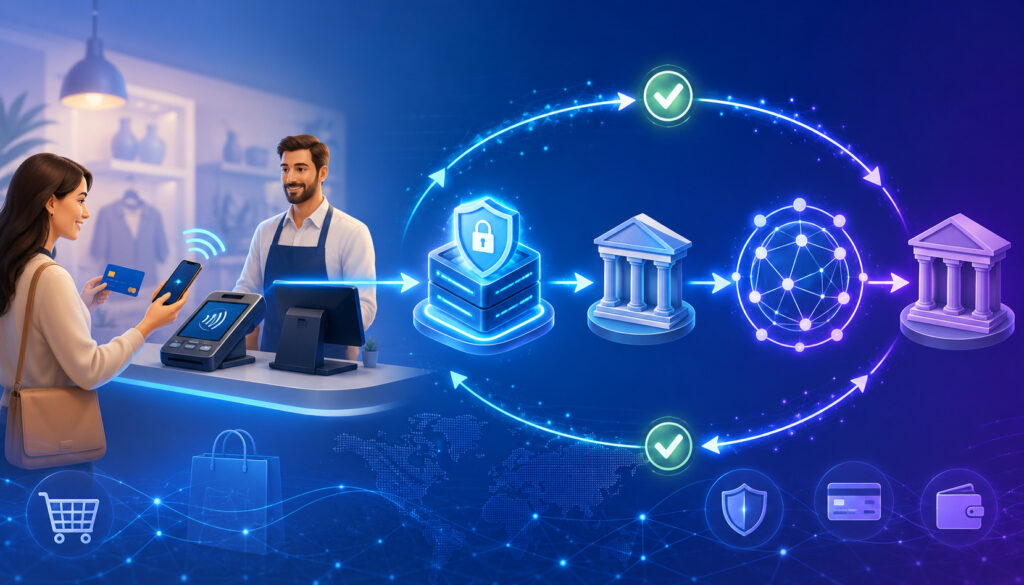
The payment authorization flow involves several parties, each with a specific role. Customers usually see only the checkout screen, terminal, or receipt. Merchants, however, benefit from understanding the path an authorization request takes because each party can influence speed, approval outcomes, security, fees, and reporting.
The core participants are the cardholder, merchant, point-of-sale system or payment gateway, payment processor, acquiring bank, credit card networks or payment networks, and issuing bank.
In some setups, there may also be fraud tools, token service providers, digital wallet providers, shopping cart platforms, recurring billing systems, or risk management platforms.
Cardholder and Merchant
The cardholder is the person using the payment card, digital wallet, or stored credential. The merchant is the business accepting payment for goods or services. The authorization process begins when the cardholder initiates a transaction and the merchant submits the payment information for approval.
In a card-present environment, the customer may tap, dip, swipe, or use a mobile wallet at a point-of-sale system. In a card-not-present environment, the customer may enter card details online, save a payment method, pay an invoice, or approve recurring billing.
In both cases, the merchant is responsible for collecting accurate transaction data, using secure payment tools, and following applicable payment security practices.
Merchants also decide how strict some gateway and fraud rules should be. For example, an ecommerce merchant may choose whether to automatically reject orders with certain AVS mismatches or send them to manual review.
A service provider may use preauthorization before beginning work. A restaurant may authorize an initial amount and later adjust the capture amount to include a tip.
Payment Gateway, POS System, and Payment Processor
The payment gateway or point-of-sale system collects payment information and securely passes the transaction to the processor. In ecommerce, the payment gateway authorization step is the bridge between the checkout page and the payment processing system.
In retail, the POS system and terminal perform a similar role by reading the card or wallet credential and transmitting the authorization request.
A payment processor routes the transaction between the merchant side and the broader card payment system. The processor formats the transaction data, communicates with the acquiring bank and payment networks, and returns the authorization response to the merchant’s system.
Some processors also provide fraud screening, reporting, tokenization, recurring billing support, batch processing, and settlement tools.
The gateway and processor can affect authorization performance. Poor integration, incorrect transaction settings, outdated terminal software, missing billing information, or weak error handling can all create avoidable authorization problems. For ecommerce businesses, integration quality matters because checkout failures may lead directly to abandoned carts.
Merchants comparing online payment tools can use this overview of how payment gateways work to better understand the gateway’s role in transmitting payment data, supporting security checks, and returning authorization responses.
Acquiring Bank, Card Networks, and Issuing Bank
The acquiring bank is the financial institution on the merchant side. It supports the merchant account and receives transactions from the payment processor. The acquiring bank helps move the authorization request into the appropriate payment network and later supports settlement into the merchant’s account.
Credit card networks and payment networks route transaction authorization messages between the acquiring side and the issuing side. They also maintain operating rules, data requirements, message formats, dispute rules, security standards, and interchange structures.
The network does not usually make the final approval decision for a standard card transaction, but it plays a key role in routing and rule enforcement.
The issuing bank is the financial institution that issued the customer’s card. It makes the approval or decline decision based on account status, available funds, credit limit, fraud risk, cardholder authentication, card controls, and network requirements.
The issuer sends back an authorization response, often with an authorization code for an approved transaction or a decline code for a declined transaction.
This is why merchants cannot simply “force” an issuer to approve a transaction. If the issuing bank declines the transaction, the customer may need to use another card, contact the issuer, correct billing details, or retry after resolving the issue.
Step-by-Step Payment Authorization Process
The payment authorization process happens quickly, but several actions occur behind the scenes. Understanding this flow helps merchants diagnose problems, explain pending charges, improve checkout design, and ask better questions when reviewing payment processing reports.
Authorization Request
An authorization request begins when the customer initiates payment. The merchant’s system collects key transaction details, such as the transaction amount, card data or token, merchant identification, transaction type, currency, entry method, billing details, and sometimes shipping or device information.
For card-present payments, the card data may come from a chip, contactless tap, magnetic stripe fallback, or digital wallet token. For online payment authorization, the data may come from a checkout form, stored credential, invoice payment page, or mobile app.
For recurring payments, the request may use a saved token and stored credential indicators instead of freshly entered card details.
The POS system or payment gateway sends the authorization request to the payment processor. The processor routes it through the acquiring bank and appropriate payment network to the issuing bank. Along the way, the transaction may pass through fraud screening tools, AVS checks, CVV verification, velocity checks, geolocation checks, device checks, or 3D Secure authentication.
The quality of the authorization request matters. Missing or incorrect data can lead to higher risk scoring, avoidable authorization decline, customer friction, or transaction downgrades.
A keyed card-present transaction may be treated differently from a chip or contactless transaction. A card-not-present authorization without billing information may be harder to evaluate than one with complete checkout data.
Authorization Response
After reviewing the transaction, the issuing bank sends an authorization response back through the payment network, acquiring side, processor, and gateway or POS system. The merchant then sees the result as approved, declined, referred, or sometimes held for review depending on the system.
An approved response means the merchant may proceed with the transaction. The response usually includes an authorization code. A declined response means the issuer did not approve the transaction.
The decline may be related to insufficient funds, credit limit, suspected fraud, expired card, incorrect card data, account restrictions, issuer system issues, or other reasons.
Some responses are soft declines, meaning the transaction may succeed later after the customer corrects information, authenticates, uses a different method, or contacts the issuer. Others are hard declines, meaning the merchant should not keep retrying the same transaction without a valid reason or updated payment details.
The merchant should design customer messaging carefully. Saying “Your card was declined” may be technically accurate, but it can feel harsh and may not tell the customer what to do next. A better checkout message may ask the customer to verify details, try another payment method, or contact the card issuer if the problem continues.
Authorization Code
An authorization code is a confirmation value returned with an approved transaction. It indicates that the issuer approved the authorization request at that moment. Merchants may see the authorization code in transaction reports, receipts, payment gateway logs, or processor records.
The authorization code is useful for tracking, reconciliation, support, and research. If a customer asks about a pending transaction, the merchant can use transaction details such as date, amount, last four digits, authorization code, and order number to locate the payment event.
This does not mean the authorization code itself guarantees final payment. The transaction still needs to be captured and settled correctly.
Authorization codes can also help when reviewing batch processing, partial approvals, duplicate authorizations, and failed captures. For example, if an ecommerce order was approved but not fulfilled, the merchant may need to confirm whether the transaction was only authorized, successfully captured, or voided before shipment.
Payment Authorization Process at a Glance
| Step | What Happens | Who Is Involved | What Merchants Should Know |
| Customer starts payment | Card, wallet, or stored credential is used | Cardholder, merchant | Accurate amount and payment entry method matter |
| Data is collected | POS system or gateway gathers transaction details | POS system, payment gateway | Missing billing or order data can affect approval and risk checks |
| Authorization request is sent | Request moves to the processor and acquiring side | Processor, acquiring bank | Routing quality and integration settings influence reliability |
| Network routes request | Payment network sends request to the issuer | Card networks, payment networks | Network rules and transaction type affect handling |
| Issuer reviews transaction | Issuer checks account status, funds, credit, and risk | Issuing bank | Issuer makes the final approval or decline decision |
| Response returns | Approval, decline, or other response comes back | Issuer, network, processor, gateway or POS | Merchant should store response details for reporting |
| Merchant captures or voids | Approved transaction is submitted or canceled | Merchant, processor | Authorization is not the same as settlement |
| Clearing and settlement follow | Transaction data and funds move through the system | Acquirer, issuer, network, processor | Funding depends on batch timing, provider rules, and account setup |
Credit Card Authorization vs Debit Card Authorization

Credit card authorization and debit card authorization follow a similar payment authorization flow, but the underlying account logic is different. A credit card authorization checks whether the cardholder has enough available credit and whether the transaction fits issuer and network risk rules.
A debit card authorization checks whether the linked deposit account generally has enough available funds and whether the transaction is permitted under the cardholder’s account controls.
With credit card payment authorization, the issuer may approve the transaction if the card account is open, the credit limit is sufficient, the transaction is not suspicious, and the cardholder has not exceeded account restrictions. The authorization can reduce the customer’s available credit until the transaction is captured, expires, or is reversed.
With debit card authorization, the transaction may reduce the customer’s available balance more directly. This is why authorization holds can feel more disruptive for debit card users.
If a hotel, gas station, rental service, or restaurant places a hold that exceeds the final purchase amount, the customer may temporarily have less available money in the account even before the final transaction settles.
Debit card authorization may also involve PIN or signature routing depending on the transaction environment and card network rules. In-person debit transactions may have different routing options than ecommerce debit transactions.
Online debit card authorization often behaves similarly to credit card authorization from the merchant’s checkout perspective, but the issuer is checking a deposit account rather than a revolving credit line.
For merchants, the practical takeaway is that card type can influence customer expectations. A customer using a credit card may be less affected by a temporary authorization hold than a customer using a debit card. Service providers, restaurants, travel-related businesses, and rental models should be especially clear about holds, timing, and final charges.
Merchants should also monitor debit declines separately from credit declines when possible. A high debit decline rate may point to insufficient funds, account restrictions, expired cards, billing mismatches, or retry timing problems. Subscription businesses may see debit card authorization failures when customers are paid on specific cycles, making retry strategy important.
Online, In-Person, Mobile, and Recurring Payment Authorization
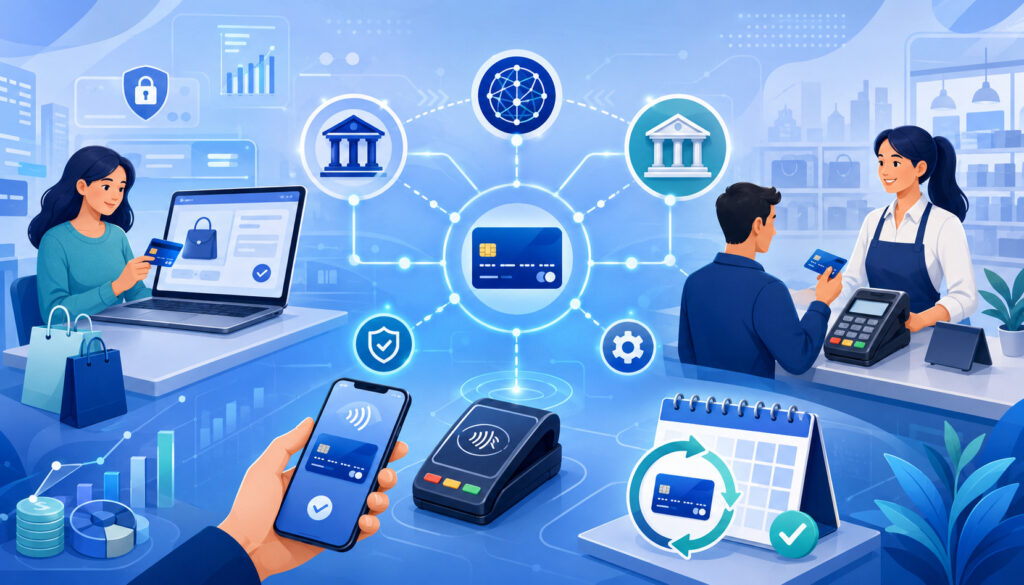
Payment authorization works differently depending on how the customer pays. The core approval concept is the same, but the risk level, data quality, security tools, and customer experience can vary significantly between card-present payments, card-not-present payments, ecommerce payments, mobile payments, contactless payments, digital wallets, and recurring billing.
Card-Present Authorization
Card-present authorization happens when the customer physically presents a card or wallet credential at the point of sale. Common entry methods include chip insert, contactless tap, magnetic stripe fallback, and mobile wallet tap. Chip and contactless transactions typically provide stronger transaction data than manual entry or older swipe methods.
For retailers, restaurants, repair shops, salons, professional offices, and other in-person businesses, card-present authorization usually happens in seconds. The customer presents the card, the terminal sends the authorization request, the issuer responds, and the POS system shows approval or decline.
Card-present payments can reduce certain fraud risks because the transaction includes evidence that a card or wallet credential was used in person. However, merchants still need secure terminals, staff training, accurate prompts, updated software, and PCI-aware handling practices.
Employees should not write down card numbers, store sensitive authentication data, or bypass security prompts just to move a line faster.
In-person businesses should also watch for fallback transactions. If a chip card fails and is swiped instead, the transaction may carry different risk implications. Staff should follow terminal prompts and store policy rather than improvising.
Card-Not-Present and Ecommerce Authorization
Card-not-present authorization applies when the cardholder is not physically presenting the card to the merchant. This includes ecommerce checkout, invoice payments, phone orders, mail orders, in-app purchases, and many subscription transactions.
Because the merchant cannot inspect the card or customer in person, the transaction depends more heavily on data quality and fraud screening.
Online payment authorization typically uses a payment gateway to capture card details or tokens and send the authorization request. The gateway may support AVS, CVV verification, fraud filters, velocity limits, device checks, IP analysis, 3D Secure, tokenization, and encryption.
The payment gateway integration process is especially important for ecommerce sellers because checkout design, error handling, and security settings directly influence approvals and customer experience.
Card-not-present authorization can fail for simple reasons: a mistyped card number, wrong expiration date, incorrect CVV, billing address mismatch, expired stored card, issuer risk rules, or suspicious order pattern. It can also fail because fraud settings are too strict or because the merchant does not collect enough information for accurate risk scoring.
Mobile, Contactless, and Digital Wallet Authorization
Mobile payment authorization can refer to several payment experiences. A customer may tap a phone at a contactless terminal, pay through an app, use a mobile browser checkout, or enter card details into a mobile invoice page. Each scenario has different authorization and security characteristics.
Contactless payments and digital wallets often use tokenization, meaning the actual card number is replaced by a token used for transaction processing. This can reduce exposure of sensitive card data.
Mobile wallets may also require device-level authentication, such as a passcode, fingerprint, or facial recognition, before payment credentials are released.
From the merchant’s perspective, a digital wallet transaction may still move through a familiar card payment authorization process. The POS system or gateway sends the request, the processor routes it, the issuer evaluates it, and a response returns. The difference is that the credential may be tokenized and supported by additional authentication signals.
Mobile checkout design matters. Small screens, autofill errors, weak form validation, and unclear decline messages can all increase failed authorizations. Ecommerce sellers should test checkout on mobile devices regularly, including wallet options, saved cards, billing fields, shipping fields, and error messages.
Recurring Billing Authorization
Recurring billing authorization is used when a customer gives permission for future payments, such as subscriptions, memberships, retainers, service plans, software billing, utility-style billing, or scheduled invoices. The first transaction may involve active customer participation, while later transactions may use stored credential data and tokens.
Recurring payments depend on accurate setup. The merchant should clearly disclose billing timing, amount, cancellation terms, and payment method storage practices.
The payment system should use proper recurring billing indicators and tokenization where supported. This helps issuers understand that future authorization requests are merchant-initiated under a prior customer agreement.
Recurring billing can experience failed authorizations due to expired cards, replaced cards, insufficient funds, changed account status, issuer risk controls, or customer disputes. Subscription businesses should monitor decline patterns, use account updater tools where available, send pre-billing reminders when appropriate, and create a respectful retry schedule.
A strong recurring billing authorization workflow balances revenue recovery with customer trust. Excessive retries can create frustration and may raise risk concerns. Too few retries can increase involuntary churn. The right approach depends on the business model, transaction amount, customer relationship, and provider settings.
Authorization Holds, Captures, Voids, and Settlements
Authorization holds, captures, voids, and settlements are related, but they are not the same thing. Merchants who understand these differences can reduce customer confusion and improve payment reconciliation.
An authorization hold is a temporary reservation of funds or available credit. It occurs when a transaction is approved but not yet fully settled. The hold helps ensure the funds or credit remain available while the merchant completes the transaction.
Holds are common in restaurants, lodging, fuel, rentals, ecommerce order fulfillment, service estimates, and delayed shipping models.
Capture is the step where the merchant confirms that an approved authorization should be submitted for payment. In a simple retail transaction, authorization and capture may happen together or in the same batch process.
In ecommerce, the merchant may authorize when the order is placed and capture when the order ships. In service businesses, the merchant may preauthorize before work begins and capture when the final amount is known.
A void cancels an authorization before it settles. Voids are commonly used when a merchant catches an error the same day, cancels an order before capture, or needs to reverse an authorization that should not proceed. A refund, by contrast, happens after a transaction has already settled and the merchant returns funds to the customer.
Settlement is the process by which funds are transferred through the payment system and ultimately deposited into the merchant account, subject to fees, reserves, adjustments, chargebacks, and provider rules. Batch processing often determines when captured transactions are submitted for settlement.
Authorization Holds
A payment authorization hold can be useful, but it must be handled carefully. If the final transaction amount is unknown, a hold gives the merchant some assurance before providing goods or services.
Restaurants may authorize the meal amount before the tip is added. Hotels and rental businesses may authorize an estimated amount. Ecommerce merchants may authorize before shipment.
Holds can create customer frustration when the pending amount is larger than expected, appears duplicated, or remains visible after a void or failed order. The merchant may have released the authorization, but the customer’s issuing bank controls when the pending hold disappears from the account view. This timing can vary.
Merchants should explain holds clearly before payment when the amount may differ from the final charge. This is especially important for service providers, rentals, bookings, fuel, restaurants, and any business that uses preauthorization.
Transaction Capture
Transaction capture converts an approved authorization into a transaction submitted for clearing and settlement. Some merchants use automatic capture, where the transaction is captured immediately after approval. Others use delayed capture, where authorization occurs first and capture happens after fulfillment, shipment, service completion, or review.
Delayed capture can be useful, but it creates operational responsibility. If the merchant forgets to capture, captures late, captures the wrong amount, or captures after the authorization expires, payment problems can occur. The authorization may need to be refreshed, reauthorized, or canceled depending on rules and provider settings.
Ecommerce sellers should align capture timing with fulfillment policies. Capturing too early can create customer dissatisfaction if items are out of stock. Capturing too late can cause authorization expiration or funding delays.
Clearing, Settlement, Voids, Refunds, and Chargebacks
Clearing is the exchange of finalized transaction information after capture. Settlement is the movement of funds between financial institutions and into the merchant account. Voids cancel unsettled transactions or authorizations.
Refunds return funds after settlement. Chargebacks are disputes initiated through the cardholder’s issuing bank that can reverse funds from the merchant if the dispute is resolved against the merchant or not properly represented.
These distinctions are important for customer support. If a customer sees a pending transaction, a refund may not be the correct solution because the transaction may not have settled. A void or authorization reversal may be more appropriate. If a transaction has settled, a void may no longer be available and a refund may be required.
Why Payment Authorizations Are Approved or Declined
An authorization approval means the issuing bank allowed the transaction to proceed at that moment. An authorization decline means the issuer, gateway, processor, fraud system, or network rule did not allow it to proceed. For merchants, the key is to understand that not all declines mean the same thing.
A transaction may be approved because the card is active, the account has sufficient available funds or credit, the payment data is accurate, the transaction fits expected behavior, and the security checks are acceptable. The issuer returns an approved transaction response, and the merchant can proceed to capture according to its workflow.
A transaction may be declined for many reasons:
- Insufficient available funds or credit limit
- Expired card
- Incorrect card number, expiration date, or CVV
- Billing address mismatch
- Card reported lost or stolen
- Account closed or restricted
- Suspected fraud
- Unusual purchase amount or location
- Merchant category restrictions
- Issuer system unavailability
- Duplicate transaction controls
- Failed 3D Secure authentication
- Gateway fraud filter rejection
- Processor or configuration error
Declined transactions should be monitored by reason, channel, card type, and customer segment. A high decline rate at ecommerce checkout may suggest form errors, billing address confusion, overly strict fraud filters, unsupported cards, or issuer concerns about the merchant category.
A high decline rate for recurring billing may suggest expired cards, insufficient funds, outdated stored credentials, or retry timing problems.
Merchants should avoid repeatedly retrying the same declined card without understanding the decline type. Excessive retries can create customer irritation, processor scrutiny, and network compliance concerns.
A better approach is to use intelligent retry logic, ask customers to update payment information, offer another payment method, and review decline data with the processor.
For the customer experience, authorization decline messaging should be clear but not overly specific about fraud rules. A message such as “We could not authorize this payment. Please check your details, try another payment method, or contact your card issuer” is often more helpful than a generic failure message.
Fraud Screening, Security Checks, and Card Network Rules
Payment authorization is not only about available funds. It is also a risk decision. Modern payment systems use fraud screening, authentication, encryption, tokenization, and compliance controls to help protect cardholders and merchants.
Security standards matter because merchants and service providers that store, process, or transmit cardholder data are expected to follow payment card data security requirements.
The PCI Security Standards Council explains that PCI DSS applies to entities involved in payment card processing, including merchants, processors, acquirers, issuers, and service providers that can affect the cardholder data environment. See the PCI DSS overview from the PCI Security Standards Council for authoritative guidance.
AVS, CVV, and Basic Data Checks
AVS, or Address Verification System, compares billing address details submitted during checkout with the information on file at the issuing bank. CVV verification checks the security code printed on the card or associated with the card credential. These tools are commonly used in card-not-present authorization.
AVS and CVV do not guarantee that a transaction is legitimate. A fraudster may have correct billing information, and a legitimate customer may mistype an address. However, these checks provide useful signals. Merchants can use them to approve, decline, or review transactions based on risk tolerance.
For example, a low-value order from a returning customer with a partial AVS mismatch may be treated differently from a high-value first-time order with a CVV mismatch, expedited shipping, and an unusual device location. The best settings depend on the merchant’s products, average ticket size, chargeback history, customer base, and fulfillment speed.
Merchants should regularly review AVS and CVV rules rather than setting them once and forgetting them. Too-strict rules can block valid customers. Too-loose rules can invite preventable fraud.
3D Secure, Fraud Filters, and Risk Scoring
3D Secure is an authentication protocol designed to add an extra layer of verification for online card payments. Depending on the transaction and issuer, the customer may be asked to complete an authentication step, or the transaction may be authenticated silently based on risk data. The goal is to help verify that the person making the purchase is likely the legitimate cardholder.
Fraud filters and risk scoring tools review signals such as transaction amount, velocity, billing and shipping mismatch, device identity, IP location, order history, email reputation, card testing patterns, and unusual purchasing behavior. These tools may approve, decline, or flag transactions for review.
Manual review can be useful for high-value or unusual orders, but it should be used intentionally. Reviewing every transaction slows fulfillment and can frustrate customers. Automatically declining too many transactions can reduce revenue.
A balanced approach uses risk tiers: low-risk transactions flow through, medium-risk transactions may require review or authentication, and high-risk transactions may be blocked.
The Federal Trade Commission provides consumer and business education on fraud and scams, including guidance that can help merchants understand common fraud patterns and customer protection concerns through its business guidance resources.
Tokenization, Encryption, and PCI Compliance
Encryption protects payment data during transmission by making it unreadable to unauthorized parties. Tokenization replaces sensitive card data with a token that can be used for processing without exposing the actual card number in merchant systems. Together, encryption and tokenization can reduce the amount of sensitive data a merchant handles directly.
PCI compliance is not just a technical checkbox. It is part of a broader payment security program that includes secure networks, access controls, vulnerability management, monitoring, policies, and vendor oversight. Merchants can also review this internal guide to PCI DSS compliance for a practical introduction to payment security expectations.
The right security setup depends on the merchant’s environment. A small ecommerce seller using a hosted payment page may have a different compliance scope than a merchant storing customer profiles in a custom application. A mobile service provider using a secure card reader has different responsibilities than a call center accepting phone payments.
Payment Authorization Fees, Costs, and Merchant Considerations
Payment authorization can affect costs in direct and indirect ways. Some merchant pricing models include per-authorization fees, gateway fees, processor fees, assessment fees, batch fees, or transaction fees. Other costs are embedded in broader processing pricing. Interchange fees may also vary based on card type, transaction type, card-present or card-not-present status, data quality, and settlement behavior.
Merchants should not look at authorization cost in isolation. A very low per-transaction fee does not help much if the setup causes avoidable declines, weak fraud controls, poor reporting, or customer frustration.
On the other hand, overly aggressive fraud tools can increase manual review workload and reduce conversion. The goal is not simply the lowest apparent cost. The goal is a reliable authorization workflow that supports approval quality, security, customer experience, and manageable total cost.
Several merchant considerations can influence authorization economics:
- Card-present transactions often carry different risk and pricing treatment than card-not-present transactions.
- Manually keyed transactions may be treated differently from chip, contactless, or properly tokenized ecommerce transactions.
- Missing transaction data can affect qualification.
- Delayed capture or late settlement can create downgrades or operational problems.
- Excessive authorization retries may create additional fees or compliance concerns.
- Fraud losses, chargebacks, and manual review labor can outweigh small processing fee differences.
- Poor reconciliation can increase accounting time and customer support costs.
Merchants should ask their payment processor how authorization fees are charged, how gateway fees apply, how declines are billed, whether account updater tools are available, how recurring billing retries are handled, and how transaction data affects interchange qualification.
Payment reconciliation is also a cost issue. If transaction IDs, order IDs, batch records, settlement deposits, refunds, and chargebacks do not connect cleanly, staff may spend hours matching records manually. A good reporting setup saves time and reduces errors.
Common Payment Authorization Problems and How to Reduce Them
Payment authorization problems are common, but many are preventable. Merchants should monitor both technical failures and business process failures.
A technical failure may involve gateway downtime, terminal connectivity, integration errors, or processor response issues. A business process failure may involve incorrect amounts, poor staff training, expired stored cards, unclear checkout fields, or weak fraud rules.
One common issue is avoidable authorization decline. This happens when a legitimate customer cannot complete payment because the system rejects the transaction unnecessarily.
Causes may include strict AVS rules, required fields that customers misunderstand, poor mobile form design, duplicate transaction filters, unsupported cards, or outdated recurring billing credentials.
Another issue is duplicate authorizations. A customer may click the checkout button multiple times, refresh a page, lose connection, or retry after a slow response. The merchant may not capture duplicates, but the customer may still see multiple pending holds. Strong checkout design should disable duplicate clicks, show progress clearly, and handle timeouts gracefully.
Pending hold confusion is also frequent. Customers may believe they were charged even when a transaction was only authorized. This is especially common with voids, failed ecommerce orders, restaurant tips, fuel purchases, bookings, deposits, and preauthorizations. Merchants should provide clear receipts, order status updates, and support scripts.
Recurring billing failures are another major category. Cards expire, cards are replaced, customers change banks, accounts lack funds, or issuers block merchant-initiated transactions. Merchants can reduce failures by using tokenization, account updater tools, pre-billing reminders, retry schedules, and customer self-service payment update pages.
Card-not-present fraud settings can also create problems. Too loose, and fraud losses may rise. Too strict, and good customers are blocked. The best approach is to review decline rates, fraud rates, chargeback reasons, order values, customer history, and manual review outcomes together.
Practical steps to reduce authorization problems include:
- Keep terminals, plugins, and payment applications updated.
- Test checkout flows on desktop and mobile devices.
- Use clear error messages.
- Collect accurate billing details where needed.
- Monitor decline codes and gateway filter results.
- Train staff on voids, refunds, and authorization holds.
- Review recurring billing retry rules.
- Match capture timing to fulfillment timing.
- Keep payment records connected to order records.
- Ask your processor to review recurring decline patterns and transaction routing.
Best Practices for a Smoother Authorization Process
A smoother payment authorization process is built through good technology, clear policies, accurate data, and ongoing review. Merchants do not control every approval decision, but they can reduce avoidable friction and improve the quality of authorization requests.
Start by mapping your payment authorization flow. Identify every place where a transaction can begin: in-store terminal, ecommerce checkout, mobile app, invoice link, phone order, stored card, recurring billing system, or virtual terminal.
Then identify what happens after approval: immediate capture, delayed capture, review queue, fulfillment, batch processing, settlement, reconciliation, and customer receipt.
Next, review the data you send with each authorization request. Ecommerce payments often benefit from accurate billing details, shipping details, customer identifiers, order numbers, and device information.
Card-present payments benefit from secure terminal entry methods rather than manual keying. Recurring payments benefit from stored credential indicators and tokenized credentials.
Fraud settings should be tuned to the business. A high-ticket electronics seller may need stricter review rules than a low-ticket local service provider. A restaurant, professional office, subscription business, and mobile merchant may each need different settings. The goal is not maximum friction. The goal is appropriate risk control.
Customer communication is another best practice. If your business uses authorization holds, say so before payment. If billing occurs after service completion, explain when capture happens. If recurring billing is used, clearly disclose amount, timing, and cancellation terms. If a payment fails, give customers a respectful path to fix it.
Here is a checklist merchants can use to evaluate their authorization workflow:
- Do we know which channels create authorization requests?
- Are card-present transactions using secure chip or contactless entry where possible?
- Are ecommerce billing and shipping fields clear?
- Are AVS, CVV, and fraud rules reviewed regularly?
- Do we understand which declines come from issuers versus gateway filters?
- Do we separate authorized, captured, settled, voided, refunded, and disputed transactions in reports?
- Do we explain authorization holds before customers pay?
- Do we have a retry strategy for recurring billing?
- Do staff know when to void versus refund?
- Do order IDs match payment transaction IDs?
- Do we reconcile batches and deposits consistently?
- Do we review chargeback patterns alongside authorization patterns?
- Do we know which fees apply to authorizations, declines, gateway usage, and settlement?
- Do we reduce exposure to sensitive card data through secure tools and tokenization?
For merchants comparing payment acceptance methods across cards and bank-based payments, this article on what ACH payments are and how ACH transactions work can provide useful context for broader payment planning.
What is payment authorization?
Payment authorization is the approval step in a card transaction. It checks whether the transaction can move forward before capture, clearing, and settlement. The issuing bank reviews the authorization request and sends back an authorization response, such as approved or declined.
How does the payment authorization process work?
The customer starts a payment through a card, digital wallet, online checkout, invoice, or stored credential. The merchant’s POS system or payment gateway sends an authorization request to the processor, acquiring bank, payment network, and issuing bank.
The issuing bank reviews the account, funds or credit, risk signals, and security checks, then sends back an approval or decline response.
What is the difference between authorization and settlement?
Authorization is permission to proceed with a transaction. Settlement is the later movement of funds through the payment system into the merchant account. A transaction can be authorized but not yet settled. It may also be voided before settlement or refunded after settlement.
Why are card payments declined during authorization?
Card payments may be declined because of insufficient available funds, exceeded credit limit, expired card, incorrect card data, billing mismatch, suspected fraud, account restrictions, failed authentication, issuer rules, duplicate attempts, or gateway fraud filters. Merchants should review decline codes and patterns rather than assuming every decline has the same cause.
What is an authorization hold?
An authorization hold is a temporary reservation of available funds or credit after a transaction is approved but before it settles or is released. Holds are common when the final amount is unknown, such as restaurants, rentals, deposits, bookings, fuel, service estimates, or delayed ecommerce fulfillment.
How long does payment authorization take?
The authorization response often returns within seconds, especially for card-present and standard ecommerce transactions. However, pending holds, capture timing, clearing, and settlement can take longer depending on the issuer, processor, merchant setup, batch timing, transaction type, and account rules.
Conclusion
Payment authorization is the moment a card transaction is approved or declined before money moves through capture, clearing, and settlement. It is a small step from the customer’s viewpoint, but it carries major importance for merchants.
It affects checkout speed, fraud prevention, cash flow, customer confidence, payment reconciliation, processing costs, and dispute management.
A strong payment authorization process begins with understanding the flow. The merchant collects payment details through a POS system, payment gateway, mobile checkout, digital wallet, or recurring billing platform.
The authorization request moves through the payment processor, acquiring bank, payment network, and issuing bank. The issuer sends back an authorization response. The merchant then captures, voids, reviews, fulfills, or resolves the transaction based on the result.
Merchants do not control every authorization outcome. Issuing banks make approval decisions based on account status, available funds, credit limit, risk rules, authentication, and other factors.
But merchants can improve their own side of the process by sending better data, maintaining secure systems, tuning fraud settings, reducing checkout friction, explaining holds, monitoring declines, training staff, and reconciling payments carefully.
The best authorization workflow is not the most aggressive or the most permissive. It is the one that fits the business model, transaction type, risk profile, customer expectations, and merchant account setup.
A retailer, ecommerce seller, service provider, restaurant, subscription business, professional office, startup, and mobile merchant may all need different settings and procedures.
This article is for general educational purposes. Payment authorization requirements, rules, costs, approval outcomes, security obligations, and funding timelines can vary by provider, card network, transaction type, business model, risk profile, and merchant account setup.
Merchants should review their own processing agreement, gateway settings, payment reports, and provider guidance before making operational changes.